Every evening, the same scene plays out in many homes. "Have you studied?" "Yes." "How much?" "Enough." Then the door closes, and you are left wondering whether your child is revising or scrolling.
A good study routine ends that daily tug-of-war. When study time, breaks, phone time and sleep are fixed in advance, there is less to argue about. This guide shows you how to build a routine for Class 10 that your child can actually keep, with a sample timetable you can adapt tonight.
Why now is the right time
CBSE released the 2026-27 sample papers in September and said the paper design is unchanged from last year (CareerIndia). The first Class 10 board exam is expected from mid-February to early March 2027, with an optional second attempt in May–June. The better of the two scores counts (FindMyCollege). Exact dates are not out yet, so keep an eye on cbse.gov.in.
That leaves about four months. It is enough time for steady daily work, and not enough for last-minute cramming. Habits built in October carry a child through February.
One more thing to know: in the main Class 10 subjects, 20 marks come from internal assessment and 80 from the theory paper (Careers360). School projects and practicals done now are part of the final result.
Step 1: Sit down together and plan, don't dictate
A routine your child helps design is a routine they will follow. Spend 20 minutes this weekend on three questions:
- When does your child focus best? Some teens are sharp after school; others work better after dinner.
- What is fixed? School hours, tuition, travel, sports practice, family dinner.
- Which subjects need the most time? Use recent school test results, not guesses.
Write the plan on paper and put it on the wall. A visible plan replaces nagging. You can point to the chart instead of asking "Have you studied?"
Step 2: Protect sleep and set phone rules
These two decide whether the routine works.
Sleep. The American Academy of Sleep Medicine advises that teenagers aged 13–18 sleep 8–10 hours a day. The US CDC suggests the same bedtime and wake-up time on school nights and weekends, and a "media curfew" with devices kept out of the bedroom (CDC). Late-night study that cuts sleep usually costs more than it gains.
Phones. Teachers across India describe shorter attention spans since the pandemic, and the Economic Survey 2025-26 recommends device-free hours (Careers360). In the same report, Chennai families describe a simple shared rule: no phones in bedrooms after 9:30 PM, with devices charged in the living room. A Madurai parent put it well: "You cannot just remove the phone. You have to give them something stronger than it."
Practical rules that work in most homes:
- Phone in another room during study blocks
- Phones charged outside the bedroom at night
- Parents follow the same rule at dinner
Step 3: A sample school-day routine
Here is a routine for a child who attends school from about 7:15 AM to 2 PM. Adjust the times to your child's day.
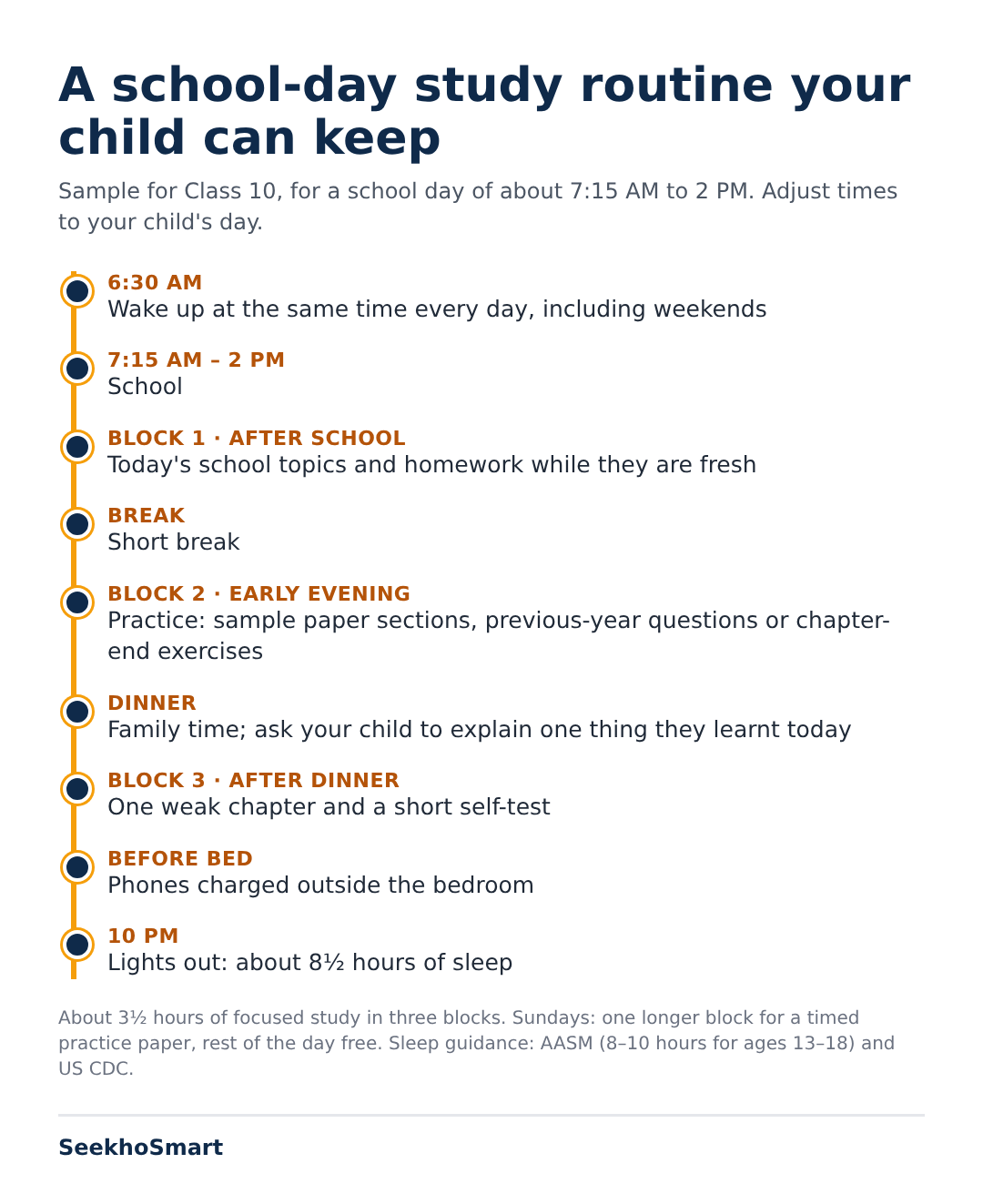
This gives about three and a half hours of focused study in three blocks, plus 8½ hours of sleep. Each block has a clear job:
- Block 1 (after school): Today's school topics and homework while they are fresh.
- Block 2 (early evening): Practice. Sample paper sections, previous-year questions or chapter-end exercises.
- Block 3 (after dinner): One weak chapter and a short self-test.
On Sundays, keep one longer block for a timed practice paper, and leave the rest of the day free. Rest is part of the plan.
Step 4: Make study active, not just long
Hours at the desk are not the same as learning. Research on memory shows that testing yourself and spacing revision over days both work better than re-reading notes (Chartered College of Teaching).
You don't need to know the subject to encourage this. Simple ways to help:
- Ask your child to explain one thing they learnt today, in two minutes, at dinner.
- Check whether they solved questions in Block 2, not how many pages they read.
- Encourage them to revisit last month's chapters each weekend, not only this week's.
Step 5: Check progress without becoming the police
Teenagers push back against constant checking. Agree on one short check-in a week instead of daily questioning. Sunday evening works well:
- What went well this week?
- Which subject felt hard?
- What should change in next week's plan?
Look at effort and consistency, not just marks. A child who studied on 6 of 7 days and is still struggling in Maths needs help with Maths, not a lecture about discipline.
What to do when the routine breaks
It will break: a wedding, a cold, a bad test result. Agree in advance that a missed day is not a failure. The rule is simple: never miss two days in a row. Restart with a light day rather than a punishing "make-up" day.
Watch for signs the routine is too heavy: constant tiredness, irritability, or study hours rising while marks stay flat. When you see these, cut a block, protect sleep and talk to the class teacher.
How SeekhoSmart helps your child keep the routine
The hardest part of a routine is knowing what to study in each block, and knowing it is happening without asking every evening. SeekhoSmart's adaptive daily study plan tells your child exactly what to practise each day, mixing new chapters with older ones for revision. Streaks and XP show at a glance whether your child is studying consistently, so you can see progress without nagging. Its 10-year PYQ bank tagged by chapter gives Block 2 real board questions to work on. Everything follows NCERT, works in Hindi or English, and is free to start.
Try SeekhoSmart free with your child → seekhosmart.in
Padhai, ab smart tareeke se.
Frequently asked questions
What is a good study routine for Class 10?+
About three to four hours of focused study on school days, in two or three blocks with short breaks, plus a weekend practice paper. Protect 8–10 hours of sleep.
How do I make my child study at home without fights?+
Plan the routine together, put it on the wall and agree on phone rules for everyone in the family. Replace daily questioning with one weekly check-in.
How can I make my child study independently?+
Give them ownership of the plan, check results weekly rather than daily, and ask them to explain what they learnt instead of asking how long they studied.
How should a Class 10 student study for boards in the last 3 months?+
Keep the daily routine, shift Block 2 to full sample papers and previous-year questions, and use weekends for timed practice and revising older chapters.
- SeekhoSmart (infographic)
- Aron Weerakoon / Unsplash
- PublicCo / Pixabay
- Kunal Lakhotia / Pexels