Your child's school bag now has an unexpected new subject: artificial intelligence. On 23 October 2026, NCERT released an introductory module on Computational Thinking and AI for Classes 9 to 12. At the same time, your phone is probably full of ads for "AI tutors" and "AI learning apps" that promise better marks.
So which AI tools actually help a Class 9–12 student, and which ones just make homework faster and learning weaker? This guide gives you a simple way to decide, using the same habits NCERT now wants your child to learn.
What NCERT's new AI module means for your child
The module is designed for beginners, with no prior knowledge needed (Education Bytes). It teaches three things:
- Computational thinking: breaking a problem into steps and solving it logically.
- How AI works: where it's useful, and where it falls short.
- Responsible use: data privacy, misinformation, fairness, digital safety and checking AI answers before trusting them (Elets digitalLEARNING).
NCERT says students should become "informed, confident, and responsible users of technology" (The Logical Indian). The reports we read don't say whether the module is compulsory or tested in exams, so there's no need to buy anything or enrol in a special AI course because of it.
What it does give you is a useful lens. If NCERT is teaching your child to question AI, you can use the same questions to judge the AI apps you're paying for.
What a good AI tutor can do
Used well, an AI tutor can be a patient helper available at 10 pm when you can't remember Class 10 trigonometry:
- Explain again, differently. If the teacher's explanation didn't click, an AI tool can try another way, or switch to Hindi.
- Show why an answer was wrong. The best tools explain the mistake, not just the correct answer.
- Give practice at the right level. Adaptive apps make questions easier or harder based on how your child is doing.
- Build a routine. Daily plans and streaks can help a teen study a little every day instead of cramming.
Where AI tutors go wrong
There are real risks too, and NCERT's module names several of them:

- Wrong answers that sound right. AI can confidently give incorrect facts. That's why the module teaches students to verify AI-generated information.
- Doing the thinking for them. If the app simply solves the homework, your child gets the marks today and loses the understanding needed in the board exam.
- Data and privacy. Some apps collect far more personal information than they need.
- Content not matched to the syllabus. A tool trained on random internet content may teach beyond, or different from, what NCERT and the board expect.
A 7-point checklist before you choose (or pay for) an AI tutor
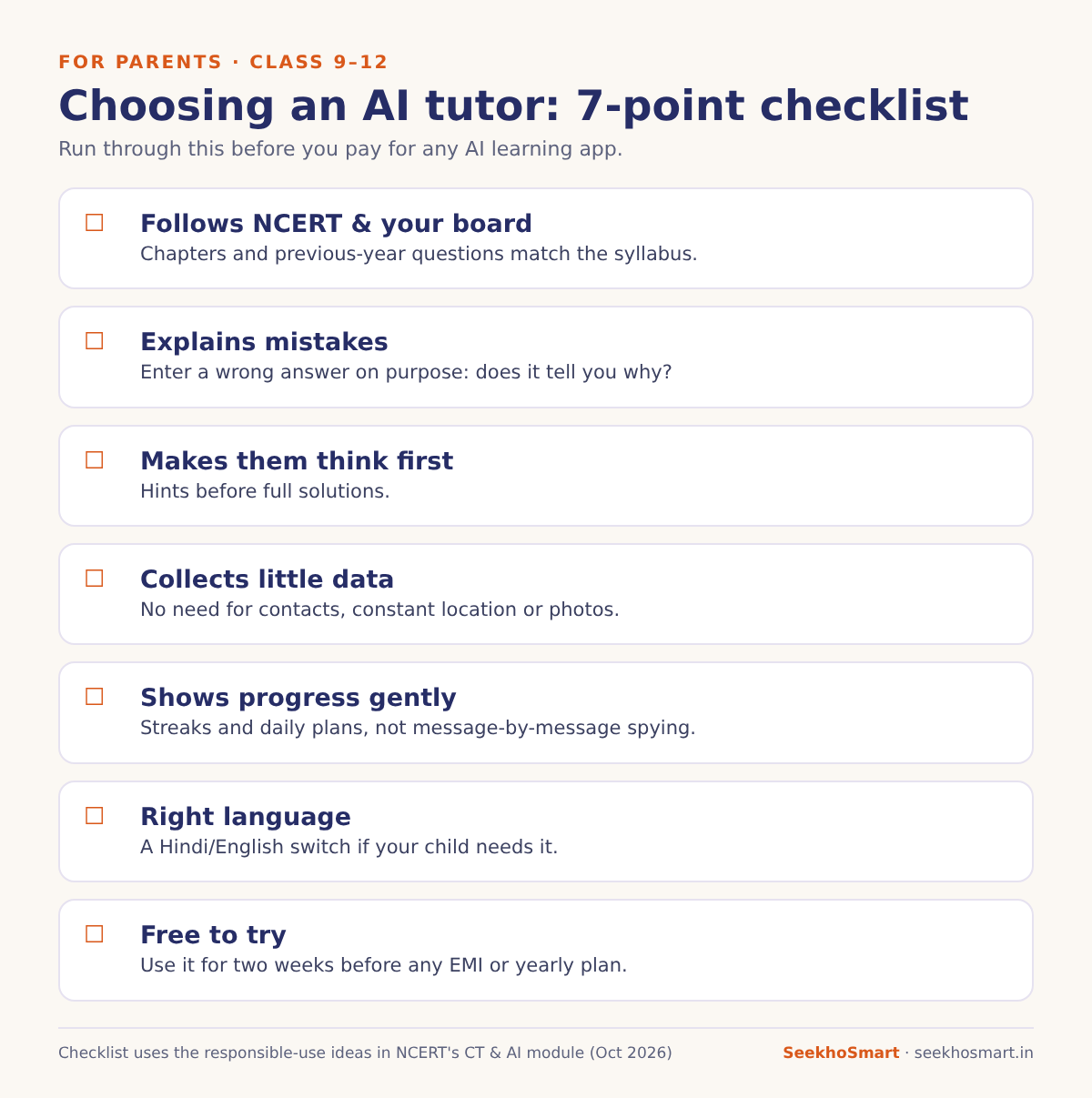
1. Is it matched to NCERT and your child's board?
For Class 9–12, the textbook decides the exam. Ask: does the app follow NCERT chapters? Does it have previous-year board questions?
2. Does it explain, or just answer?
Try it yourself. Enter a wrong answer on purpose. A good tutor tells you why it's wrong and what step to fix. A weak one just shows the right answer.
3. Does it make your child think first?
Look for tools where the student attempts the question before getting help. Hints before solutions is a good sign.
4. What data does it collect?
Read what the app asks for at sign-up. A study app doesn't need your child's contacts, location all the time, or photos. Teach your child the rule from the NCERT module: protect personal information.
5. Can you see progress without spying?
You should be able to see if your child is practising regularly, without reading every message they type. Streaks and daily plans are a gentle way to check consistency.
6. Is it in a language your child thinks in?
Many students understand Science faster in Hindi or their mother tongue. A Hindi/English switch can make a big difference.
7. Can you try it free first?
Never sign a long EMI or yearly plan before your child has used the app for at least two weeks. Watch whether they open it on their own.
Setting AI rules at home
A few family rules go a long way:
- Try first, then ask AI. Your child attempts the question for 10 minutes before asking for help.
- Check with the textbook. Any AI fact used in homework or a project must be confirmed in the NCERT book.
- No personal details. No full name with school, phone number, Aadhaar number or photos in chatbots.
- Talk, don't police. Ask once a week: "What did the AI get wrong this week?" It turns supervision into a conversation, and it's exactly the skill NCERT wants to build.
Talking to your teen about AI
Teenagers often know more about apps than parents do, and that's okay. Instead of banning AI, ask your child to show you how they use it. Ask what they've learned in the new module at school. When you show curiosity rather than suspicion, they're more likely to come to you when something online feels wrong, which is one of the safety habits the module itself encourages.

The bottom line
AI tutors are neither magic nor poison. A good one explains mistakes, follows the syllabus, protects your child's data and builds a steady habit. A bad one does the homework and leaves your child unprepared. Use the checklist, start free and keep talking.
How SeekhoSmart helps your child learn with AI, the right way
SeekhoSmart was built around the checklist above. It's NCERT-aligned, with a 10-year PYQ bank tagged by chapter, so practice matches what the board asks. Its AI explains every answer, including wrong ones, so your child learns from mistakes instead of copying solutions. And the adaptive daily study plan with streaks lets you see at a glance whether your child is practising consistently, without checking their phone or nagging. It switches between Hindi and English, and it's free to start.
Padhai, ab smart tareeke se.
Try SeekhoSmart free with your child → seekhosmart.in
Frequently asked questions
Is there a free AI tutor for kids?+
Several AI learning apps offer free versions or free trials. Use the free period to check whether the app follows NCERT, explains mistakes and protects your child's data before paying.
How should kids use AI for studies?+
Kids should try the question first, use AI to understand mistakes, confirm facts in the NCERT textbook and never share personal details. These are the same habits NCERT's new module teaches.
Which AI study app is best for students in India?+
There is no single best app. Choose one that matches NCERT and your child's board, explains wrong answers, collects little data, shows progress and offers your child's preferred language.
Does my child need a paid AI course because of the new NCERT module?+
No. The module is a free NCERT resource designed for beginners, and reports do not say it is examined. There is no need to buy a course because of it.
- SeekhoSmart (infographic)
- Noman Khan / Unsplash
- jaikishan patel / Unsplash
- Sanket Mishra / Unsplash