Science, Commerce or Humanities? Around this time of the year, as Class 10 students sit pre-boards and schools start talking about Class 11, this question comes up at almost every dinner table. Relatives have opinions. Neighbours have opinions. Your child may have a different opinion, or none at all.
This guide will help you make the decision with your child, not for them, using evidence you already have. It works whether your child is in a CBSE, ICSE or state board school.
First, the good news: the "stream" is less rigid than it used to be
Many of us grew up with three fixed boxes: Science for the "bright" student, Commerce for the "practical" one, and Arts for "the rest". That thinking is out of date.
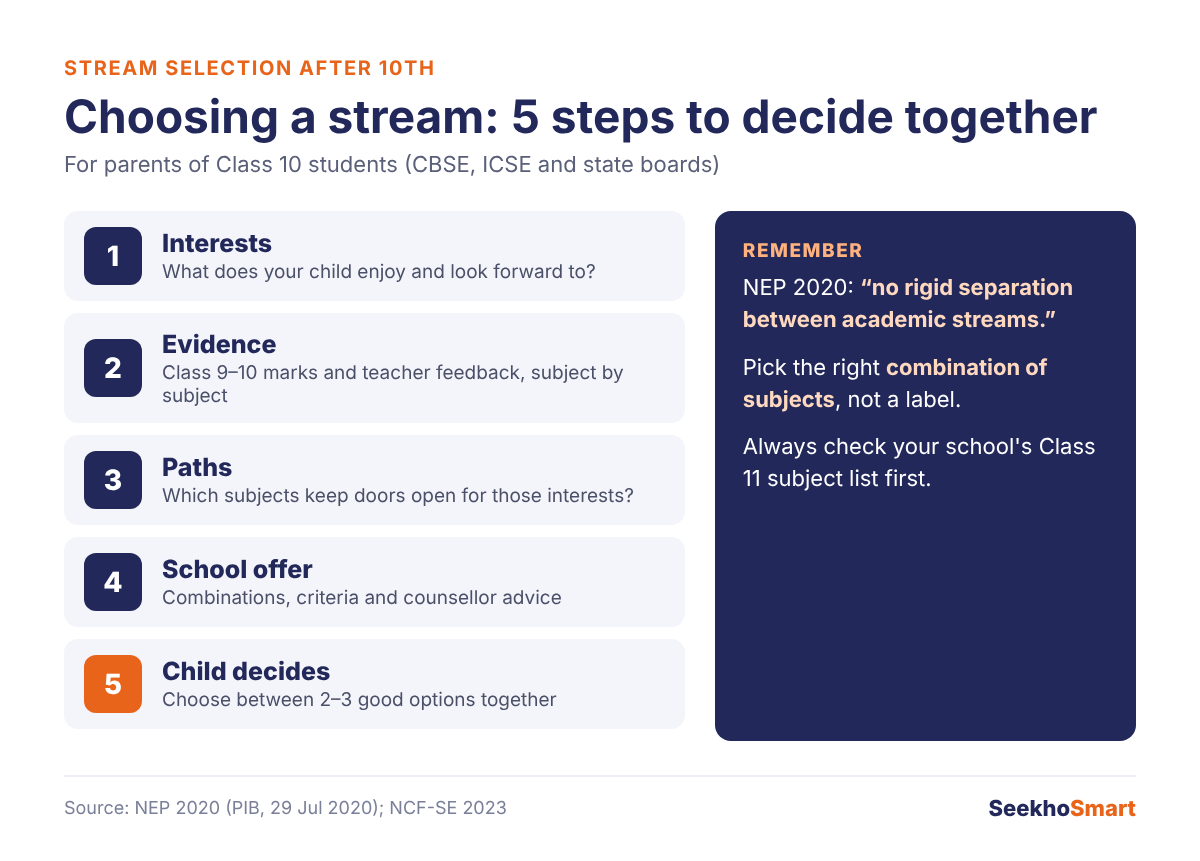
The National Education Policy 2020 calls for "no rigid separation between academic streams, extracurricular, vocational streams in schools." The National Curriculum Framework for School Education 2023 goes further. It says NEP 2020 "gives clear mandate to move away from the current practice of streaming into science, arts or humanities, and commerce." It describes a future model where students in Grades 11 and 12 choose two languages and four subjects (with an optional fifth) from at least two subject groups.
One important caution: that framework describes the direction. What your child can actually choose this year depends on your board's current scheme of studies and on which subject combinations your school offers. Ask the school for its Class 11 subject list before you decide anything.
What this means for you: the choice is less about picking a "label" and more about picking the right combination of subjects for your child's interests and future plans.
A 5-step way to decide together
Step 1: Start with your child's interests
Sit with your child and ask open questions, without judging the answers:
- Which subjects do you look forward to? Which do you dread?
- When you have free time, what do you enjoy doing or reading about?
- What kind of problems do you like solving: numbers, people, machines, ideas, money, nature?
- Is there any job or field you are curious about, even vaguely?
Write the answers down. Don't argue yet. You're collecting information.
Step 2: Look at evidence from Class 9 and 10
Interest matters, but so does how your child actually does. Look at their marks and teacher feedback across Class 9, the Class 10 unit tests and the half-yearly exam:
- Maths and Science: Is your child comfortable, or just surviving with heavy tuition?
- Social Science and languages: Do they write well, argue a point, enjoy reading?
- Consistency: Are the marks steady, improving or dropping?
A child who scores 75 with genuine interest in Biology may do better in Class 11 than one who scores 90 in Maths but hates it. Marks show ability today. Interest keeps a child going for two hard years.
Step 3: Connect subjects to possible paths, not to one dream
Instead of asking "Will my child become a doctor?", ask "Which subjects keep the most doors open for what my child likes?"
- If your child wants engineering, medicine or pure sciences, entrance exams expect specific Class 12 subjects. Check the latest eligibility rules on the official exam website before you finalise.
- If your child is drawn to business, economics, law, design, psychology, media or civil services, there are many routes. Several of them don't depend on one fixed stream.
- If your child is unsure, choose subjects that keep options open. For many students, keeping Mathematics is one such choice. Talk to the school counsellor about what works for your child.
Step 4: Check what the school actually offers
Before you get attached to a combination, find out:
- Which subject combinations are available in Class 11 in your school?
- Is there a minimum marks criterion for certain subjects or sections? (Each school sets its own.)
- Are there skill or vocational subjects, or an optional fifth subject?
- What does the school's counsellor recommend after seeing your child's record?
If the school offers an aptitude or stream-selection test, treat it as one input, not the final word.
Step 5: Let your child make the final call
Once you've done Steps 1 to 4, let your child choose between two or three good options. A student who chose their own subjects takes ownership when Class 11 gets hard, and it does get hard. If you strongly disagree, explain your reasons calmly, with the evidence you collected. Then listen.
Common mistakes parents make (and what to do instead)
| Common mistake | Better approach |
|---|---|
| Choosing Science because "it keeps all options open" for every child | It keeps some options open, but only if your child can enjoy and cope with it for two years |
| Deciding based on what cousins or friends chose | Every child's strengths are different. Use your child's own evidence |
| Treating Humanities as a "fallback" | Humanities and Commerce lead to strong careers. Choose them with pride when they fit |
| Waiting until results day to talk | Start the conversation now, during Class 10, without pressure |
| Ignoring your child's stress | If your child is anxious, slow down. A decision made in panic is rarely the best one |
Questions to ask in your next PTM
Your child's teachers see them every day. At the next parent-teacher meeting, ask:

- "In your subject, does my child show real understanding, or mostly memorisation?"
- "Which subjects do you think suit my child for Class 11, and why?"
- "Is there anything we should improve before the board exams?"
These answers are often more useful than any online stream-selection quiz.
What if the choice turns out to be wrong?
It happens, and it's not the end of the world. Some schools allow a subject change early in Class 11 within their own rules. Ask your school what's possible. More importantly, keep the conversation open. Check in once a month: "How are the new subjects going? What's hard? What's interesting?" Spotting a mismatch early is far better than discovering it in the Class 12 pre-boards.
How SeekhoSmart helps you and your child decide
The best stream decisions rest on real evidence of how your child learns, not just one exam's marks. SeekhoSmart gives your child NCERT-aligned practice in every Class 9–10 subject and AI explanations of every answer, including the wrong ones, so you can both see where they genuinely understand a subject and where they're just getting by. The adaptive daily study plan and streaks show whether your child is studying regularly, so you don't have to keep asking. A Hindi/English switch makes it easy for the whole family to follow along. It's free to start.
Padhai, ab smart tareeke se.
Try SeekhoSmart free with your child → seekhosmart.in
Frequently asked questions
Which stream is best after 10th?+
There is no single best stream. The best choice matches your child's interests, their real performance in Class 9–10 and the subjects their future paths need. Humanities, Commerce and Science all lead to strong careers.
Is there a stream selection test after 10th?+
Some schools and counsellors use aptitude or stream-selection tests. Treat the result as one input alongside marks, teacher feedback and your child's interests, not as the final answer.
What percentage is needed for Science after 10th?+
There is no single national cut-off. Each school sets its own criteria for subjects or sections, so ask your school for its Class 11 rules.
How do I choose a stream after 10th in CBSE?+
Get your school's Class 11 subject list, review interests and Class 9–10 evidence with your child, check the subjects needed for possible entrance exams on their official websites, and let your child choose between two or three good options.