It's the end of October. Half-yearly results are in, pre-boards are coming, and the board exam is now only a few months away. As a parent, you want to help — but you also know that too much reminding can turn into nagging, and nagging rarely works with teenagers.
The good news: the most useful things a parent can do are small, steady and practical. This guide shows you how to help your child study for exams without taking over, with a simple checklist you can start this week.
First, know the calendar
You can't help your child plan if you don't know what's coming. Here is what's known so far for CBSE students:
- Theory board exams are expected to start in February 2027. Careers360's board exam page says the official date sheet is still awaited. It lists Class 10's first exam in February–March 2027 and Class 12's exams in February–April 2027.
- Class 10 now has a second board exam. The same page lists a Phase 2 exam for Class 10 in May 2027.
- Practicals come earlier — November–December 2026 for winter-bound schools and January–February 2027 for others, according to the same page.
Put the school's pre-board dates, the practical dates and the expected board months on one calendar at home, where your child can see it too. When the official date sheet comes out on cbse.gov.in, update it together. State board families can do the same with their own board's dates.
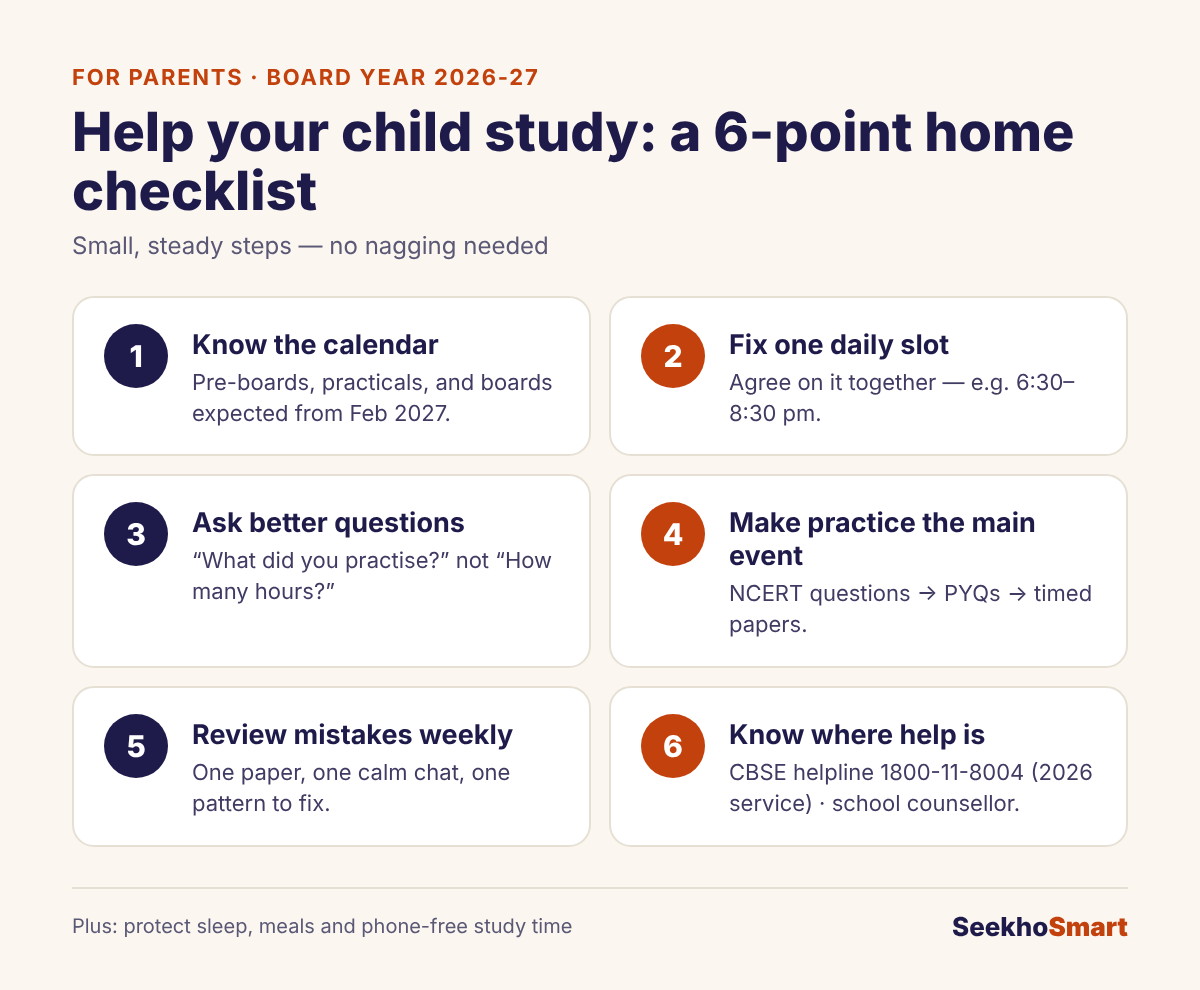
The 6-point home checklist
1. Fix one study slot every day — together
Sit with your child for ten minutes and agree on a fixed daily study time, for example 6:30–8:30 pm. The key word is agree. A slot your child chooses is a slot they'll keep. Keep weekends lighter but not empty.
2. Ask better questions
"How many hours did you study?" invites a number and an argument. Try instead:
- "Which chapter did you finish today?"
- "What did you practise?"
- "Which question was the hardest?"
These questions are about progress, not time. They also tell you much more about where your child actually stands.
3. Make practice the main event
Many students spend most of their time re-reading notes. Re-reading feels comfortable, but marks come from practice — solving questions, writing answers and checking them. Encourage your child to:
- Finish the NCERT textbook questions for every chapter first
- Then solve previous-year questions chapter by chapter
- In the last few weeks, write full papers under exam timing
You don't need to know the subject to support this. You only need to ask, "Did you solve questions today, or only read?"
4. Look at mistakes together, once a week
Pick a calm time — Sunday morning works for many families — and ask your child to show you one test or practice paper. Don't focus on the marks. Ask, "Which mistakes keep coming back?" Common patterns are calculation slips, missing steps, not reading the question fully, or running out of time. Once your child can name the pattern, they can fix it.
5. Protect sleep, food and phone-free study time
A tired brain doesn't remember well. Help your child:
- Keep a regular sleep time, even during exams
- Eat proper meals instead of skipping them to study
- Keep the phone in another room during the study slot
This isn't about banning the phone. It's about one or two focused hours without notifications. Agree on the rule together, and follow it yourself during that time if you can.
6. Know where help is
Sometimes a child needs more than a parent can give. CBSE runs a psycho-social counselling service before the board exams. For the 2026 exams, Careers360 reported that it was launched on 6 January 2026, with:
- A toll-free IVRS helpline, 1800-11-8004, available 24x7 in Hindi and English
- Tele-counselling with a panel of 73 trained professionals, including principals, counsellors, special educators and psychologists
- Access for both students and parents
CBSE announces this service each year, so watch cbse.gov.in for the 2027 details. And if your child seems very anxious, withdrawn or unwell, talk to the school counsellor or a doctor — don't wait for exam season to end.
If your child is in Class 9 or 11
Not every family is facing a board exam this year — but Class 9 and 11 are where board results are really built. The same checklist works, just with less pressure:
- Keep the daily study slot, but make it shorter (45–60 minutes on school days).
- Focus on understanding each chapter as it's taught, instead of saving everything for the exam.
- Encourage your child to solve the NCERT exercises the same week a chapter is finished.
- Use the weekly mistake review to catch weak topics early — a gap in Class 9 Maths or Class 11 Physics becomes much harder to fix a year later.
Small habits started now mean a calmer board year later.
What not to do
- Don't compare your child with cousins, neighbours or classmates. It doesn't motivate; it discourages.
- Don't change the plan every week. Constantly switching coaching, books or apps wastes time. Pick a plan and give it a few weeks.
- Don't make marks the only topic at home. Talk about other things at dinner. A home that feels calm helps a child focus.
- Don't do the work for them. Helping with a project file is fine; writing it isn't.
A simple weekly rhythm for parents
| Day | What you do (10–15 minutes) |
|---|---|
| Monday | Check the week's plan together: which chapters, which tests |
| Wednesday | Ask one "what did you practise?" question |
| Friday | Notice effort out loud — "You finished Chemistry this week, well done" |
| Sunday | Look at one practice paper together and name one mistake pattern |
Fifteen minutes, four times a week. That's enough for your child to feel supported without feeling watched.
How SeekhoSmart helps your child study — and helps you see progress
The hardest part of this checklist is knowing whether your child is practising every day without asking all the time. SeekhoSmart makes that easier. Your child gets an adaptive daily study plan built around the chapters where they need the most help, along with NCERT-aligned practice for Class 9–12. Streaks show whether they're keeping up day after day, so you can see consistency at a glance instead of asking "Did you study today?" And because every answer comes with an AI explanation — even the wrong ones — your Sunday mistake review becomes much easier. There's a Hindi/English switch, and it's free to start.
Try SeekhoSmart free with your child → seekhosmart.in
Frequently asked questions
How can I help my child study for exams without nagging?+
Agree on one fixed daily study slot together, ask about what was practised rather than hours, and review one practice paper together once a week.
How to make your child study when they don't want to?+
Let your child choose the study time, keep sessions short and regular, notice effort out loud, and keep the phone in another room during the slot rather than banning it.
How to improve children's study habits before board exams?+
Shift from re-reading to practice: NCERT questions first, then previous-year questions chapter by chapter, then timed full papers in the last weeks.
Is there exam stress help for CBSE students and parents?+
Yes. For the 2026 exams CBSE ran a toll-free helpline, 1800-11-8004, and tele-counselling for students and parents. Watch cbse.gov.in for the 2027 details.
- SeekhoSmart (infographic)
- Kingshukchakravarty / Wikimedia Commons (CC BY 4.0)
- Samir Kumar / Wikimedia Commons (CC BY-SA 4.0)