Board exams, pre-boards, entrance coaching, stream choices — for students in Class 9–12, the next few months are the most pressured of the school year. For principals and school owners, this is also the right moment to check one thing: does your school have a mental health policy that meets what the Supreme Court now expects of every educational institution in India?
This guide explains the Supreme Court's guidelines in plain language and gives you a practical checklist to put them in place before the exam season peaks.
What the Supreme Court has said
In Sukdeb Saha v. State of Andhra Pradesh (2025 INSC 893), reported on 25 July 2025, the Supreme Court issued guidelines on student mental health for educational institutions. The case concerned the death of a 17-year-old NEET aspirant in Visakhapatnam. As Verdictum's report explains, the guidelines apply to all educational institutions across India regardless of affiliation — public and private schools, colleges, residential institutions and coaching centres.
The guidelines are interim measures. They stay in force until specific legislation is made and are meant to complement the work of the National Task Force on Mental Health Concerns of Students. Copies were sent to bodies including CBSE and NCERT and to the Chief Secretaries of all states and UTs.
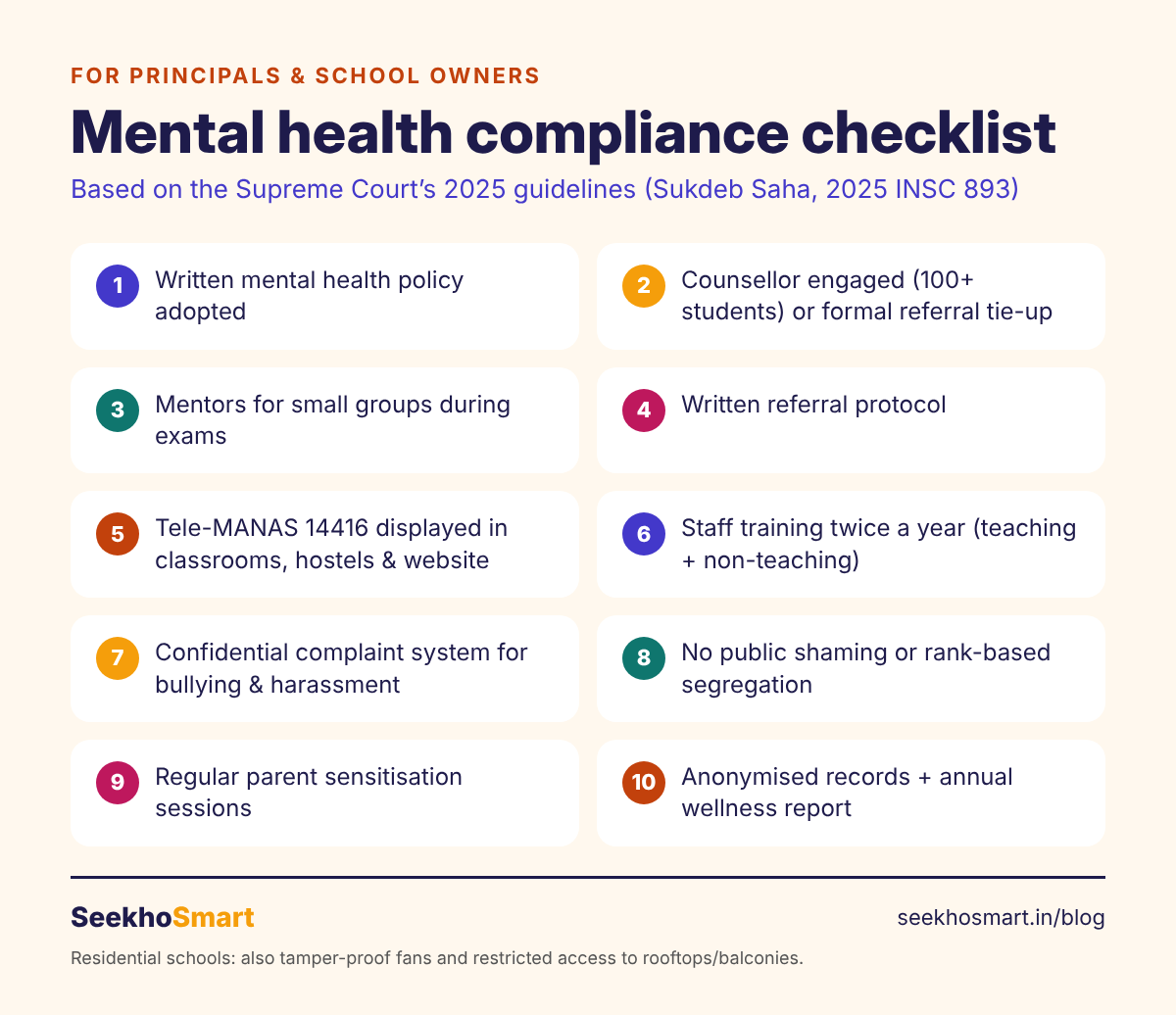
The key requirements for schools, in plain words
1. Adopt a mental health policy
Every institution should adopt a uniform mental health policy. The Court pointed to the UMMEED draft guidelines, the MANODARPAN initiative and the National Suicide Prevention Strategy as reference points.
2. Have a counsellor — or a formal referral link
- Schools with 100 or more students must appoint or engage at least one qualified counsellor, psychologist or social worker trained in child and adolescent mental health.
- Smaller schools must set up formal referral links with outside mental health professionals.
- Keep student-to-counsellor ratios manageable and assign mentors to smaller groups, especially during exams and academic transitions.
3. Train all staff twice a year
Teaching and non-teaching staff must be trained at least twice a year by certified mental health professionals — on psychological first aid, recognising warning signs, responding to self-harm and making referrals. Staff should also be trained to deal sensitively with students from vulnerable and marginalised backgrounds.
4. Display helplines and write down referral steps
Have written protocols for referring students to mental health services and hospitals. Display helpline numbers, including Tele-MANAS, prominently in classrooms, common areas, hostels and on your website. Tele-MANAS is free and available 24x7 on 14416 or 1800-891-4416.
5. Set up confidential complaint systems
Students need a safe, confidential way to report harassment, ragging and bullying — including bullying based on caste, class, gender, sexual orientation, disability, religion or ethnicity.
6. Avoid segregating or shaming by marks
The guidelines ask that, as far as possible, institutions avoid separating batches by academic performance, publicly shaming students and setting targets out of proportion to students' abilities. Though this point is framed for coaching centres, it is good practice for any school with "toppers' sections" or public rank lists.
7. Involve parents and keep records
- Hold regular sensitisation sessions for parents, in person or online.
- Keep anonymised records and prepare an annual report on wellness activities, referrals and training.
- Offer structured career counselling to students and parents.
- Give priority to sports, arts and personality-development activities.
8. Extra duties for residential schools
Schools with hostels must keep campuses free of harassment, bullying and drugs, install tamper-proof ceiling fans or equivalent safety devices, and restrict access to rooftops, balconies and other high-risk areas.
A 30-day action plan for principals
Week 1: Find out where you stand
- Check your total enrolment. Are you above or below 100 students?
- List what you already have: counsellor, referral tie-ups, helpline posters, complaint box, anti-bullying committee.
- Note the gaps against the eight points above.
Week 2: Fill the people gap
- If you have 100+ students and no qualified counsellor, start hiring or engage one part-time.
- If you are smaller, sign a written referral arrangement with a local psychologist, hospital or district mental health service.
- Name one senior teacher as the wellbeing coordinator.
Week 3: Write and share the policy
- Draft a short policy (3–4 pages) covering: who to approach, referral steps, confidentiality, complaint process, staff training calendar and parent sessions.
- Put Tele-MANAS and your counsellor's details on every notice board and on the school website.
- Share the policy with staff and parents in simple language, in English and the local language.
Week 4: Train and schedule
- Book the first staff training session with a certified professional. Put the second one in the calendar for the next term.
- Schedule a parent session before pre-boards — exam pressure, sleep and realistic expectations are useful topics.
- Set up a simple, anonymised log so you can prepare the annual report.
Reducing academic pressure in the board year
Policy is only half of the work. The everyday experience of a Class 10 or 12 student matters just as much:
- Spread tests out. Coordinate across subjects so students don't face four tests in one week.
- Give feedback, not just ranks. Tell students what to fix, privately.
- Protect games and activity periods, even in the exam term.
- Create a clear, steady study routine so students aren't left guessing what to revise.
How SeekhoSmart helps your school ease exam-season pressure
A lot of exam stress comes from uncertainty — students not knowing what to revise or how they are doing. SeekhoSmart gives your Class 9–12 students NCERT-aligned practice with an adaptive daily study plan, so every student has a clear, manageable list each day instead of last-minute cramming. AI explanations for every answer, including wrong ones, mean students learn from mistakes privately, without public comparison. It adds structured, personalised practice to what your teachers already do — and it's free to start, so there's no upfront cost to try it with one section.
Try SeekhoSmart for your school → seekhosmart.in
Frequently asked questions
Is a school counsellor mandatory in India?+
Under the Supreme Court's 2025 guidelines, institutions with 100 or more students must appoint or engage at least one qualified counsellor, psychologist or social worker. Smaller institutions must have formal referral links with outside professionals.
What should a school mental health policy include?+
At minimum: counsellor or referral arrangements, written referral steps, displayed helplines such as Tele-MANAS, staff training twice a year, a confidential complaint system, parent sessions and anonymised annual records.
What is a school mental health programme?+
It is the set of regular activities that put the policy into practice — counselling access, staff training, parent sessions, anti-bullying work, career guidance, and sports and arts activities.
Do the Supreme Court guidelines apply to CBSE and state board schools?+
Yes. The guidelines apply to all educational institutions in India regardless of affiliation, and copies were sent to CBSE, NCERT and all state governments.
- SeekhoSmart (infographic)