On 23 October 2026, NCERT announced a new introductory module on Computational Thinking (CT) and Artificial Intelligence (AI) for Classes 9 to 12, as reported by The Logical Indian and Education Bytes. For school leaders, the questions come quickly. Where does it fit in the timetable? Who teaches it? Do we need a computer lab? How is it assessed?
This post walks you through what the module actually contains, based on the module PDF on NCERT's website, and gives you a practical plan to roll it out in your school.
What the NCERT CT and AI module is
The module is titled An Introductory Module on Computational Thinking and Artificial Intelligence for the Secondary Stage (Grades 9 to 12). According to its foreword, it "assumes no previous knowledge of Artificial Intelligence" and "does not seek to turn every learner into a specialist". Instead, it aims to help every student become "a careful, confident, creative, and responsible user and evaluator of AI systems." It is aligned with NEP 2020 and the National Curriculum Framework for School Education 2023.
The "About the Module" section says it "can be taught across all four grades, providing a common foundation". That matters for planning: you don't need four different versions for Classes 9, 10, 11 and 12.
Note: the copy currently on NCERT's site carries a draft watermark. Plan with it now, but check for an updated version before printing in bulk.
The five units
| Unit | Central question | Portfolio output |
|---|---|---|
| 1. AI is Already in Your Life | Where do we meet AI? | AI Diary |
| 2. How Machines Learn from Examples | How does learning from data work? | Train-and-Break log |
| 3. When AI Gets It Wrong | How do we check confidence? | Verification checklist / Hallucination Hunt |
| 4. Your Data, Your Rights, Your Responsibility | What should we share or protect? | Privacy Policy Dissection |
| 5. Working with Modern AI Tools | How do we use AI well? | Prompt Library |
Each unit ends with a portfolio task and a three-part assignment: Quick Checks, Apply It, and an optional Stretch Question.
How it connects to CBSE's 2026-27 changes
CBSE Circular Acad-18/2026, dated 9 April 2026, set out the board's CT and AI plans. As quoted in this explainer, it says NCERT will provide CT and AI modules for Classes 9 to 12 "for the session 2026-27… as modules for internal assessment", and that "all other courses on AI being run till the session 2025-26 are being discontinued for class IX, session 2026-27 onwards." Class 10 students in 2026-27 continue with the 2025-26 scheme.
The same explainer flags that another CBSE curriculum document mentions 2027-28 for the modules, so the exact start date for internal assessment is not fully settled. Our advice: start teaching the module this term, and watch the CBSE academic circulars page for assessment instructions. State board and ICSE schools can use the module as an enrichment course in the meantime.
Your rollout plan in six steps
Step 1: Read the "Note for the Teacher" with your staff
Before anything else, hold a 45-minute staff meeting around the module's "Note for the Teacher". It is short, clear and reassuring. It tells teachers: "You do not need to be an AI expert to teach it well." What they need is to be curious alongside students and willing to say "let us check that together."
Step 2: Pick your teachers wisely
The module isn't a coding course, so it doesn't have to go only to the computer teacher. Good choices include:
- The computer science / IT teacher, for comfort with devices
- A science or maths teacher who enjoys discussion-based classes
- A social science or language teacher for Units 3 and 4 (misinformation, privacy, fairness)
One option is to pair two teachers per grade so they can share planning and cover for each other.
Step 3: Find the 20 hours in your timetable
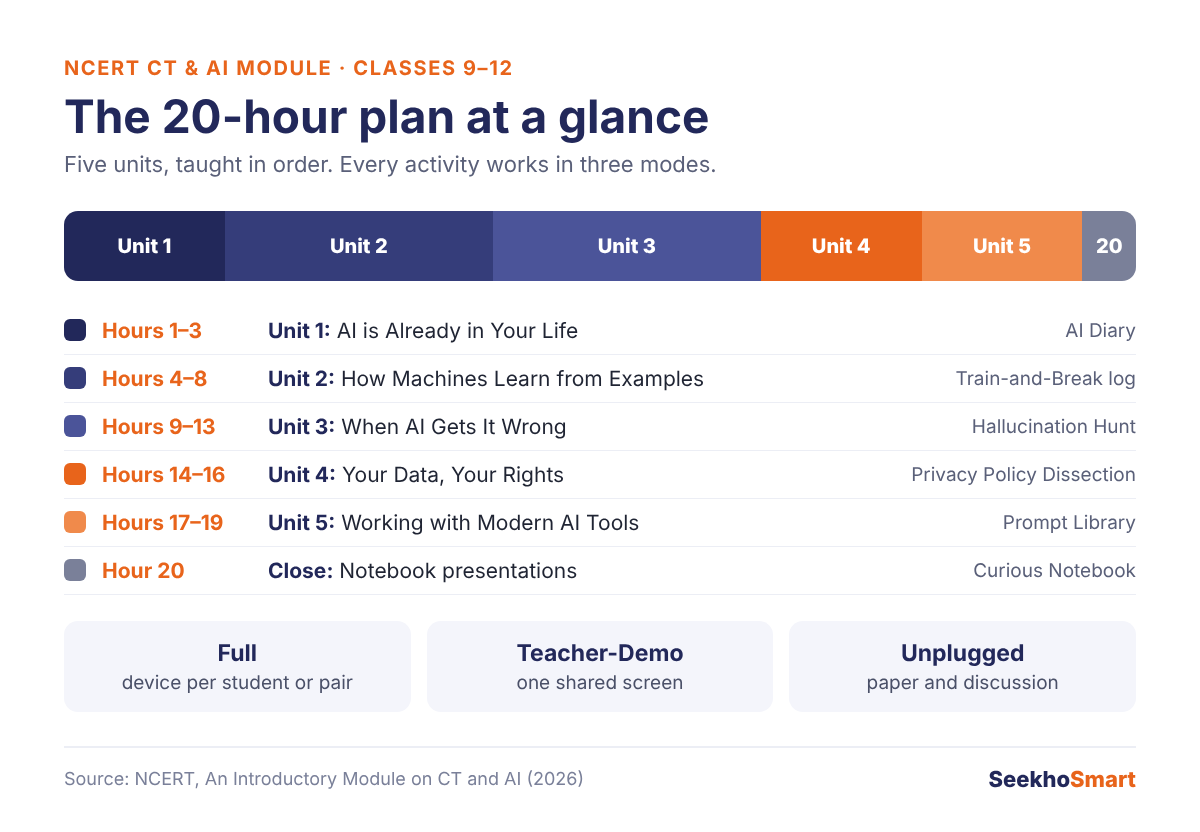
The module's teacher note suggests a plan of 20 class hours, with units taught in order:
- Hours 1–3: Unit 1 (AI scavenger hunt, AI or Not?, starting the AI Diary)
- Hours 4–8: Unit 2 (rules vs learning from examples, bias in data, the Train-and-Break activity)
- Hours 9–13: Unit 3 (confident but wrong, deepfakes, the Five Checks, Hallucination Hunt)
- Hours 14–16: Unit 4 (kinds of data, consent and the DPDP Act, privacy policy dissection)
- Hours 17–19: Unit 5 (asking better questions, building a Prompt Library, peer review)
- Hour 20: Closing session where students present their Curious Notebook work
Practical options: one period a week for about 20 weeks, or two periods a week across one term. For Classes 10 and 12, try to finish the core units before pre-boards so the module doesn't compete with board revision.
Step 4: Decide your activity mode, not whether to do it
This is one of the module's strongest features for Indian schools. Every hands-on activity comes in three forms:
- Full: a device per student or pair
- Teacher-Demo: one shared screen
- Unplugged: paper and discussion, no tools at all
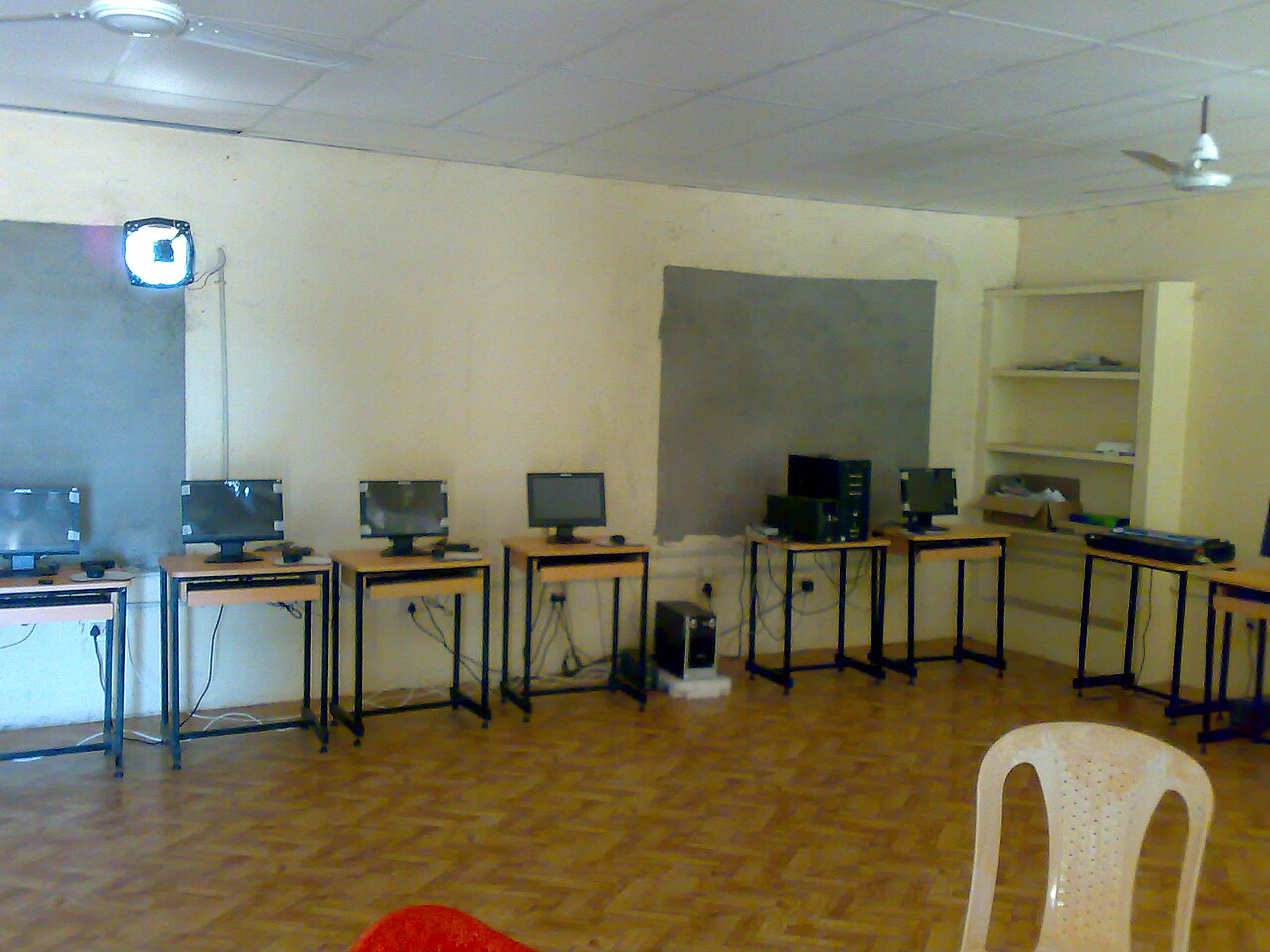
The teacher note says "a classroom with no internet can complete the core of this module in full," and suggests changing the mode rather than leaving out a unit. So a school with one projector and a smartboard can start tomorrow. If you have a computer lab, book it for Units 2 and 5, where students train a simple classifier and work with AI tools.
Step 5: Set clear safety rules before Unit 5
The module asks students to use real AI tools and gives four safety habits you can adopt as school policy:
- Keep personal data out. No names paired with IDs, Aadhaar or PAN numbers, passwords, OTPs or photos of documents in any AI tool.
- Don't train tools on people. Use everyday objects (a pen, an eraser, a water bottle), not faces or ID cards.
- Check before you trust. Use the module's Five Checks: Source, Claim type, Compare, Pause and Confidence.
- Tell an adult if something feels wrong.
Share these with parents too, in a short circular or at the next PTM.
Step 6: Use the Curious Notebook for assessment
The module recommends a running portfolio called the Curious Notebook as the home for assessment, and says it "may be used for formative assessment". Any exercise book will do. The teacher note is clear that crossings-out and revised answers are evidence worth having, and that students shouldn't be marked down for them. Ask teachers to leave short comments rather than collecting notebooks for correction. When CBSE confirms the internal-assessment format, you'll already have a full term of evidence ready.
A quick readiness checklist
- Staff have read the module's foreword and "Note for the Teacher"
- Teachers assigned for each grade (ideally in pairs)
- 20 hours mapped into the timetable for this term
- Activity mode chosen per section (Full / Teacher-Demo / Unplugged)
- AI-tool safety rules shared with students and parents
- Curious Notebook started for every student
- Someone assigned to track CBSE circulars on assessment
How SeekhoSmart supports your students
The CT and AI module teaches students to use AI "as a helper rather than a replacement" for their own thinking. SeekhoSmart applies that idea to everyday subject learning. Students get NCERT-aligned practice and a chapter-tagged 10-year PYQ bank, with AI explanations of every answer, including wrong ones. They see why an answer is right, not just what it is. The adaptive daily study plan gives each Class 9–12 student a personalised revision path, so your teachers don't have to build one for every child. It's free to start, so you can pilot it with a few sections at no upfront cost.
Padhai, ab smart tareeke se.
Try SeekhoSmart for your school → seekhosmart.in
Frequently asked questions
Is AI compulsory in Class 9 CBSE in 2026-27?+
According to CBSE Circular Acad-18/2026 as quoted by secondary sources, other AI courses are discontinued for Class 9 from 2026-27 and NCERT's CT and AI modules are meant for internal assessment. Reports differ on whether the modules start in 2026-27 or 2027-28, so watch CBSE circulars.
Where can I download the NCERT computational thinking and AI book?+
The module is available as a PDF on NCERT's website: ncert.nic.in/pdf/An_Introductory_Module_AI_CT_UN514.pdf. The current copy carries a draft watermark.
Is there an NCERT computational thinking teachers' handbook?+
The module itself includes a 'Note for the Teacher' with the teaching approach, the three activity modes, a 20-hour plan and guidance on assessment through the Curious Notebook.
Does the module need computers or internet?+
No. Every activity has Full, Teacher-Demo and Unplugged versions, and NCERT says a classroom with no internet can complete the core of the module in full.
- NCERT Introduces Computational Thinking And AI Module For Classes 9 To 12 – The Logical Indian
- NCERT Rolls Out Computational Thinking And AI Module For Classes 9 to 12 – Education Bytes
- An Introductory Module on CT and AI (NCERT PDF)
- Is AI Compulsory in Class 9 and 10 CBSE? (2026-27) – littleaimaster
- CBSE Academic – Circulars
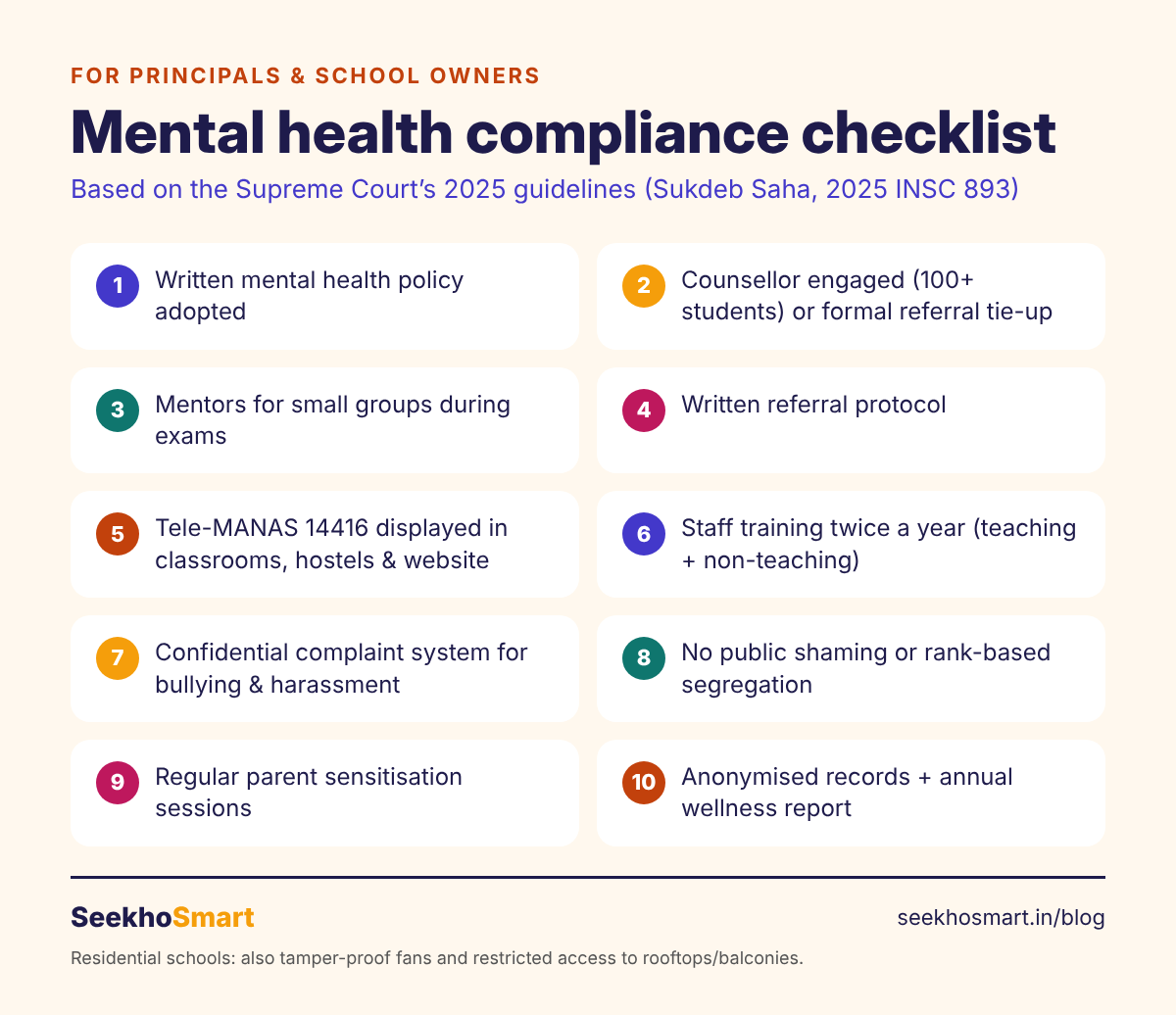
- SeekhoSmart (infographic)
- Ravichandra (రవిచంద్ర) / Wikimedia Commons (CC BY 3.0)
- Pinakpani / Wikimedia Commons (CC BY-SA 4.0)