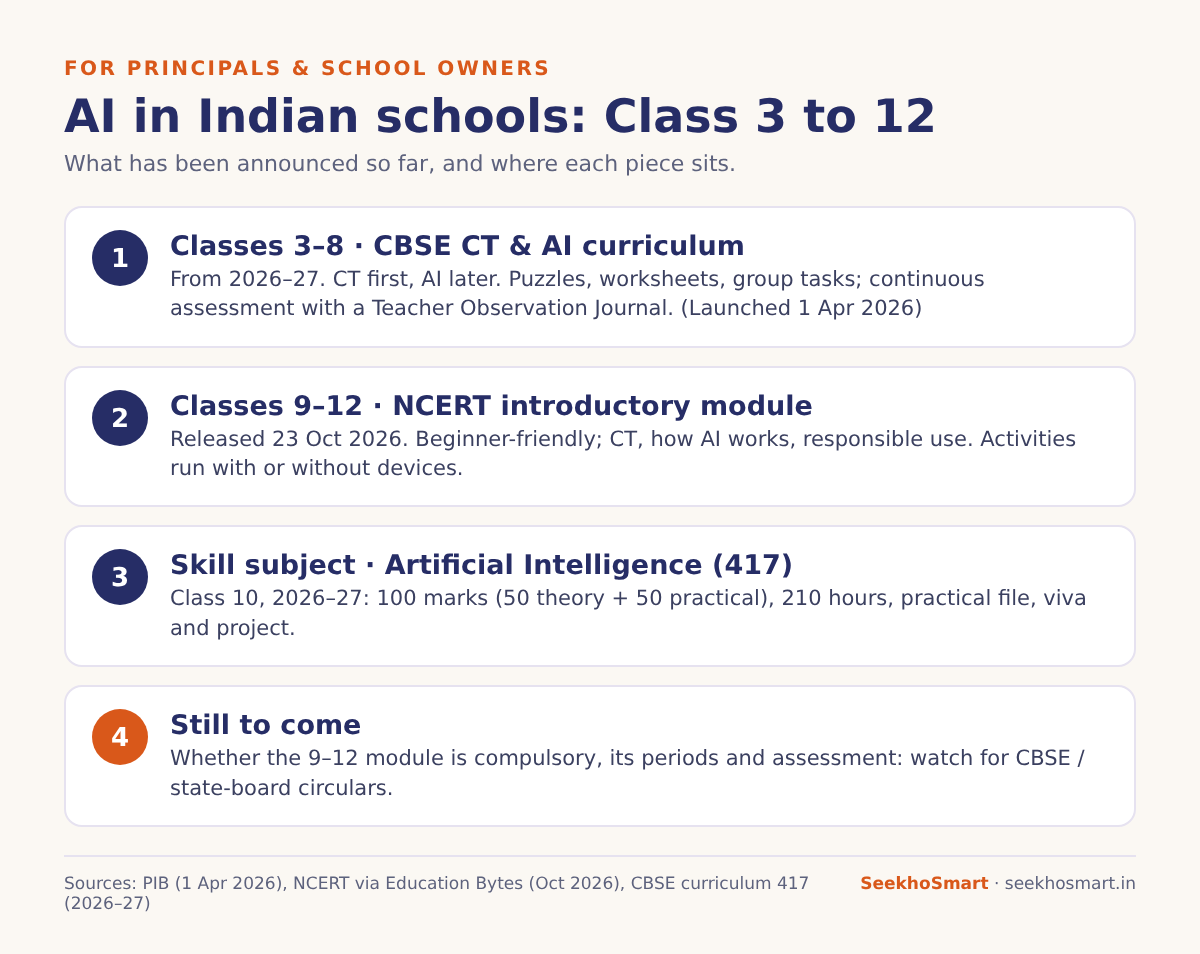
Indian schools now have an AI pathway that runs from Class 3 to Class 12. In April 2026, CBSE launched a Computational Thinking (CT) and AI curriculum for Classes 3 to 8. On 23 October 2026, NCERT filled the gap above it with an introductory CT and AI module for Classes 9 to 12.
For principals and school owners, this raises practical questions. Do we need a lab? Who will teach it? What do we tell parents? This guide sets out what has been announced and a step-by-step plan you can start this term.
What has been announced so far
Classes 3–8: CBSE's CT and AI curriculum
The Union Education Minister launched the CBSE Curriculum on Computational Thinking and AI on 1 April 2026, with implementation from the 2026–27 session (PIB release). Key points from the release:
- CT is taught first, and AI is introduced in later classes.
- It links to Maths, Science and Humanities through interdisciplinary learning.
- Teaching uses maths games, puzzles, hands-on exercises and worksheets.
- Assessment is continuous and competency-based, including CT puzzles, group activities and a Teacher Observation Journal.
- It is backed by modules, teacher handbooks and assessment frameworks.
Careers360 reports that faculty from IIT Madras, Azim Premji University and others prepared the syllabi, and that three documents were created: the curriculum, a Teachers' Handbook and Teaching Learning Material.
Classes 9–12: NCERT's introductory module
The new module is aligned with NEP 2020 and designed for beginners with no prior subject knowledge (Education Bytes). It covers computational thinking, how AI works and its limits, and responsible use: data privacy, misinformation, fairness, digital safety and verifying AI output. Activities are experiential and "can be conducted with or without digital devices" (The Tribune).
Already in place: AI as a skill subject
CBSE also offers Artificial Intelligence (code 417) as a skill subject. For Class 10 in 2026–27 it carries 100 marks: 50 theory and 50 practical, with 210 hours, a practical file, a practical exam, viva and project work (CBSE curriculum).
What is still unclear
The reports we checked don't say whether the Class 9–12 module is compulsory, how many periods it needs or how it will be assessed. Plan for flexibility, and watch for CBSE or state-board circulars before you lock your 2027–28 timetable.
A 6-step rollout plan for your school
Step 1: Appoint an AI coordinator
Choose one interested teacher (not necessarily from Computer Science) to own the rollout. Give them two free periods a week for planning. Their first job: read the NCERT module (official PDF linked by Education Bytes) and the Classes 3–8 teacher materials.
Step 2: Map it to your existing timetable
Because the module is activity-based and needs no specific subject background, you don't have to wait for a new period. Options to consider:
- one zero period or activity period a week for Class 9,
- integration into Maths and Science for CT activities,
- integration into English and Social Science for misinformation and fairness discussions.
Step 3: Start device-light
NCERT has designed activities that work without devices. Begin with paper-based CT puzzles and group discussions. Use your existing computer lab or smart class only where it adds value. This keeps the upfront cost close to zero.
Step 4: Train teachers, cheaply
- Run an internal workshop where the coordinator demonstrates two module activities.
- Encourage teachers to take free AI courses. IIT Madras has offered free AI courses for school teachers of all classes on SWAYAM Plus, 25–45 hours each (Careers360, September 2025).
- Copy the Teacher Observation Journal idea from the Classes 3–8 curriculum to track progress without extra exams.
Step 5: Write a simple AI-use policy
Students are already using chatbots for homework. A one-page policy should cover what AI use is allowed for homework and projects, what's banned in tests, what student data must never go into AI tools, and how teachers will check for misuse. The module's responsible-use topics give you a ready framework.
Step 6: Tell parents early
Parents will see headlines about "AI in schools" and worry about screen time or costs. Send a short note or hold a 20-minute PTM session explaining:
- what the module is (NCERT-designed, beginner-friendly),
- that it focuses on thinking and safety, not just gadgets,
- that there is no extra fee for it (if that's your plan).
A simple timeline for the rest of 2026–27
- November: appoint the coordinator, download the module, run one staff workshop.
- December: pilot two device-free CT activities with one Class 9 and one Class 11 section.
- January: share the AI-use policy with staff, students and parents; collect teacher feedback.
- February–March: keep Class 10 and 12 focused on boards; review what worked in the pilot sections.
- April (new session): expand to all Class 9 and 11 sections, adjusting to any new CBSE or state-board guidance.
What not to do
- Don't rush to buy expensive "AI labs". Nothing in the reports we read requires special hardware for the Class 9–12 module.
- Don't let AI become a marketing slogan only. Parents and students notice when "AI-enabled school" means one smartboard.
- Don't overload Class 10 and 12 students. Their board exams come first. Start with Class 9 and 11, where timetables are lighter.
Why this is an opportunity for your school
Schools that roll out the module thoughtfully can show parents something concrete: students who can break down problems, question information and use AI safely. That's a stronger admissions story than a brochure line, and it aligns with what NCERT and CBSE are now asking for.
How SeekhoSmart helps schools add AI-powered practice at no upfront cost
Rolling out the module covers AI awareness. Your students still need daily practice for boards. SeekhoSmart adds an NCERT-aligned, adaptive practice layer outside class: each student gets an adaptive daily study plan based on their own weak areas, plus AI explanations of every answer, including wrong ones, so teachers spend less time re-explaining the same mistakes. The 10-year PYQ bank tagged by chapter fits your existing teaching sequence. It's free to start, in Hindi and English, so you can pilot it with one section before deciding on a wider rollout.
Try SeekhoSmart for your school → seekhosmart.in
Frequently asked questions
What is the AI curriculum for schools in India?+
CBSE launched a Computational Thinking and AI curriculum for Classes 3 to 8 from 2026-27, and NCERT released an introductory CT and AI module for Classes 9 to 12 on 23 October 2026. CBSE also offers AI as a skill subject.
Is AI part of the CBSE curriculum for Classes 3 to 8?+
Yes. The CT and AI curriculum for Classes 3 to 8 was launched on 1 April 2026 for the 2026-27 session, with CT taught first and AI introduced in later classes.
What is the CBSE AI curriculum for Class 9?+
Class 9 students can study the new NCERT CT and AI module, and CBSE offers Artificial Intelligence (code 417) as a skill subject at the secondary stage. Check CBSE's curriculum documents for the Class 9 details.
Does a school need an AI lab to start?+
Not for the Class 9-12 module. NCERT says its activities can run with or without digital devices, so schools can start with paper-based activities and existing labs.
- PIB: CBSE CT & AI curriculum for Classes 3-8
- CBSE launches CT and AI curriculum for Classes 3 to 8 (Careers360)
- NCERT CT & AI module (Education Bytes)
- NCERT launches AI, computational thinking module (The Tribune via PressNewsAgency)
- CBSE Artificial Intelligence (417) Class X curriculum 2026-27
- NCERT module PDF (official)
- IIT Madras free AI courses for school teachers (Careers360)
- SeekhoSmart (infographic)
- CIMT HOOGHLY / Unsplash
- Swastik Arora / Unsplash