The half-yearly answer sheets are checked, the marks are entered, and the PTM notice has gone home. In a few days, you'll meet 40 or more families, often with five to ten minutes each. Some parents will come anxious, some defensive, some just in a hurry to get back to work.
A good parent-teacher meeting can change a student's second term. A rushed one turns into a marks recital that nobody remembers by evening. This guide gives you a simple structure, the points to cover, sample lines you can use, and a feedback format you can fill in after each meeting. It's written for Class 9–12 teachers in CBSE, ICSE and state board schools.
Why the PTM matters more than the report card
India's curriculum framework treats PTMs as a core part of learning, not an administrative event. The National Curriculum Framework for School Education (NCF-SE) 2023 says parents and the community "must be deliberately and systematically engaged, including through orientation meetings, regular Parent-Teacher meetings, and continuing dialogues."
The same document, quoting NEP 2020, describes the holistic progress card as "an important link between home and school" that "will be accompanied by Parent-Teacher Meetings in order to actively involve parents in their children's holistic education and development." It also says progress should be compared with the student's own earlier performance, "and not with the performance of other students in the class." The NEP 2020 announcement lists "360 degree Holistic Progress Card" among its assessment reforms.
In practice, that gives you a clear message for every PTM: talk about this child's progress, with evidence, and agree on what home and school will each do next.
Before the PTM: 30 minutes of prep that saves hours

Make a one-line note for each student
Go through your register and answer-sheet analysis. For each student, write one line with three parts:
- One genuine strength (with an example): "Explains reasoning clearly in long answers."
- One priority to work on: "Loses 6–8 marks on units and diagrams in Physics."
- One action for home: "15 minutes of numericals, three evenings a week."
If you can't think of a specific strength, look again. Every student has one: neat work, regular attendance, good questions in class, steady improvement since the unit test.
Bring evidence, not adjectives
"He's careless" starts an argument. "Here, here and here he wrote the right method but copied the number wrong" starts a conversation. Keep the answer sheet, two or three marked examples, and the student's unit-test marks side by side so parents can see the pattern.
Plan for the common situations
- High scorers: parents often want "more". Talk about depth: competency-based questions, explaining answers, reading beyond the textbook.
- Students who dropped: check attendance and any change at home before assuming lack of effort.
- Students who are struggling: pick one subject skill to fix this month. Ten problems at once means nothing gets fixed.
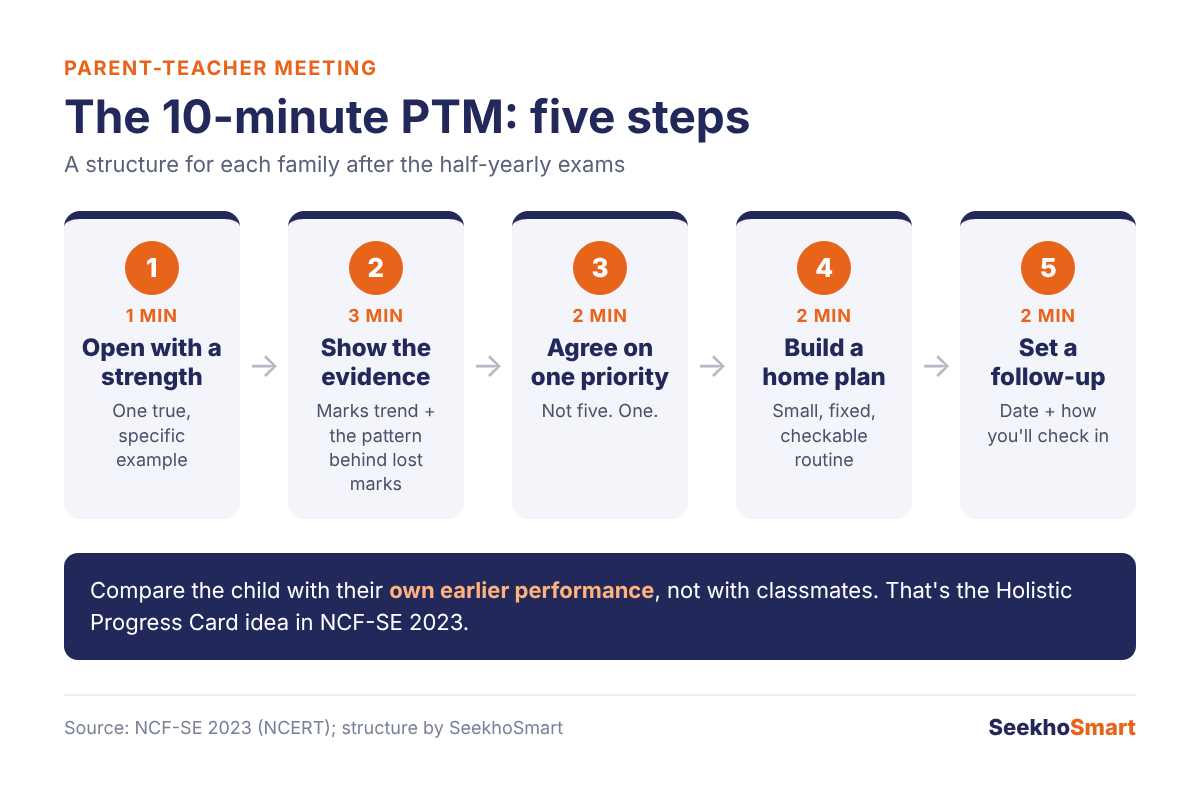
During the PTM: a simple 10-minute structure
1. Open with a strength (1 minute)
Start with something true and specific. It tells the parent you know their child as a person, not a roll number.
"Ananya asks some of the best questions in class. Last week she asked why the reaction needed a catalyst, and half the class learnt from it."
2. Show the evidence (3 minutes)
Share the marks, but quickly move to the pattern behind them. Compare with the student's own earlier performance (unit test → half-yearly), not with the class topper.
"Her Maths went from 28/40 to 31/40. The marks she's losing are mostly in the last step of word problems: she solves correctly but doesn't write the final statement."
3. Agree on one priority (2 minutes)
Choose one thing. Not five. Say clearly why it matters for the board exam or the next term.
4. Build a home plan together (2 minutes)
Ask, don't instruct: "What time in the evening works best for her to study quietly?" Then agree on something small and checkable: a fixed 30-minute slot, a weekly mistake review, or a sleep time before exams. Parents don't need to teach the subject. They need to support the routine.
5. Close with a follow-up (2 minutes)
Tell them when and how you'll check in: a note in the diary after two weeks, or a quick message after the next class test. End on a hopeful line.
"If she does this for three weeks, I expect to see it in the next test. I'll send you a note on the 15th."
Points to discuss in a parent-teacher meeting
Keep this checklist on your table so you don't miss anything important:
- Attendance and punctuality (especially for board classes)
- Marks trend: unit test → half-yearly, subject by subject
- The specific pattern behind lost marks (concept, presentation, time, reading the question)
- Classwork, homework, projects and practical records
- Participation, behaviour and peer relationships
- Well-being: sleep, screen time, stress, any changes at home (ask gently)
- For Class 10 and 12: board-exam timeline, internal assessment, practicals
- For Class 10: early thoughts on subject choices for Class 11
- One agreed action for home and one for school
What to say (and avoid) in a PTM
| Instead of… | Try… |
|---|---|
| "He's lazy." | "He completes classwork but homework is missing 3 days out of 5. Can we find out why?" |
| "She's very weak in Maths." | "She understands the method. She's losing marks in calculation. Let's try 10 practice sums a day." |
| "Look at the topper's marks." | "Compared to her unit test, she has improved in two subjects. Let's work on the third." |
| "You need to put him in tuition." | "Here's what would help at home. Let's review in three weeks before deciding anything else." |
| "Everything's fine." (for a quiet student) | "She's doing well in tests. I'd love her to speak up more. Can you encourage her to ask one question a day?" |
Handling a difficult conversation
If a parent becomes upset, slow down. Acknowledge the feeling ("I can see you're worried"), return to the evidence on the table, and move to what you can do together. If the issue is serious (bullying, a health concern, a big drop with no clear reason), note it and involve the class teacher, counsellor or coordinator. Don't try to solve it in five minutes with a queue outside.
After the PTM: what to write in the feedback
Fill in a short record for each family the same day, while it's fresh. A simple format:
- Student / class / date
- Strength discussed
- Priority agreed
- Home action (who, what, how often)
- School action (what you will do)
- Follow-up date
- Parent concerns raised
This record makes your next PTM much easier. You start by asking, "Last time we agreed on X. How has it gone?"
How SeekhoSmart helps after the PTM
The hardest part of any PTM plan is what happens at home on a Tuesday evening. SeekhoSmart can carry your "one priority" home without adding to your workload. Its NCERT-aligned practice and chapter-tagged 10-year PYQ bank give students ready questions on exactly the chapter you discussed. Its AI explanations of every answer, including wrong ones, help a student understand a mistake even when you're not there to explain it again. And streaks and the daily study plan give parents a simple, visible way to see if the agreed routine is happening, so your next PTM starts with facts, not guesses. It's free to start.
Padhai, ab smart tareeke se.
Share SeekhoSmart with your students → seekhosmart.in
Frequently asked questions
What are the points to discuss in a parent teacher meeting?+
Attendance, the marks trend from unit test to half-yearly, the pattern behind lost marks, classwork and projects, behaviour and well-being, and one agreed action each for home and school. For Class 10 and 12, add the board-exam timeline and practicals.
What should a teacher say in a parent teacher meeting?+
Open with one specific strength, show evidence rather than adjectives, agree on one priority, build a small home routine together, and close with a follow-up date.
What should I write in parent teacher meeting feedback?+
Record the strength discussed, the priority agreed, the home action, the school action, the follow-up date and any concerns the parent raised. Fill it in the same day.
What is a holistic progress card?+
NCF-SE 2023 describes it as individualised reporting of a student's progress across all areas of learning, based on evidence beyond tests, comparing the student with their own earlier report rather than with classmates.