Every teacher knows the moment. You check the half-yearly papers and see the same eight or ten names at the bottom again. Some of them try hard. Some have stopped trying. And the board exams are only a few months away.
"Weak students" is the phrase most of us type into Google, but it is rarely the right label. Most of these children are not weak. They have gaps — a concept missed in Class 8, a fear of maths, a language barrier, or simply too little practice. Gaps can be closed. This guide gives you a practical six-week remedial plan that works in a normal Indian classroom of 40 students, without extra periods every day.
Why "more of the same" doesn't work
When a student is struggling, the instinct is to give more homework, more worksheets, more repetition. But if the base is missing, repetition only builds frustration.
The National Education Policy 2020 asks for a different approach. Para 4.34 says assessment should shift from testing rote memory to being "more regular and formative", and that "the primary purpose of assessment will indeed be for learning". In simple words: test to find the gap, then teach to that gap.
Step 1: Diagnose before you teach (Week 1)
Don't start remedial classes with the next chapter. Start by finding out exactly where each student is stuck.
Run a 20-minute diagnostic test
- Pick 10 questions from the prerequisite skills for your current chapter. For Class 10 quadratic equations, that means factorisation, squares, and simple linear equations — not quadratics.
- Keep it short and low-stakes. Tell students it won't count for marks.
Sort the mistakes, not the students
For each wrong answer, note the type of error:
- Concept gap — doesn't understand the idea.
- Skill gap — understands, but can't do the steps (calculation, writing, diagrams).
- Language gap — can't read or express the answer in English.
- Careless error — knows it, but rushes.
You'll usually find that 3–4 gaps explain most of the low marks.
Step 2: Group by gap, not by rank (Week 1)
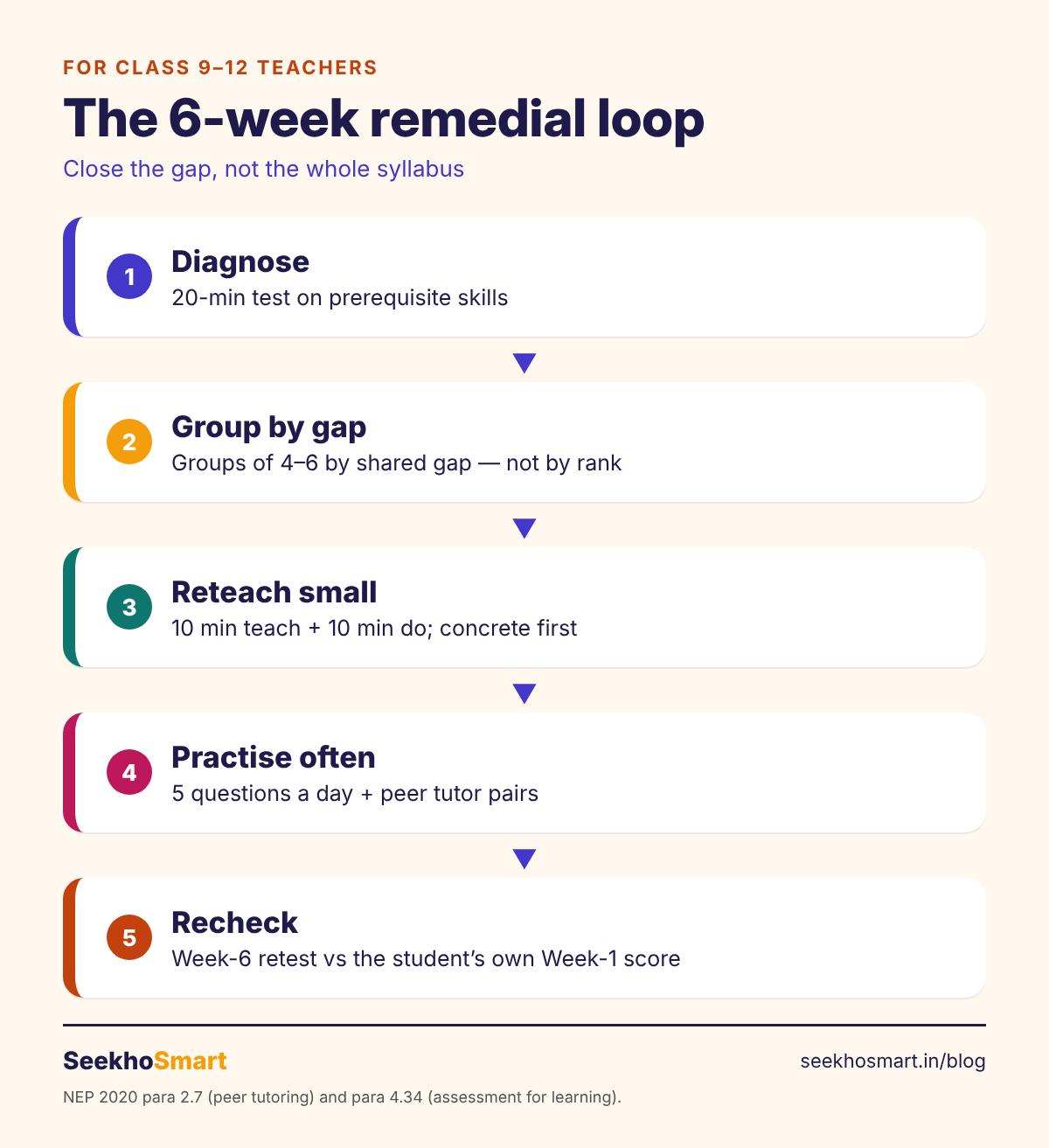
Make small groups of 4–6 students based on the gap they share, not their total marks. A child who scored 60% but can't do fractions belongs in the fractions group too.
Avoid labelling groups as "weak" or "slow" in front of the class. Call them by topic — the "Fractions group" or the "Diagram group". Children notice labels, and a label can become what they believe about themselves.
Step 3: Reteach in small chunks (Weeks 2–4)
Use the 10-minute rule
Struggling students lose focus quickly in long explanations. Teach one small idea in 10 minutes, then let them do it themselves for 10 minutes while you walk around.
Go concrete first
- In maths, use number lines, paper folding or real prices before symbols.
- In science, start with a daily-life example before the definition.
- In English and social science, give a model answer and let students underline its structure before writing their own.
Allow the mother tongue to build understanding
If a student understands "photosynthesis" better in Hindi, Marathi or Tamil first, let them. Once the concept is clear, help them write it in the exam language. Understanding comes before vocabulary.
Use 15 minutes, three times a week
You don't need a separate period every day. Fifteen minutes at the start of a free period or during a revision class, three times a week, is enough if it's focused on one gap.
Step 4: Use peer tutoring (Weeks 2–6)
You can't sit with every student, but their classmates can help. NEP 2020 (para 2.7) notes that studies show "one-on-one peer tutoring to be extremely effective for learning not just for the learner, but also for the tutor", and suggests it can be "a voluntary and joyful activity for fellow students under the supervision of trained teachers".
How to set it up:
- Pair a confident student with one who is struggling in that specific topic.
- Give the pair a clear task: five questions, with the tutor explaining each step aloud.
- Rotate tutors so it doesn't become a fixed "helper" and "helped" relationship. A student weak in maths might be the best tutor for map work.
- Check in for two minutes at the end of each session.
Step 5: Practise little and often (Weeks 3–6)
Short daily practice beats one long weekend worksheet. Give each group:
- 5 questions a day on their gap, starting easy and building up.
- One board-style question each week, so they see how the skill appears in the exam.
- Immediate feedback. A mistake corrected the next day is far more useful than one corrected two weeks later.
Keep a simple tracker: student name, gap, and a tick for each day they practise. You'll see who is building the habit and who needs a nudge.
Step 6: Recheck and celebrate progress (Week 6)
At the end of six weeks, give a fresh diagnostic test on the same skills. Compare each student only with their own Week 1 score.
- Share progress with the student first, privately. "You got 3 out of 10 in Week 1. Today you got 7." That one sentence can change how a child sees themselves.
- Share specific progress with parents too — not just "needs improvement".
- Move students who have closed their gap back to regular work, and start a new six-week cycle on the next gap.
A note for Class 10 teachers
CBSE's new two-phase Class 10 board system gives students a second chance. According to Careers360, students can take Phase 1 or both phases, the better score counts, and Phase 2 is held after Phase 1 results. That makes remedial teaching even more valuable — the gap you close after February can still change a student's final result.
Common mistakes to avoid
- Teaching the whole syllabus again, faster. Focus only on the gap.
- Publicly comparing marks. It shuts down the students who most need to speak up.
- Giving up after two weeks. Most gaps take four to six weeks of steady practice to close.
- Doing it all yourself. Use peer tutors, parents and practice tools to share the load.
How SeekhoSmart helps you support struggling students
The hardest part of remedial teaching is giving each student enough practice and feedback when you have 40 children and limited time. SeekhoSmart can carry some of that load outside class. Students get NCERT-aligned practice on the exact chapter you are working on, and every answer — including a wrong one — comes with an AI explanation, so a student practising at home gets the "why" without waiting for you. A Hindi/English switch helps students who understand concepts better in Hindi first. You keep the teaching; SeekhoSmart handles the daily practice and repetition. It's free to start.
Share SeekhoSmart with your students → seekhosmart.in
Frequently asked questions
What is the meaning of remedial teaching?+
Remedial teaching means teaching that targets a specific learning gap. It starts with finding out what a student hasn't understood, then reteaching that skill in a simpler way with extra practice, and rechecking until the gap is closed.
How do I teach weak students in maths?+
Start with a short diagnostic test on prerequisite skills, then reteach the missing basics using concrete examples before formulas. Give five practice questions a day and correct mistakes quickly.
How do I teach very weak students in a big class?+
Group them by shared gaps, use 15-minute focused sessions three times a week, and set up peer tutoring pairs. You don't need to teach each child separately.
Are there free AI tools for teachers in India for student practice?+
Yes. Some platforms, including SeekhoSmart, are free to start and give students NCERT-aligned practice with explanations, which can support your remedial work outside class.
- SeekhoSmart (infographic)