Every teacher has seen it by now: a homework answer that is a little too polished, a project with facts that no textbook mentions, a student who says "but ChatGPT said so". The question isn't whether students will use AI. It's whether anyone will teach them to use it well.
On 23 October 2026, NCERT gave teachers a starting point. Its new introductory module on Computational Thinking (CT) and Artificial Intelligence (AI) for Classes 9 to 12 puts responsible AI use right at the centre. This guide shows how you can use it in your own classroom, even if you are not a computer teacher and even if your school has only one projector.
What the module asks students to learn
The module was developed by NCERT under the Ministry of Education and is aligned with NEP 2020 (Education Bytes). It is designed for beginners: no prior knowledge of any subject is needed.
Its responsible-use strand covers five areas, as listed in reports by Elets digitalLEARNING and The Tribune:
- Data privacy: protecting personal information.
- Misinformation: recognising misleading content.
- Fairness: understanding that AI can be biased.
- Digital safety: staying safe online and seeking help from trusted adults.
- Verification: checking the accuracy of AI output instead of accepting it without question.
NCERT's message is that "human judgement, creativity, and ethical responsibility remain central to learning", as quoted by The Logical Indian. That is a line worth writing on your board.
A note on what's still unclear: the reports we read don't say whether the module is compulsory, how many periods it needs, or how it will be assessed. Until your board or school sends guidance, treat it as a ready-made resource you can draw from in any subject.
Teaching it with or without computers
The best news for Indian classrooms is that NCERT says the activities "can be conducted with or without digital devices" (The Tribune). The module uses discussions, practical exercises, experiments and reflection rather than lectures.
That means a Science, Social Science or English teacher can bring it into a normal 40-minute period. Here is a simple flow.
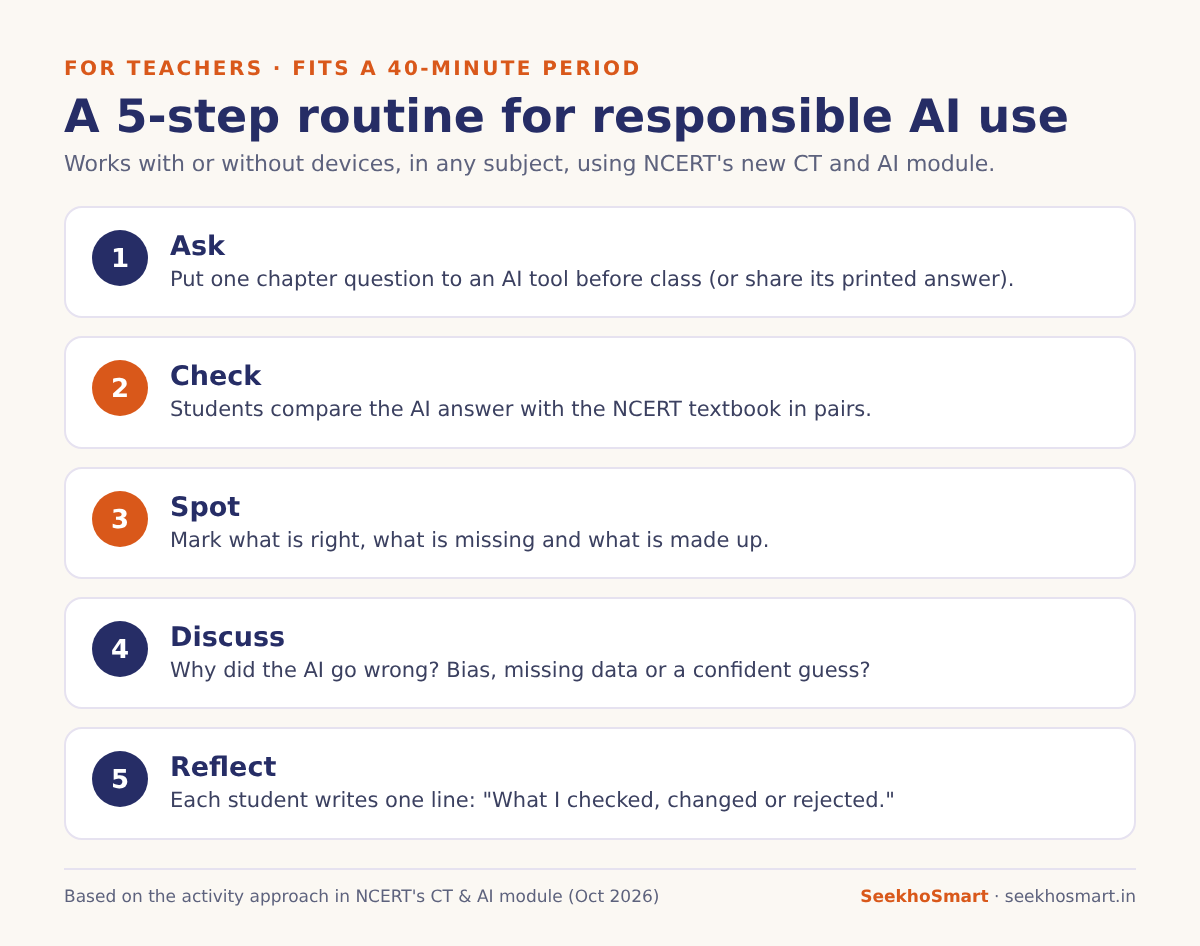
Five classroom activities that work in 40 minutes
1. "Spot the AI mistake" (no devices needed)
Before class, ask an AI tool a question from the chapter you're teaching and print or write the answer on the board. Choose one that has a small error or a missing step. Students work in pairs to find what's wrong using only their NCERT textbook. This teaches verification better than any lecture.
2. Break it down (computational thinking)
Give a real problem, such as "plan the school's sports day for 600 students" or "find the cheapest way to travel from your town to the district HQ". Groups break it into smaller steps, decide the order and spot repeating patterns. This is CT, and it needs nothing but chart paper.
3. Privacy sorting game
Write 12 pieces of information on slips: favourite cricketer, phone number, school name, Aadhaar number, home address, a photo of a marksheet, and so on. Students sort them into "OK to share with an app", "Never share" and "Ask an adult first". The discussion that follows is the real lesson.
4. Fair or unfair?
Describe a made-up AI tool that suggests careers, and tell students it was trained mostly on data from one city or one gender. Ask: who might it treat unfairly, and why? Students start to see that AI reflects the data it learns from.
5. The two-column homework rule
For any assignment where AI is allowed, students submit two columns: "What I asked AI" and "What I checked, changed or rejected, and why". You get to see their thinking, and copying becomes pointless.
Making AI rules clear in your class
Students do better with clear rules than with a blanket ban they will quietly ignore. You could agree on rules like these with your class:

| Allowed | Not allowed |
|---|---|
| Asking AI to explain a concept in simpler words | Submitting AI-written answers as your own |
| Using AI to generate practice questions | Sharing personal or family details with chatbots |
| Checking your own answer after you've tried | Trusting an AI fact without checking the textbook |
| Translating a difficult paragraph to Hindi or English | Using AI during tests or in-class work |
Put the table up on the class noticeboard and review it once a term.
Building your own AI confidence
You don't need to be an AI expert to teach this module. You need to be one step ahead and honest about what you don't know. A few starting points:
- Read the module yourself first. Education Bytes links to NCERT's official module PDF. Pick two activities to try this month.
- Take a free course. IIT Madras offers free AI courses for school teachers of all classes on SWAYAM Plus, including one for K-12 educators, each 25–45 hours long (Careers360, September 2025). Check SWAYAM Plus for current batches.
- Borrow from the Classes 3–8 approach. CBSE's CT and AI curriculum for Classes 3–8 (from 2026–27) uses puzzles, worksheets, group tasks and a Teacher Observation Journal to track progress, according to the PIB release. A simple observation notebook works just as well for older students.
Talking to students about "will AI do my work for me?"
Many students quietly believe AI makes studying pointless. Answer it directly: AI can produce an answer, but it can't sit your board exam, explain your project in a viva or think through a new problem for you. The module's focus on judgement and verification gives you a ready answer: the skill of the future is knowing when the machine is wrong.
How SeekhoSmart helps teachers support responsible AI use
You can't sit with every student after school, but you can point them to practice that uses AI the right way. SeekhoSmart gives each student AI explanations of every answer, including wrong ones, so the AI explains the reasoning instead of handing over a finished answer. Its NCERT-aligned practice and 10-year PYQ bank tagged by chapter let you tell students "practise Chapter 7 tonight", knowing the questions match what you taught. And the adaptive daily study plan keeps weaker students practising steadily without you making extra worksheets. It's free to start, in Hindi or English.
Share SeekhoSmart with your students → seekhosmart.in
Frequently asked questions
How should students use AI responsibly in school?+
Students should attempt work themselves first, use AI to explain or quiz rather than write answers, verify AI facts against the textbook, keep personal data out of chatbots and never use AI in tests unless allowed.
Is there a free AI for teachers course?+
Yes. IIT Madras has offered free AI courses for school teachers of all classes on SWAYAM Plus, including one for K-12 educators, each 25 to 45 hours. Check SWAYAM Plus for current batches.
Do I need computers to teach the NCERT AI module?+
No. NCERT says the module's activities can be conducted with or without digital devices, using discussions, exercises and reflection.
Can AI help with lesson plans for free?+
Many AI chatbots have free versions that can draft lesson ideas or practice questions. Always check what they produce against the NCERT textbook before using it in class.
- NCERT CT & AI module (Education Bytes)
- NCERT develops AI and CT module for classes 9 to 12 (Elets digitalLEARNING)
- NCERT launches AI, computational thinking module (The Tribune via PressNewsAgency)
- NCERT introduces CT and AI module (The Logical Indian)
- NCERT module PDF (official)
- IIT Madras free AI courses for school teachers (Careers360)
- PIB: CBSE CT & AI curriculum for Classes 3-8
- SeekhoSmart (infographic)
- Raj Rana / Unsplash
- Swastik Arora / Unsplash