Every staffroom has the same conversation now. Students are already using AI tools at home. Some teachers have tried them for worksheets or lesson plans; others are unsure where to begin, or worried about accuracy and misuse. Searches like ai for teachers course free are rising because teachers want one thing: a clear, trustworthy way to learn — without paying for an expensive certificate.
This guide lists the free, government-backed AI training options that Indian teachers can use, what each one covers, and a simple four-week plan to try AI safely with your Class 9–12 students.
Free, official AI courses for Indian teachers
Here are the programmes we found on official pages. Dates and deadlines change from one batch to the next, so check each page before you register.
1. CIET-NCERT: "Leveraging AI for Transforming School Education"
CIET-NCERT's five-hour series was broadcast live on NCERT's YouTube channel and PM eVIDYA channels — in English from 19–23 January 2026 and in Hindi from 26–30 January 2026. The five sessions covered:
- Foundations of AI
- Policy frameworks and governance for AI
- AI-driven classroom practices
- Pedagogical integration strategies
- Ethical, safe and responsible AI use
The page states that participants who completed the linked DIKSHA course and scored 70% or above in the final assessment (up to three attempts) got a certificate, and that the course was open till 15 March 2026. The certificate window has closed for that batch, but the session videos are a good free starting point.
2. CIET-NCERT: "Empowering Teachers with AI – Phase III"
This five-day series (19–23 January 2026) was designed for teachers, school leaders and administrators. Its topics were practical: an overview of modern AI and its limits and bias, machine learning in real life, the impact of AI on education, teacher productivity with AI tools, and building a future-ready classroom. The same certificate rule (DIKSHA course, 70% in the final assessment) applied.
3. CIET-NCERT: "AI in Education" (with COL-CEMCA)
An earlier five-day training from CIET-NCERT and COL-CEMCA covered generative AI for teaching, AI tools in the classroom, AI for inclusive education, and a session on ethical and responsible use with resource persons from MIT. The page notes that recordings are available in a playlist — useful if you teach students with special needs.
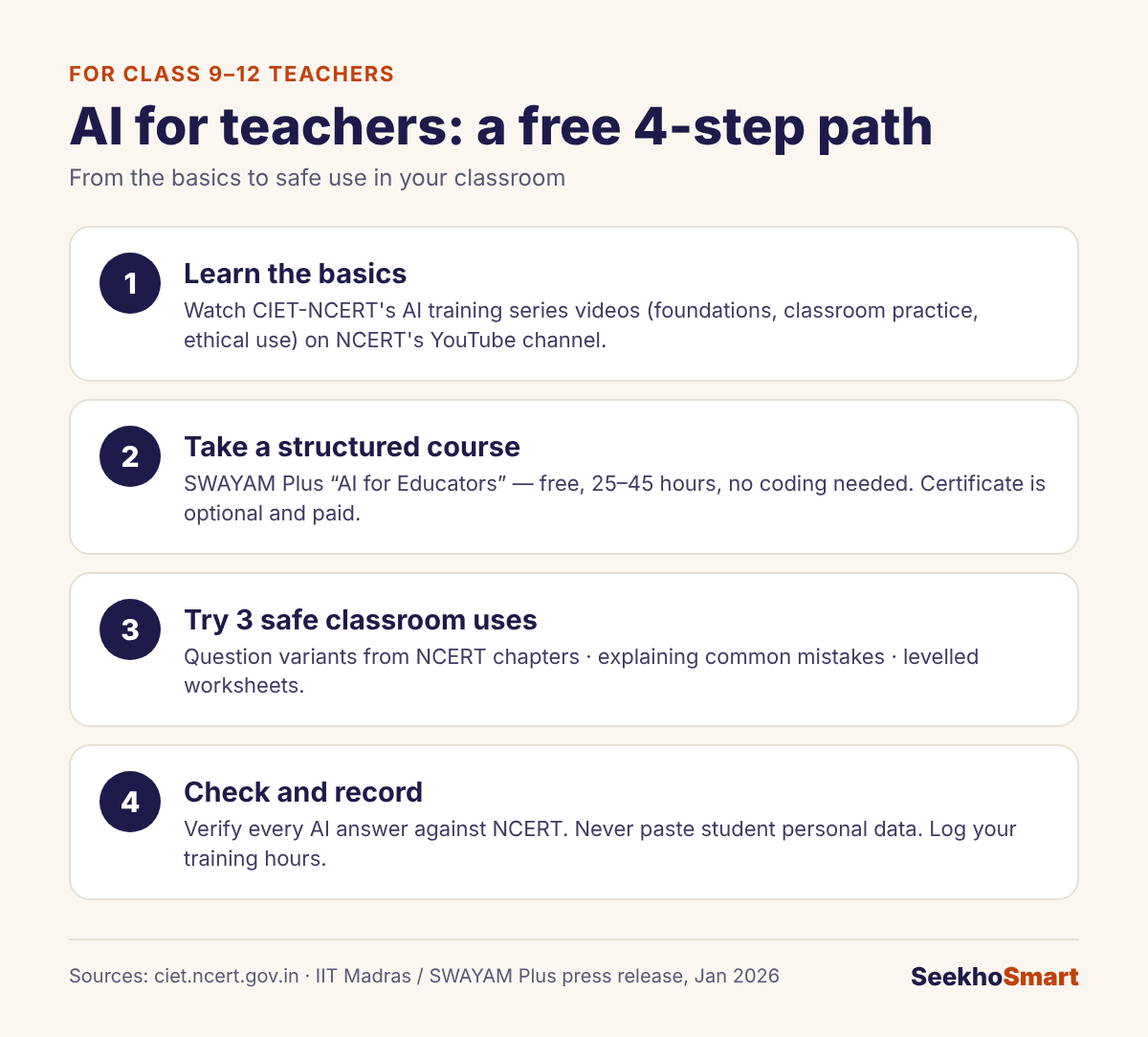
4. SWAYAM Plus: "AI for Educators"
For a longer, structured course, look at SWAYAM Plus. According to IIT Madras's January 2026 press release, the "AI for All" courses (including AI for Educators, built for aspiring and K–12 teachers) are:
- Free to access, each running 25–45 hours
- Open to beginners — no prior AI or coding knowledge needed
- Available in Hindi as well as English
- Certified only if you choose: certification is optional and paid, through an online proctored exam
The January 2026 batch's registration closed on 26 January 2026. The release also says the second edition, in September 2025, had over 50,000 registrations, so new batches do come up. Watch the SWAYAM Plus AI for All page for the next round.
What AI can (and can't) do for a Class 9–12 teacher
AI is a helper, not a replacement for your judgement. Used well, it saves time on routine work so you can spend more time on students.
Where it genuinely helps
- Question variants: turn one NCERT exercise question into three versions at different difficulty levels.
- Explaining mistakes: ask why a common wrong answer is wrong, then use that explanation in class.
- Differentiated worksheets: a basic sheet for students who need support, a stretch sheet for those who are ahead.
- Lesson starters: a real-life hook or a short quiz to open a chapter.
- Parent communication drafts: a clear, polite first draft that you then edit.
Where you must stay in charge
- Accuracy: AI tools can be confidently wrong. Check every fact, formula and answer against the NCERT textbook.
- Privacy: never paste students' names, marks, phone numbers or other personal details into a public AI tool.
- Assessment: don't let AI grade answer scripts on its own. Use it to draft a rubric, then mark yourself.
- Academic honesty: talk openly with students about when using AI is allowed and when it isn't.
A four-week plan to start using AI in your classroom
You don't need to change everything at once. Try this over one month.
Week 1: learn the basics
Watch the CIET-NCERT session videos on foundations and ethical use. Write down three tasks in your week that take the most time — for most teachers it's making question papers, worksheets and remedial material.
Week 2: one tool, one task
Pick a single task, such as making practice questions for the chapter you're teaching. Give the AI clear instructions: the class, subject, chapter, number of questions, difficulty and the format you want. Compare the output with NCERT and fix whatever is wrong. Note how much time it saved.
Week 3: try it with students
Use AI-made material in one class — for example, a levelled worksheet. Show students how you checked it against the textbook. This models good AI habits for them.
Week 4: review and share
Note what worked, what didn't, and how much time you saved. Share one tip in your department meeting. If your school tracks professional development hours, record the training you completed.
Simple prompts that work
- "Make 5 competency-based questions on Class 10 Science, Chapter: Light – Reflection and Refraction, with answers and one-line explanations. Use only NCERT content."
- "Explain why students often get this answer wrong: [paste the question and the common wrong answer]. Keep it under 100 words, for a Class 9 student."
- "Make two versions of this worksheet: one with hints for students who need support, one with an extra challenge question."
Always check the result before it reaches students.
How SeekhoSmart helps teachers support students outside class
The most time-consuming part of AI-assisted teaching is follow-up: giving every student enough practice and explaining each mistake one by one. SeekhoSmart can take some of that load. Your students get NCERT-aligned practice for Class 9–12, and every answer — including the wrong ones — comes with an AI explanation, so a student who misses a question at home understands why, without waiting for the next class. The adaptive daily study plan keeps each student practising the chapters where they need it most. It's free to start, so you can recommend it to the whole class.
Share SeekhoSmart with your students → seekhosmart.in
Frequently asked questions
Is there an AI for teachers course free in India?+
Yes. CIET-NCERT has run free AI training series for teachers with DIKSHA courses, and SWAYAM Plus offers a free 'AI for Educators' course for K–12 teachers. Certification on SWAYAM Plus is optional and paid.
What is the AI for Educators course on SWAYAM Plus?+
It is part of the IIT Madras-led 'AI for All' courses. It covers AI-enabled teaching strategies, assessment and student engagement, runs 25–45 hours, and needs no prior AI or coding knowledge.
How do I get a certificate from a DIKSHA AI course for teachers?+
For CIET-NCERT series, you join the linked DIKSHA course, complete all videos and score 70% or above in the final assessment, with up to three attempts. Check the deadline on the event page.
Can I use AI for teachers lesson plans?+
Yes, as a first draft. Give clear instructions about class, chapter and format, then check every fact against the NCERT textbook before using it.