If you teach Class 9 this year, you are doing something no teacher before you has done: teaching a full year with the new NCERT Class 9 textbooks built on NEP 2020 and NCF-SE 2023. The second parts of the Maths and Social Science books arrived only in late September, so many of us planned Term 1 from Part 1 and are now planning Term 2 almost from scratch.
This guide sums up what has changed, what is still evolving, and gives you a practical plan for the months ahead.
What's new in the Class 9 books this year
Mathematics: Ganita Manjari, in two parts
The new Maths book replaces the old 12-chapter textbook. According to Physics Wallah's summary, Part 1 has 8 chapters. Ganita Manjari – Part 2 became available from 21 September 2026 through NCERT sales counters, the NCERT website and Amazon (details here).
Social Science: Understanding Society – India & Beyond
Understanding Society: India & Beyond – Part 2 was scheduled to be available from 30 September 2026, per the same report. If your students are still using printouts or the PDF, plan for that in your homework and map work.
Science: Exploration
The Science book, Exploration: Textbook of Science for Grade 9, came out in April 2026 with 13 chapters, according to this chapter-by-chapter review. Points that matter for your planning:
- Reproduction has moved into Class 9 (Chapter 11).
- Earth as a System (Chapter 13) is a new Earth-science chapter.
- Mixtures and their separation is now a standalone chapter, and simple machines sit inside the Work and Energy chapter.
- Gravitation is folded into "How Forces Affect Motion".
The book also has built-in features you can use as ready-made classroom moments: Think It Over openers, Pause and Ponder checkpoints, Think as a Scientist investigations and Journey Beyond projects.
Note: these summaries come from education publishers. Before you finalise your plan, check chapter titles against the books on the NCERT website.
Why Class 9 matters for the 2028 boards
As Gulf News reported on the new CBSE scheme, Maths and Science will have two levels: a standard paper (80 marks, 3 hours) for all, and an optional advanced paper (25 marks, 1 hour) testing higher-order thinking. Advanced marks won't count in the aggregate, but scoring 50% or more gets noted on the marksheet. The first board exams under this system are for Class 10 in 2028 — which means your current Class 9 students. Computational thinking and AI are also compulsory in Classes 9 and 10.
So Term 2 is not just about finishing chapters. It's about building the reasoning habits these students will need for the advanced option next year.
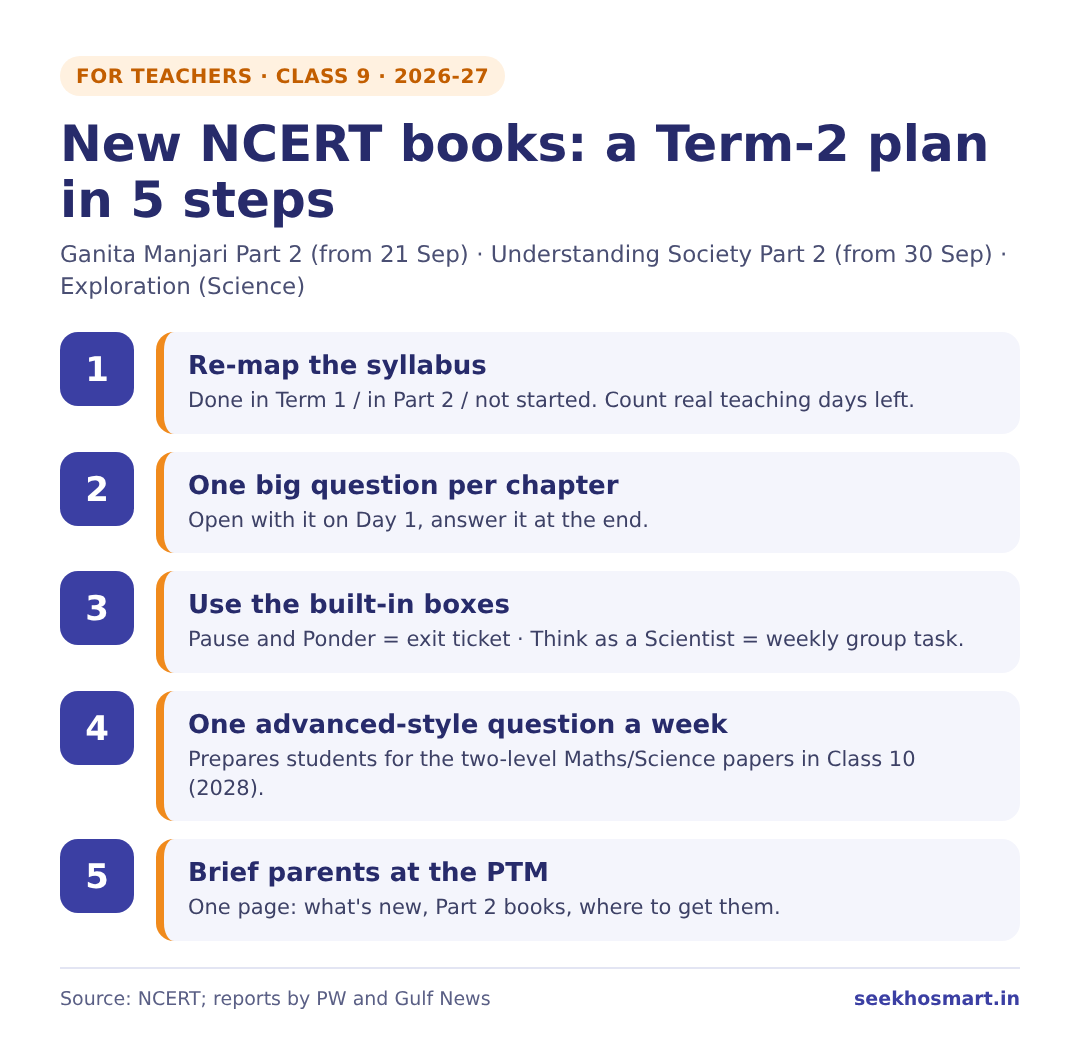
A Term-2 plan in five steps
Step 1: Re-map the syllabus this week
Put three columns on one sheet: chapters done in Term 1, chapters in Part 2, and chapters you have not started. Check it against your school's latest syllabus and the CBSE curriculum document for 2026-27. Then count your actual teaching days left after holidays, events and exams. Most of us overestimate them.
Step 2: Plan each chapter around one big question
The new books open chapters with questions rather than definitions. Use that. For each chapter, write one "big question" on the board on Day 1 (for example, "Why does a ball stop rolling?" for Forces and Motion) and come back to it at the end. Students remember chapters that answer a question they actually wondered about.
Step 3: Use the built-in boxes as your formative assessment
You don't need to make a fresh worksheet every day.
- Pause and Ponder → a 5-minute exit ticket.
- Think as a Scientist → a group task once a week.
- Journey Beyond → one project per term, ideally involving parents or the community, as the book suggests.
Record a simple ✓/✗ per student. Over a month, this gives you a clear picture of who needs help — without extra marking at home.
Step 4: Add one "advanced-style" question every week
Since the two-level paper is coming in 2028, give one stretch problem per week in Maths and Science: multi-step, unfamiliar context, or "explain why". Keep it optional at first. Watch who enjoys it; those are the students to nudge towards the advanced level next year.
Step 5: Share the plan with parents
Many parents studied from the old books and feel lost. A one-page note at the next PTM — what's new, which chapters are in Part 2, where to get the books — saves you dozens of confused messages.
Common challenges and quick fixes
| Challenge | Quick fix |
|---|---|
| Students don't have Part 2 yet | Use the NCERT PDF on the smartboard; share chapter links in the class group |
| Not enough time for activities | Do one activity per chapter well instead of all of them in a hurry |
| Few practice questions in the market | Build questions from the book's own Pause and Ponder and end-of-chapter exercises |
| Mixed-ability class | Same core question for all; extra "Ready to Go Beyond" task for faster learners |
| QR content needs devices | Play it once for the whole class on the projector |
How SeekhoSmart helps your Class 9 students practise
The hardest part of a new textbook year is giving every student enough practice — and enough explanation when they get it wrong — without adding hours to your evenings. SeekhoSmart offers NCERT-aligned practice your students can do at home after each chapter, and gives an AI explanation for every answer, including wrong ones, so a student who misreads a question learns why before the next class instead of after the test. Its adaptive daily study plan keeps each student working on their own weak spots, which helps in a mixed-ability class. It has a Hindi/English switch and is free to start, so there's no cost barrier for families.
Padhai, ab smart tareeke se.
Share SeekhoSmart with your students → seekhosmart.in
Frequently asked questions
What is the new NCERT textbook for Class 9 Maths?+
It is *Ganita Manjari*, published in two parts. Part 2 became available from 21 September 2026 through NCERT counters, the NCERT website and Amazon.
Is there a new NCERT textbook for Class 9 Social Science?+
Yes. *Understanding Society: India & Beyond* is the new Social Science book; Part 2 was scheduled for release from 30 September 2026.
What changed in the new NCERT Class 9 Science book?+
The new book, *Exploration*, has 13 chapters. Reproduction moves into Class 9, Earth-science content is new, and mixtures and simple machines get more space.
Where can I find the Class 9 new syllabus 2026-27?+
Check the CBSE academic website (cbseacademic.nic.in) for the 2026-27 curriculum, and download the textbooks from the NCERT website.