On 23 October 2026, NCERT released something new for every secondary student in India: an introductory module on Computational Thinking (CT) and Artificial Intelligence (AI) for Classes 9 to 12. If you have been searching "what is AI class 9" or "CT and AI module for class 9", this guide is for you.
Here is what the module actually covers, what it does not say yet, and how you can start learning from it this week without adding stress to your board-exam year.
What NCERT has released
The official title is An Introductory Module on Computational Thinking and Artificial Intelligence for Secondary Stage (Grades 9–12), as reported by iCBSE. It was developed by NCERT under the Ministry of Education and is aligned with NEP 2020.
A few things make it different from a normal textbook chapter:
- It is made for beginners. According to Education Bytes, no prior knowledge of any specific subject is needed. You don't have to be a "computer student" or know coding.
- It is activity-based, not mug-up-based. The module uses discussions, practical exercises, experiments and self-reflection.
- You don't need a laptop. NCERT says the activities "can be conducted with or without digital devices", as quoted in The Tribune's report. So students in schools with few computers can take part too.
NCERT's own one-line summary on social media was: "Think Smart. Create with AI. Learn Responsibly."
What's inside the module
Based on the reports we read, the module has three big ideas.
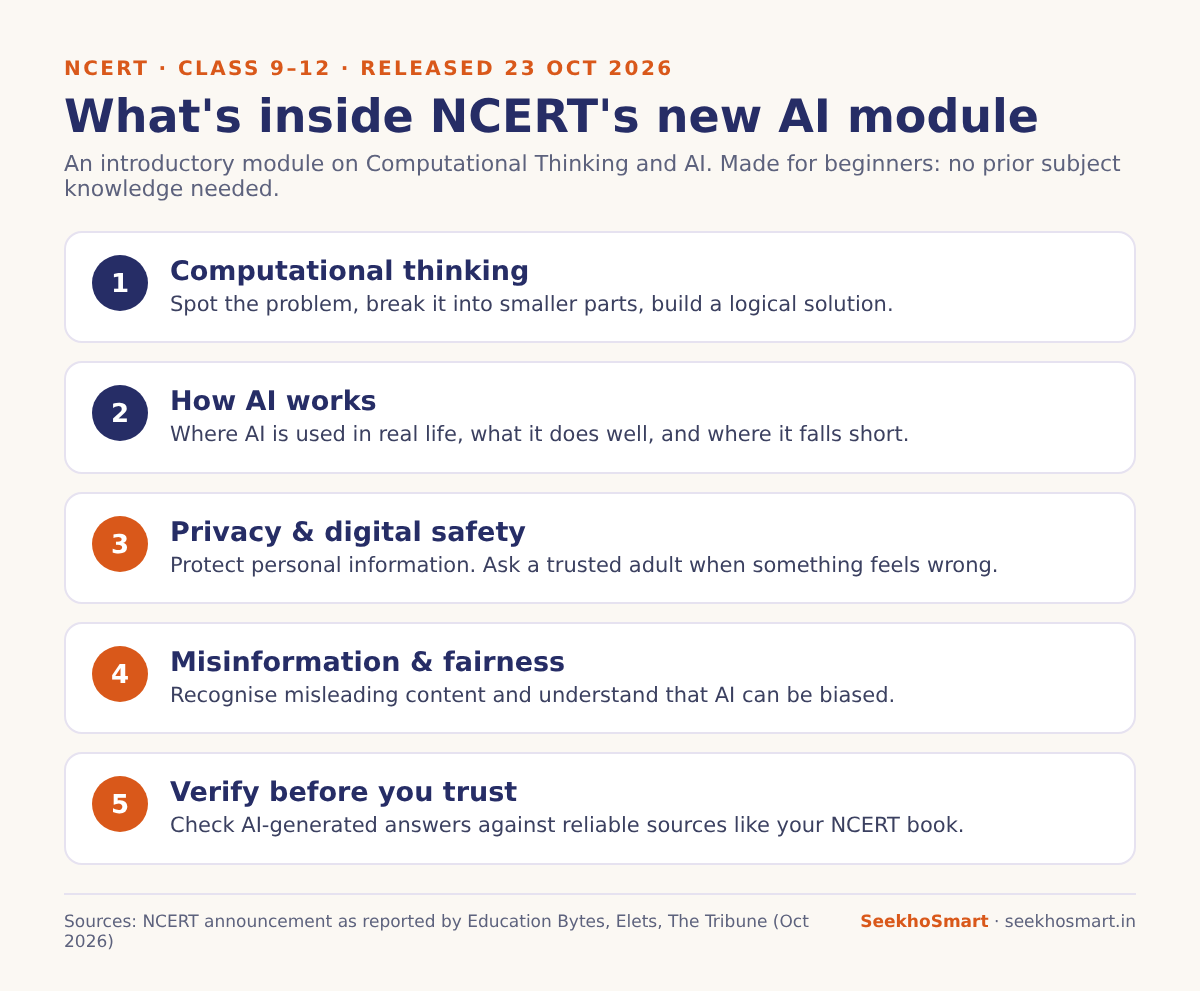
1. Computational thinking
CT is a step-by-step way of solving problems: spot the problem, break it into smaller parts, and build a logical solution. You already do this when you solve a long Maths sum or plan an answer for a 5-mark Science question. The module teaches you to do it on purpose.
2. How AI works, and where it fails
You will learn what AI is, where it is used in real life, what it is good at and where it falls short. The Tribune notes that the module uses Indian examples such as Aadhaar and UPI to show technology you already see around you.
3. Using AI safely and responsibly
This is the part every student should read twice. The module covers data privacy, misinformation, fairness, digital safety and checking AI-generated information before you trust it. In the foreword, NCERT Director Dinesh Prasad Saklani writes that "responsible and safe use of technology is woven throughout the module."
What we don't know yet
Be careful with WhatsApp forwards on this. The reports we checked (Elets, Education Bytes, The Logical Indian) do not say:
- whether the module is compulsory or optional,
- how many hours or periods it will take, or
- whether it will be tested in board exams.
So don't panic. Nothing in these reports changes your 2027 board-exam syllabus. Treat this module as a skill-builder, and wait for your school or CBSE/state board to tell you how it will be used in your class.
Not the same as the AI skill subject. CBSE already offers Artificial Intelligence (code 417) as a skill subject. For Class 10 in 2026–27, the CBSE curriculum document gives it 100 marks: 50 theory and 50 practical, including a practical file and project work. The new NCERT module is a separate introduction for everyone.
How to learn from the module (without stealing time from boards)
You are already busy with half-yearly exams and pre-board preparation. Here is a light plan that fits in 20–30 minutes, two or three times a week.
Step 1: Get the official copy
Download the module only from NCERT's website. Education Bytes links to the official module PDF and NCERT's press release. Avoid "PDF download" sites that ask for your phone number.
Step 2: Practise CT on your own subjects
Pick one tough question from Maths or Physics. Before solving it, write down:
- What is the question really asking?
- What smaller steps does it break into?
- Which formula or idea fits each step?
- Does my final answer make sense?
That's computational thinking in four lines. Doing this regularly also makes your board answers clearer and better structured.
Step 3: Do one "AI fact-check" a week
Ask any AI chatbot a question from your NCERT chapter, for example "Why does the Sun appear reddish at sunrise?" Then open your NCERT textbook and compare. Mark what the AI got right, what it missed and what it made up. This is exactly the "verify AI-generated information" habit the module wants you to build.
Step 4: Protect your data
Before typing into any app or chatbot, follow a simple rule: no full name with school, no phone number, no Aadhaar number, no photos of your marksheet. If something online feels wrong or scary, the module's advice is clear: talk to a trusted adult.
Step 5: Keep AI as a helper, not a ghost-writer
Use AI to explain a concept you didn't understand, or to quiz you. Don't use it to write your project or homework for you. In the exam hall you will be alone with your pen, so the understanding has to be yours.
Why this matters for your future
CBSE has already started Computational Thinking and AI for Classes 3 to 8 from the 2026–27 session, launched by the Union Education Minister on 1 April 2026 (PIB release). Your younger siblings will grow up with it. This new NCERT module makes sure Class 9–12 students don't miss out.
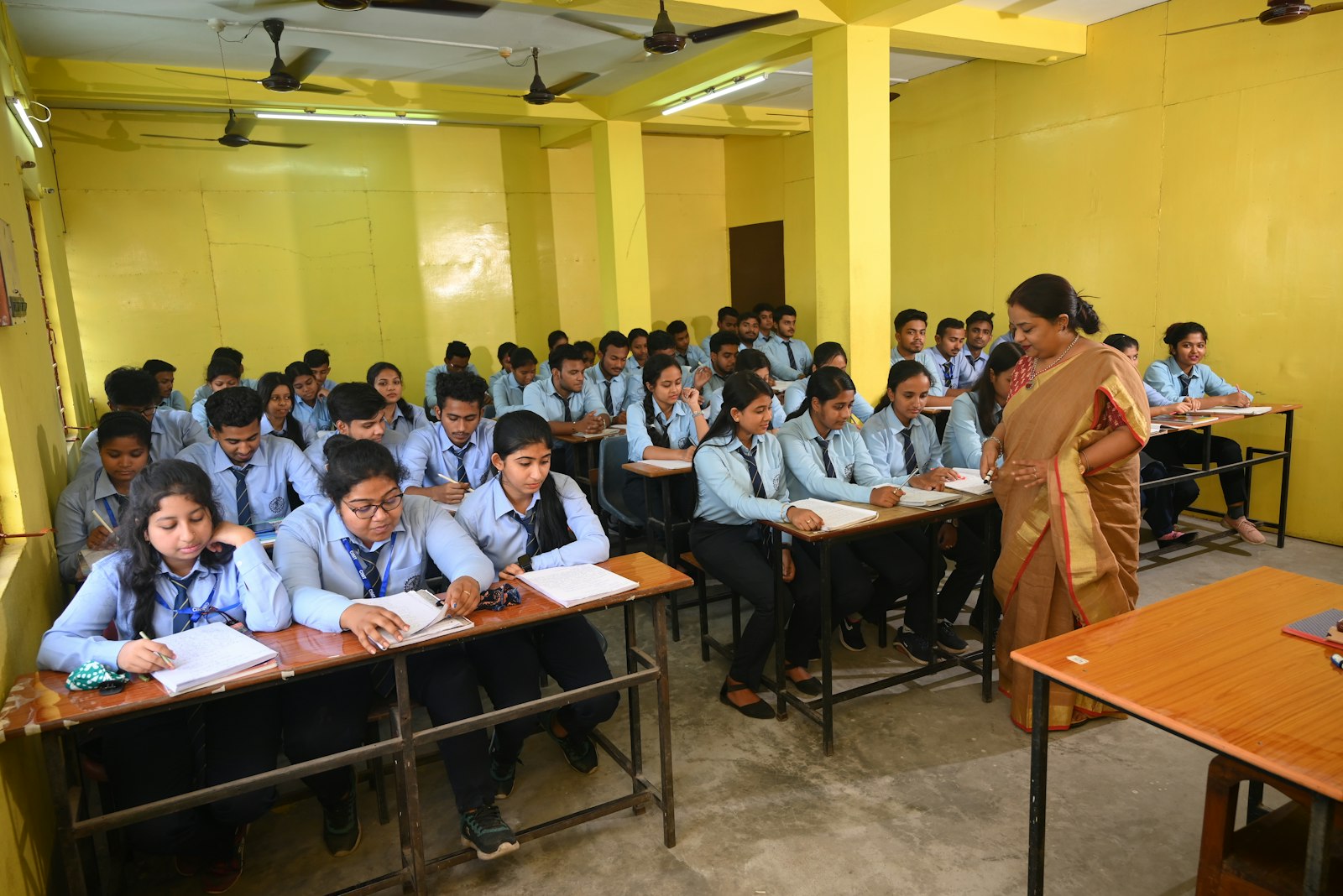
Whether you plan to take Science, Commerce or Humanities, knowing how to break down problems and how to question AI answers will help you in college and at work. Start small, stay curious, and keep your board preparation at the centre.
How SeekhoSmart helps you practise smart alongside the AI module
The module teaches you to break problems into steps and to check every answer. SeekhoSmart lets you practise exactly that on your board syllabus. Its AI explanations cover every answer, including the ones you get wrong, so you can see why a step failed instead of just copying a solution. Its NCERT-aligned practice keeps AI help tied to your actual textbook, not random internet content. And the adaptive daily study plan fits short practice sessions around your school timetable, so learning new skills doesn't eat into revision time. Switch between Hindi and English whenever you like.
Padhai, ab smart tareeke se.
Try SeekhoSmart free → seekhosmart.in
Frequently asked questions
What is AI in the new Class 9 NCERT module?+
It is an introduction to how artificial intelligence works, where it is used and where it fails, taught together with computational thinking and responsible use such as privacy and checking AI answers. It is designed for beginners with no prior knowledge.
Is the CT and AI module for Class 9 compulsory?+
The reports on the 23 October 2026 release do not say whether it is compulsory, how many periods it takes or whether it is examined. Wait for your school or board to share how it will be used.
Where can I get the computational thinking and AI CBSE Class 9 PDF?+
Download it only from NCERT's official website. Education Bytes links to the module PDF at ncert.nic.in. Avoid third-party sites that ask for your phone number.
Is there a free AI for students to study with?+
Many AI tools have free versions. Whatever you use, follow the module's advice: try the question yourself first, check AI answers against your NCERT book and never share personal details.
- NCERT CT and AI module for Grades 9-12 (iCBSE)
- NCERT CT & AI module (Education Bytes)
- NCERT launches AI, computational thinking module (The Tribune via PressNewsAgency)
- NCERT develops AI and CT module for classes 9 to 12 (Elets digitalLEARNING)
- NCERT introduces CT and AI module (The Logical Indian)
- CBSE Artificial Intelligence (417) Class X curriculum 2026-27
- NCERT module PDF (official)
- NCERT press release (official)
- PIB: CBSE CT & AI curriculum for Classes 3-8
- SeekhoSmart (infographic)
- Sanket Mishra / Unsplash
- CIMT HOOGHLY / Unsplash