Physics is the subject many Class 12 students fear most — long derivations, tricky numericals, and a lot of chapters. But here is the good news: the syllabus is fixed, the marks are known, and you have roughly three and a half months before the board exam. If you know where the marks are, you can plan your time instead of guessing.
This guide breaks down the CBSE Class 12 Physics syllabus for 2026-27, shows how the 70 theory marks are spread across the units, explains the 30 practical marks, and gives you a simple 14-week plan to the board exam.
Where things stand right now
- The theory exams are expected to start in February 2027. Careers360's 2027 board exam page says the official date sheet is still awaited, and lists Class 12 exams for February–April 2027.
- Practicals come before theory. The same page lists Class 12 practicals in November–December 2026 for winter-bound schools and January–February 2027 for other schools. Ask your school for your exact practical dates.
- The paper is 70 marks of theory plus 30 marks of practicals. The unit-wise split is below.
Always confirm the final syllabus and dates on CBSE's official academic website, cbseacademic.nic.in, and on cbse.gov.in once the date sheet is released.
Class 12 Physics syllabus 2026-27: unit-wise marks
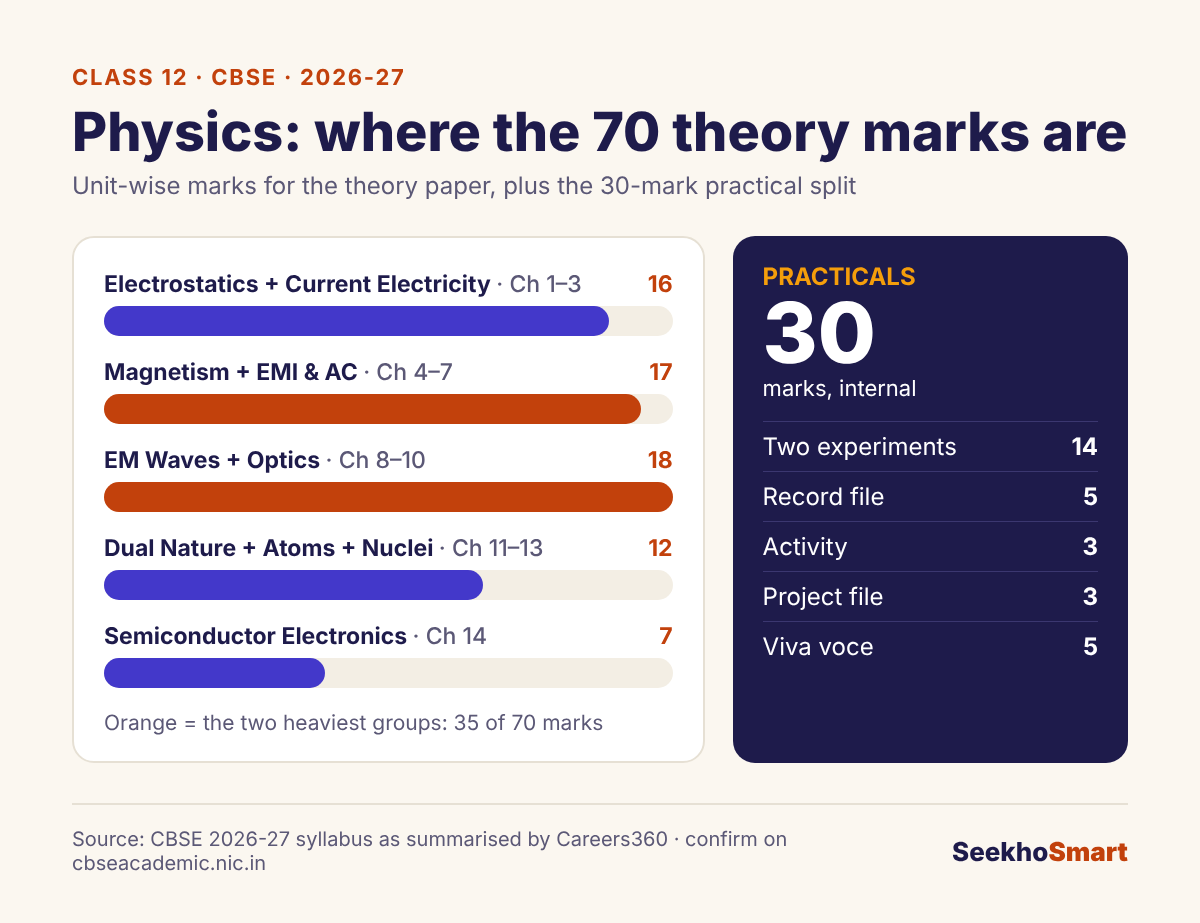
According to Careers360's summary of the 2026-27 Physics syllabus, the 70 theory marks are grouped like this:
| Units | Chapters (NCERT) | Marks |
|---|---|---|
| I–II: Electrostatics; Current Electricity | Ch 1 Electric Charges and Fields, Ch 2 Electrostatic Potential and Capacitance, Ch 3 Current Electricity | 16 |
| III–IV: Magnetic Effects of Current and Magnetism; EMI and AC | Ch 4 Moving Charges and Magnetism, Ch 5 Magnetism and Matter, Ch 6 Electromagnetic Induction, Ch 7 Alternating Current | 17 |
| V–VI: Electromagnetic Waves; Optics | Ch 8 Electromagnetic Waves, Ch 9 Ray Optics and Optical Instruments, Ch 10 Wave Optics | 18 |
| VII–VIII: Dual Nature; Atoms and Nuclei | Ch 11 Dual Nature of Radiation and Matter, Ch 12 Atoms, Ch 13 Nuclei | 12 |
| IX: Electronic Devices | Ch 14 Semiconductor Electronics | 7 |
| Total | 14 chapters | 70 |
What these numbers tell you
- Optics and EM Waves (18 marks) and Magnetism plus EMI/AC (17 marks) together carry 35 marks — half the theory paper. These deserve the most practice time.
- Electrostatics and Current Electricity (16 marks) come first in the book and set up a lot of later ideas. If these are weak, fix them early.
- Modern Physics — Dual Nature, Atoms, Nuclei (12 marks) — and Semiconductors (7 marks) are shorter and more direct. Many students find them the quickest marks to secure.
The 30 practical marks
Practicals are internal, but they are real marks. The same Careers360 page lists this split:
- Two experiments: 14 marks (7 each)
- Practical record file: 5 marks
- One activity: 3 marks
- Investigatory project file: 3 marks
- Viva voce: 5 marks
Your record file, project and viva add up to 13 marks that depend mostly on preparation, not luck. Complete your file neatly now, write the theory and precautions for each experiment in your own words, and practise explaining your project out loud in two minutes. Remember that you have to pass theory and practical separately, so don't treat practicals as an afterthought.
How to study physics so it sticks
Before the plan, a word on method. Reading the chapter again and again feels productive, but physics marks come from solving, not reading.
Use a three-step loop for every chapter
- Understand: read the NCERT chapter once with a pen. Note every formula and the conditions in which it applies.
- Derive: close the book and write each derivation from memory. Where you get stuck is exactly what you need to revise.
- Apply: solve the NCERT in-text examples and exercise questions, then previous-year questions on that chapter.
Keep a formula sheet and a mistake log
One page per unit for formulas, units and sign conventions. One notebook where you write every mistake you make — the wrong step, why it was wrong, and the correct step. Re-read the mistake log every Sunday. Most students repeat the same five or six mistakes; the log catches them.
Important derivations to practise
Students often search for class 12 physics important derivations. Instead of chasing lists, use the NCERT book itself: every derivation worked out in the chapter text is fair game. Write each one at least three times across the next three months.
A 14-week plan to the board exam
If the exam starts in mid-February, you have about 14 weeks. Here's one way to use them. Adjust it around your practicals and pre-boards.
Weeks 1–5: finish and fix (unit by unit)
- Week 1: Electrostatics (Ch 1–2)
- Week 2: Current Electricity (Ch 3) and your practical file
- Week 3: Magnetism (Ch 4–5)
- Week 4: EMI and AC (Ch 6–7)
- Week 5: EM Waves and Ray Optics (Ch 8–9)
Weeks 6–8: complete the book
- Week 6: Wave Optics (Ch 10) and Dual Nature (Ch 11)
- Week 7: Atoms and Nuclei (Ch 12–13)
- Week 8: Semiconductor Electronics (Ch 14) plus a full revision of your formula sheets
Weeks 9–11: previous-year questions by chapter
Solve PYQs chapter by chapter, starting with the heaviest unit groups. Mark every question you get wrong and add it to your mistake log. This is where most students gain the biggest jump in marks.
Weeks 12–14: full papers under time
Do at least one full 3-hour paper every week, then two a week in the final fortnight. After each paper, spend as long checking it as you spent writing it. Look for patterns: are you losing marks on units, diagrams, or steps?
A simple daily routine
- 60–90 minutes of new work or practice
- 15 minutes of derivations from memory
- 10 minutes of formula-sheet revision before sleeping
Short, daily, and consistent beats a 6-hour Sunday marathon.
Common mistakes that cost marks
- Skipping units in final answers — an answer without the SI unit can lose marks.
- Diagrams without labels in optics and semiconductors.
- Sign errors in ray optics and electrostatics — note the sign convention on your formula sheet.
- Only reading solutions instead of attempting the question first.
- Leaving Modern Physics for the end — it is scoring; don't rush it in the last week.
How SeekhoSmart helps with Class 12 Physics revision
The plan above has two hard parts: finding the right previous-year questions for each chapter, and understanding why you got a question wrong. That's what SeekhoSmart is built for. Its 10-year PYQ bank is tagged by chapter, so in Weeks 9–11 you can open "Ray Optics" or "Current Electricity" and practise only those questions. Every answer comes with an AI explanation — including for the ones you got wrong — so your mistake log fills itself with the right reasoning. And the adaptive daily study plan adjusts to the chapters where you're weakest, so your 60–90 minutes go where they're needed. It's NCERT-aligned and free to start. Padhai, ab smart tareeke se.
Start your Physics revision free → seekhosmart.in
Frequently asked questions
What is the Class 12 Physics syllabus 2026-27 for CBSE?+
It has 14 NCERT chapters in nine units, from Electric Charges and Fields to Semiconductor Electronics. The theory paper is 70 marks and practicals are 30 marks. Confirm the final PDF on cbseacademic.nic.in.
Which are the most important chapters in Class 12 Physics?+
By marks, EM Waves plus Optics (18) and Magnetism plus EMI and AC (17) carry 35 of the 70 theory marks, so give them the most practice. Modern Physics (12) and Semiconductors (7) are shorter and very scoring.
How should I prepare Class 12 Physics important derivations?+
Use the derivations worked out in the NCERT chapter text. Write each one from memory at least three times before the exam and note where you get stuck.
How to study physics for the board exam in 3 months?+
Finish and fix chapters unit by unit for about eight weeks, then solve previous-year questions chapter by chapter, and in the last three weeks write full 3-hour papers every week.
- SeekhoSmart (infographic)
- Kchava / Wikimedia Commons (CC BY-SA 4.0)
- Ashstar01 / Wikimedia Commons (CC BY-SA 3.0)