It's the end of October. Half-yearlies are done, pre-boards are coming, and the board exam is no longer "next year" — it's a few months away. If you are in Class 12 and wondering whether three months is enough, here is the honest answer: yes, if you use them well. Three months is enough to finish what's left, practise properly and walk into the exam hall calm.
This guide gives you a week-by-week plan, a daily routine and subject-wise tips. It is written for CBSE students, but state board students can use the same plan with their own board's dates.
Where things stand right now
Before you plan, know the dates you can rely on — and the ones that are still guesses.
- The 2027 date sheet is not out yet. As of Careers360's live update (24 September 2026), CBSE had not published the 2027 timetable. Based on past years, the Class 10 and 12 exams are expected to begin between February and March 2027.
- Last year's pattern is a useful guide. The 2026 exams for both classes began on 17 February 2026, and Class 12 ended on 9 April 2026.
- Practicals come first. The same Careers360 page says Class 12 practicals are expected in November–December 2026 for winter-bound schools and January–February 2027 for other schools.
- Passing rule: you need 33% in each subject, and you must pass theory and practical separately.
If 2027 looks anything like 2026, your first theory paper is roughly 16 weeks away. Practicals, pre-boards and festivals will take some of that time. So plan for 12 focused weeks and treat the rest as buffer. Always confirm the final dates on cbse.gov.in (or your state board's website) once they are released.
Before you start: a two-day audit
Don't jump straight into studying. Spend two days finding out where you actually stand.
Make a chapter list for every subject
Take the NCERT textbook for each subject and write every chapter on one page. This becomes your master list for the next three months.
Mark each chapter green, yellow or red
- Green: you can solve most questions without help.
- Yellow: you understand it but make mistakes.
- Red: not studied yet, or you feel lost.
Be honest. A red chapter that you mark yellow will hurt you in February.
Download the 2026-27 sample papers
CBSE has published 2027 sample question papers for Classes 10 and 12 on cbseacademic.nic.in. Look at one paper per subject now — not to solve it, just to see the question types and marks.
The 12-week plan
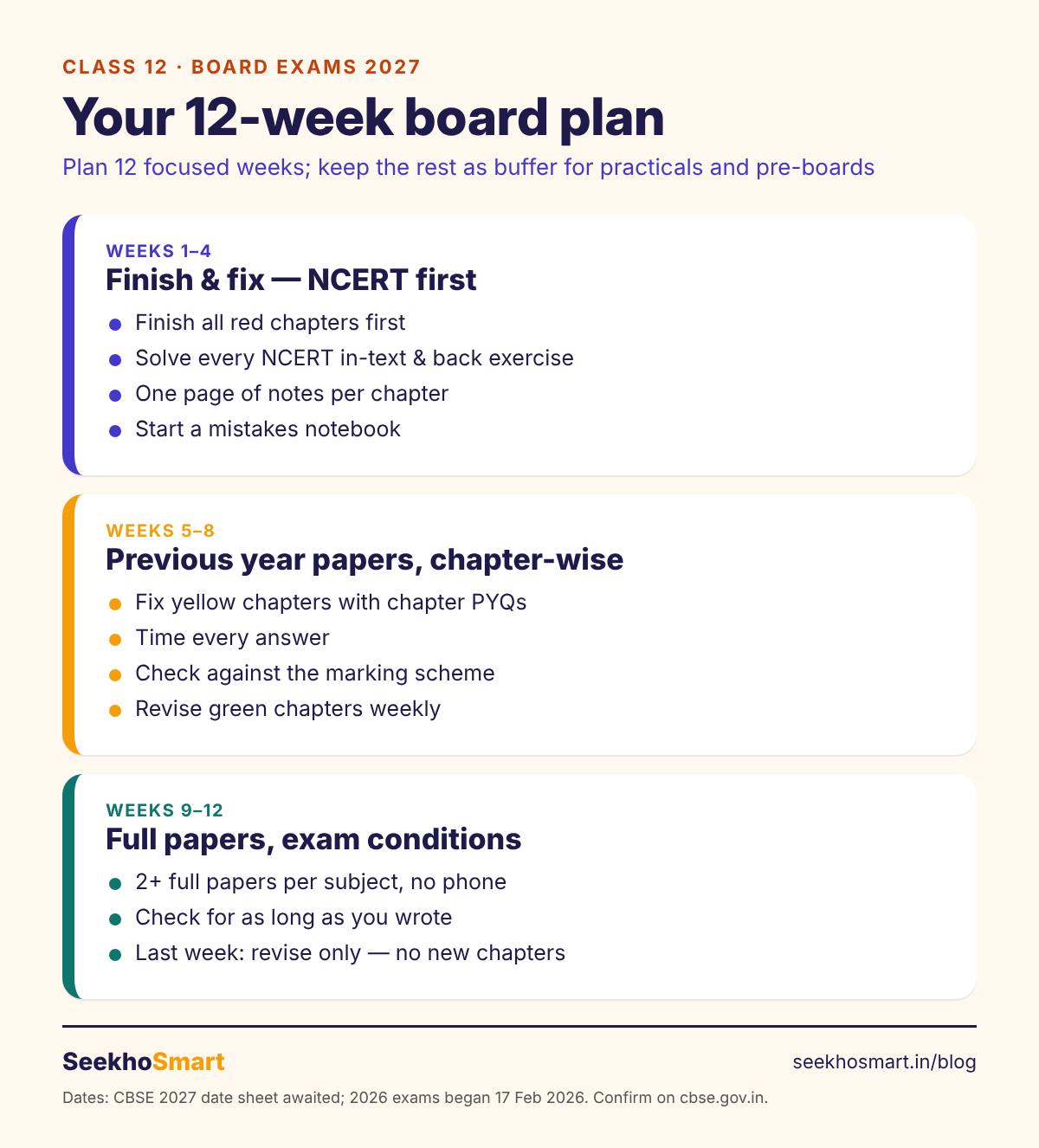
Weeks 1–4: Finish and fix (NCERT first)
- Finish every red chapter first. One chapter a day per subject is too fast; aim for two or three chapters a week per subject.
- Read the NCERT chapter, then solve every in-text question and back exercise. Most board questions are built on NCERT content.
- Make one page of short notes per chapter: formulas, definitions, diagrams, key dates. You'll revise from these later.
- Keep one "mistakes notebook". Every time you get something wrong, write the question and the correct reason.
Weeks 5–8: Previous year papers, chapter by chapter
- Now pick up the yellow chapters. For each one, solve previous years' questions (PYQs) from that chapter only.
- Time yourself. If a 3-mark answer takes you 12 minutes, that is the thing to fix.
- Check answers against the marking scheme, not just the final answer. Steps, units, labelled diagrams and keywords carry marks.
- Revise your green chapters once a week so they stay green.
Weeks 9–12: Full papers under exam conditions
- Solve at least two full sample or previous papers per subject. Sit for the full time, with no phone and no breaks.
- After each paper, spend as long checking it as you spent writing it. Add every mistake to your notebook.
- In the last week before each exam, only revise: short notes, mistakes notebook, formula sheets. No new chapters.
A daily routine that fits school, tuition and sleep
You don't need 14 hours a day. You need steady, focused hours every day.
| Time block | What to do |
|---|---|
| Morning (45–60 min) | Revise yesterday's notes or formulas — fresh mind, quick recall |
| After school (2 hours) | Main study: one tough subject, new or red chapter |
| Evening (1.5 hours) | Practice: PYQs or a timed section of a paper |
| Night (30 min) | Mistakes notebook + plan tomorrow's three tasks |
On holidays, add one full paper in the morning. And protect your sleep — 7 to 8 hours. Tired brains forget faster and make silly mistakes.
Subject-wise tips
Science stream
Know the paper pattern. For example, the Class 12 Physics paper described on the Careers360 page carries 70 marks for theory and 30 for practical and internal assessment. It has 33 questions: 16 of one mark, 5 of two marks, 7 of three marks, 2 of four marks and 3 of five marks. That tells you where the marks are. Practise five-mark derivations and numericals in full, with every step written. For Chemistry, revise named reactions and NCERT in-text questions. For Biology, practise labelled diagrams.
Commerce stream
Accountancy needs daily practice; even 45 minutes of questions a day keeps your speed up. In Economics and Business Studies, learn to write in points with headings — examiners mark faster and more fairly when the structure is clear.
Humanities stream
Answer-writing matters most. Practise writing a full answer within the word limit, with an introduction line, three or four points and a one-line conclusion. Use maps and timelines in History and Geography wherever they fit.
Mistakes that cost marks in the last three months
- Collecting too many books. NCERT plus PYQs plus sample papers is enough for most students.
- Skipping practicals. You must pass practicals separately, so prepare your file and viva on time.
- Only reading, never writing. Board exams test writing speed. Write answers, don't just read them.
- Ignoring your mistakes. The same mistake repeated in three mock papers will appear in the final paper too.
- Comparing with friends. Their plan is not your plan. Follow your green-yellow-red list.
How SeekhoSmart helps with your 3-month board plan
The hardest parts of this plan are the middle weeks: finding previous years' questions chapter by chapter and knowing why you got one wrong. SeekhoSmart helps with exactly that. Its 10-year PYQ bank is tagged by chapter, so in Weeks 5–8 you can open "Electrostatics" or "Partnership Accounts" and practise only those questions. Every answer comes with an AI explanation — including the ones you got wrong — so your mistakes notebook writes itself. And the adaptive daily study plan tells you what to revise each day, so your green chapters stay green while you fix the red ones. It's NCERT-aligned and works in Hindi or English.
Padhai, ab smart tareeke se.
Try SeekhoSmart free → seekhosmart.in
Frequently asked questions
When is the Class 12 board exam 2027 expected to start?+
CBSE has not announced the date yet. Based on past years, the exams are expected to begin between February and March 2027. In 2026, they began on 17 February. Check cbse.gov.in for the official date sheet.
Is the CBSE date sheet 2027 for Class 12 out?+
Not yet, as of the latest reports we checked. The Class 12 date sheet was expected around October–November 2026. Don't trust "tentative" PDFs shared on WhatsApp; use only the official website.
How many months does it take to prepare for the board exam?+
There is no fixed number. If you have attended classes through the year, three focused months — finishing NCERT, practising PYQs and then full papers — is enough for most students.
When are CBSE Class 12 practicals in 2027?+
They are expected in November–December 2026 for winter-bound schools and January–February 2027 for other schools. Your school will share the exact schedule.
- SeekhoSmart (infographic)
- Ashstar01 / Wikimedia Commons (CC BY-SA 3.0)
- Yann / Wikimedia Commons (CC BY-SA 4.0)