You sat with the chapter for two hours. You underlined, you highlighted, you even made notes. Three days later, in the half-yearly paper, the answer just… isn't there.
If this has happened to you, you are not "weak" and you are not alone. Forgetting is how the brain normally works. The good news is that a few changes in how you study can make what you learn stay for weeks and months, right up to your board exams. This guide shows you exactly what to do, step by step, with your NCERT books and a normal school timetable.
Why you forget what you study
Most of us study by re-reading. It feels productive because the page looks familiar. But familiar is not the same as remembered. In the exam hall, nobody shows you the page. You have to pull the answer out of your own head.
Memory researchers have studied this for more than a century. Two findings matter most for students:
- The testing effect (also called retrieval practice or active recall). Long-term memory gets stronger when part of your study time is spent pulling information out of memory instead of putting it in again. Research summarised on the testing effect page describes it as using testing "not as an assessment tool, but as a teaching tool", and notes that retrieval practice produces less forgetting than studying and restudying.
- The spacing effect. Learning works better when study sessions are spread out over days instead of crammed into one sitting. The idea goes back to Hermann Ebbinghaus in 1885, and later studies found that spaced practice beats massed practice (cramming), especially when gaps last days or weeks. You can read a summary on the spacing effect page.
Put simply: test yourself, and do it again after a gap. That's the whole secret. The rest of this post turns it into a routine you can actually follow.
The 5-step system to study without forgetting
Step 1: Learn the chapter in small pieces
Don't try to "finish" a full chapter in one go. Break it into 3–5 parts using the NCERT headings. For each part:
- Read it once, slowly, with full attention. Phone in another room.
- Close the book.
- Say or write, in your own words, what you just read. Keep it rough.
- Open the book and check what you missed.
That small "close the book" moment is your first retrieval. It feels harder than re-reading, and that's exactly why it works.
Step 2: Turn notes into questions
Instead of writing notes as statements, write them as questions. For example:
- Not "Ohm's law: V = IR", but "What does Ohm's law say, and when does it fail?"
- Not "Causes of the French Revolution", but "Give three causes of the French Revolution with one example each."
Write the questions on the left side of your notebook and keep the answers hidden on the right. Now your notebook becomes a self-test, not a storybook.
Step 3: Revise on a schedule, not on a mood
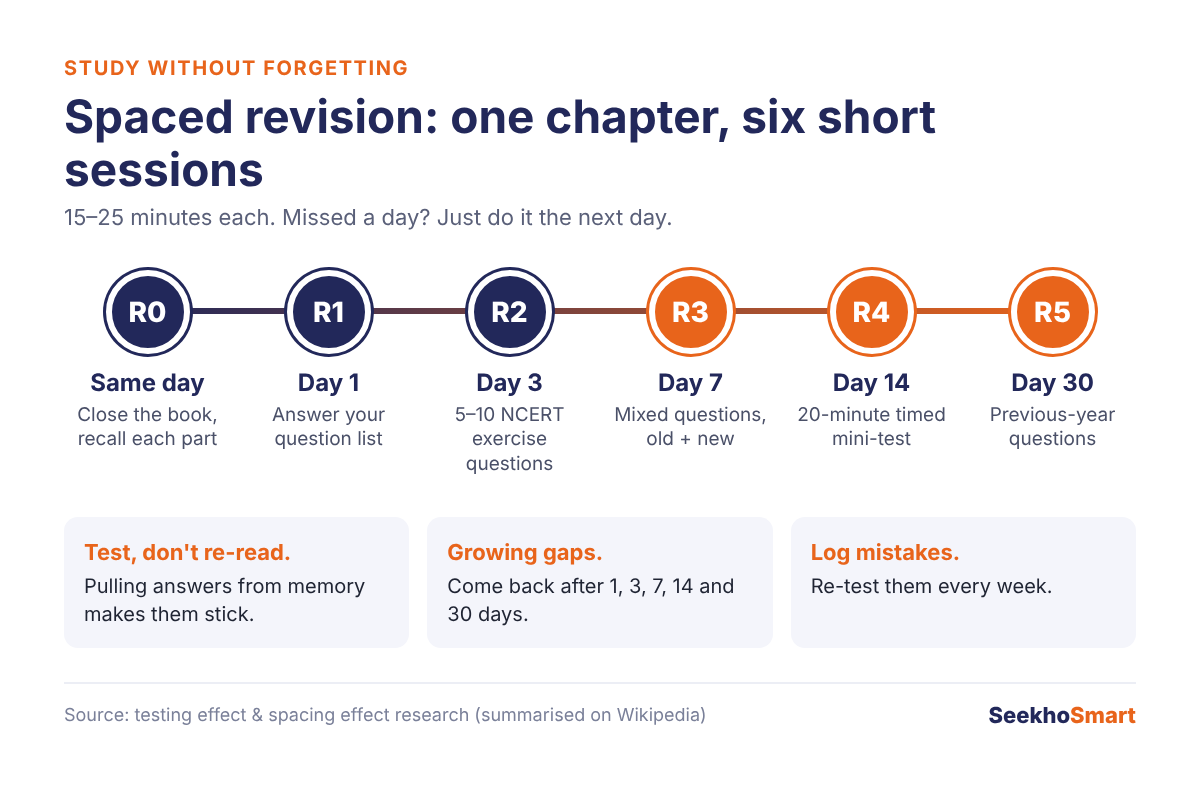
This is where spacing comes in. After you first study a chapter, test yourself on it again after a gap. A simple schedule that works for most students:
| Revision | When | What to do (15–25 min) |
|---|---|---|
| R0 | Same day | Close-the-book recall after each part |
| R1 | Next day | Answer your question list without looking |
| R2 | Day 3 | Solve 5–10 NCERT exercise or back-exercise questions |
| R3 | Day 7 | Mixed questions from this and older chapters |
| R4 | Day 14 | Timed mini-test (20 minutes) |
| R5 | Day 30 | One previous-year question set for the chapter |
You don't need perfect dates. If you miss Day 3 and do it on Day 4, fine. What matters is that you come back to the chapter several times, with growing gaps.
Tip: Keep a simple "revision calendar" on one page. Write each chapter's name on the day it is due. In five minutes every evening, you'll know exactly what to revise tomorrow.
Step 4: Mix your practice
When you practise only one type of question at a time (say, 20 questions on quadratic equations), you get fast but you stop thinking about which method to use. In the real paper, questions are mixed.
Studies summarised on the spacing effect page found that mixing problem types helped students learn when to apply each formula. So from R3 onwards, mix chapters: one question from Polynomials, one from Triangles, one from Statistics. It will feel slower. Your marks will thank you.
Step 5: Keep a mistake log
Every wrong answer is a free lesson. Keep one notebook (or the back pages of your rough copy) for mistakes only. For each one, write:
- The question (or chapter + question number)
- What I wrote
- Why it was wrong: concept gap, silly calculation, misread question, or didn't know the format
- The correct idea in one line
Re-test yourself on the mistake log every week. Research on retrieval practice also notes that feedback helps learning. Checking why you were wrong is that feedback.
A sample week for a Class 10 student
Here is how this looks in a real week with school, tuition and a little rest. Change it for your own subjects and stream.
- Monday: New Science topic (45 min) + R1 of Sunday's Maths chapter (20 min)
- Tuesday: New SST chapter part (40 min) + R2 of last week's Science (20 min)
- Wednesday: Maths practice, mixed (45 min) + mistake log review (10 min)
- Thursday: New English/Hindi lesson (30 min) + R3 mixed questions (25 min)
- Friday: New Maths topic (45 min) + R1 of Thursday's lesson (15 min)
- Saturday: 60-minute mixed mock from 3 subjects + check answers
- Sunday: Light day. R4/R5 for chapters due + plan next week's calendar
Notice that every day has some new learning and some revision. That balance is what stops the "I studied it but forgot it" problem.
Common mistakes that make you forget
- Highlighting everything. If the whole page is yellow, nothing stands out. Highlight less, test more.
- Studying with the phone next to you. Every notification breaks your attention, and attention is the first step of memory.
- All-night cramming before tests. You may remember it the next morning, but it fades fast. Spaced revision lasts longer.
- Only solving questions you already know. Spend more time on the questions that feel uncomfortable.
- Skipping sleep. Keep a regular sleep time, especially in exam weeks. A tired brain finds it much harder to recall.
What to do the night before an exam
Even with a good system, the last night matters. Keep it calm:
- Go through your question list and mistake log only. Don't open new topics.
- Do one short timed set of mixed questions.
- Write down 5 formulas or key points you fear forgetting. Read them once more in the morning.
- Sleep at your normal time.
How SeekhoSmart helps you remember what you study
The hardest part of this system is not knowing what to do. It's doing it consistently and knowing what to revise when. SeekhoSmart is built for exactly that. Its adaptive daily study plan brings chapters back for revision so you don't have to maintain the calendar yourself. Its NCERT-aligned practice and 10-year PYQ bank, tagged by chapter, give you ready questions for R2–R5 and mixed practice. When you get something wrong, its AI explanation of every answer, including the wrong ones, tells you why, which works like a mistake log that fills itself in. You can switch between Hindi and English whenever you like.
Padhai, ab smart tareeke se.
Try SeekhoSmart free → seekhosmart.in
Frequently asked questions
How can I study without forgetting anything?+
You can't stop all forgetting, but you can slow it down a lot. Test yourself instead of re-reading, revise each chapter after growing gaps (next day, day 3, day 7, day 14, day 30) and keep a mistake log you re-test every week.
How do I remember what I study the night before a test?+
Don't start new topics. Go through your question list and mistake log, do one short timed set of mixed questions, note five key points to glance at in the morning, and sleep at your usual time.
What is active recall (active recall kya hota hai)?+
Active recall means pulling an answer out of your memory without looking, for example closing the book and explaining a topic, or answering questions from your notes. Research on the testing effect shows it beats re-reading for long-term memory.
How can I study fast without forgetting for exams?+
Study in short focused blocks with your phone away, turn notes into questions, and spend more time on questions you get wrong. Short, spaced sessions save time overall because you re-learn less later.
- SeekhoSmart (infographic)
- Yann Forget / Wikimedia Commons (CC BY-SA 4.0)
- Ashstar01 / Wikimedia Commons (CC BY-SA 3.0)