If you are in Class 12 and dream of an engineering seat, the next few weeks matter more than you think. NTA has already put JEE Main 2027 Session 1 on its calendar, and the registration form is expected to open soon. Students who have their documents ready finish the form in one calm sitting. Students who don't often lose a whole evening to "photo size too large" errors and spelling mismatches.
This guide tells you what is confirmed, what is only expected, and exactly what to keep ready, so that the day the link goes live, you are done in one go.
What is confirmed so far (and what isn't)
Here is the honest picture as of 20 October 2026:
| Item | Status | Details |
|---|---|---|
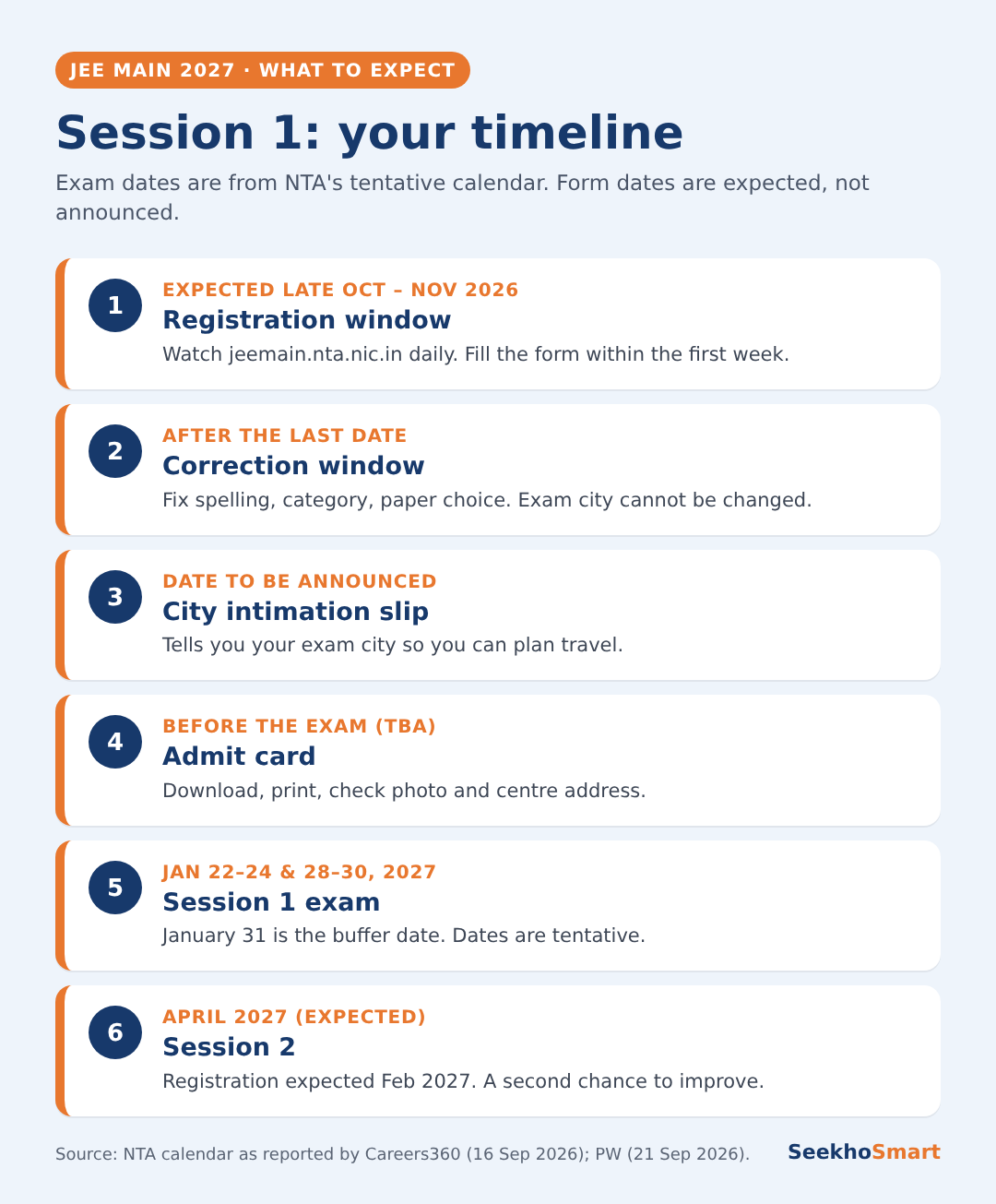
| Session 1 exam dates | Tentative, announced by NTA | 22, 23, 24, 28, 29 and 30 January 2027; 31 January is a buffer date (Careers360) |
| Detailed notification / information bulletin | Not yet released | NTA has said a separate notification will cover the application process, eligibility, exam cities and admit cards |
| Registration start date | Not announced | Expected in October 2026, with the last date in November (Careers360 guide, PW) |
| Session 2 | Expected | Registration in February 2027, exam in April 2027 (expected) |
The only official place to apply is jeemain.nta.nic.in. Bookmark it and check it once a day. Ignore WhatsApp forwards that claim "form out" unless you see it on the NTA site.
Who can apply
The 2027 bulletin will give the final rules. Going by the current cycle's rules as summarised by Careers360:
- You should have passed Class 12 in 2025 or 2026, or be appearing in 2027.
- Physics and Mathematics are compulsory, along with one of Chemistry, Biotechnology, Biology or a technical vocational subject.
- There is no age limit to appear.
- There is no minimum percentage to appear, but admission to IITs and NITs needs 75% in Class 12.
If you are appearing for your Class 12 boards in 2027, you are eligible to apply now. You only enter Class 10 details for the academic part.
Your document checklist
Collect all of this in one folder on your phone or laptop before the form opens. The specifications below are from the last cycle's process. Re-check them against the 2027 bulletin, because NTA can change them.
1. Your own email ID and mobile number
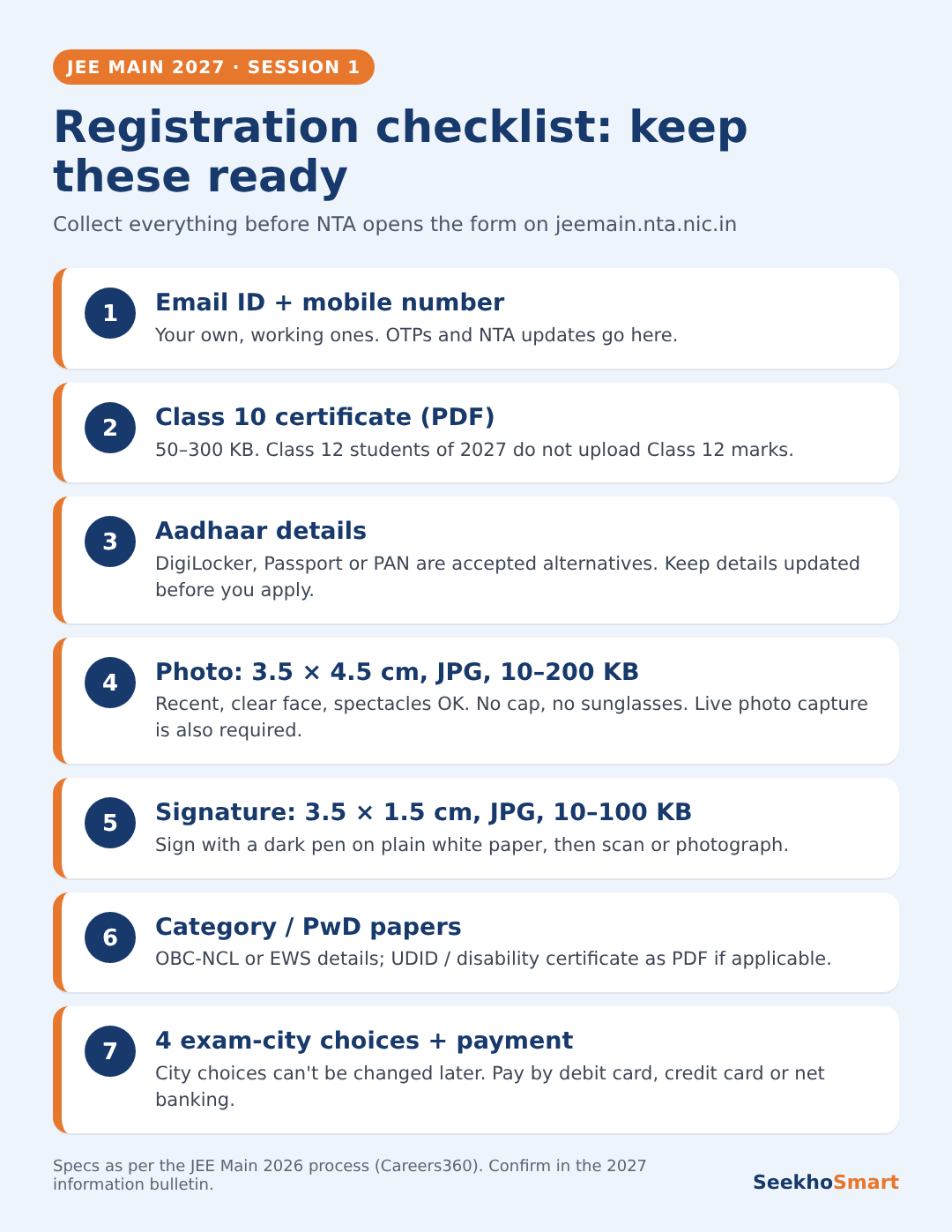
OTPs, your application number and every NTA update will come here. Use an email ID and a number that you check daily and that will stay active until results.
2. Class 10 certificate (PDF)
Scan it clearly. The size limit has been 50–300 KB in PDF format. Class 12 students of 2027 don't upload Class 12 marks.
3. Aadhaar details (or an accepted alternative)
Keep your Aadhaar number ready. DigiLocker, Passport or PAN have been accepted alternatives. PW notes that NTA has issued advisories in past years asking candidates to keep Aadhaar and category details updated, so sort out any spelling or date-of-birth problems now, not on the last day.
4. Photograph
- Size 3.5 cm × 4.5 cm, JPG/JPEG, 10–200 KB
- Colour or black-and-white; spectacles are fine
- No cap, no sunglasses, no blur
A live photo capture is also part of the process, so sit in good light with a plain background when you fill the form.
5. Signature
- Sign with a dark pen on plain white paper
- 3.5 cm × 1.5 cm, JPG/JPEG, 10–100 KB
6. Category and PwD documents (if they apply to you)
OBC-NCL or EWS details are entered in the form. If you are a PwD candidate, keep the disability certificate (at least 40% disability, in the government format) or UDID certificate as a PDF of 50–300 KB.
7. Exam-city choices and payment
You will choose four exam cities. Discuss them with your parents beforehand, because the exam centre cannot be changed in the correction window. Payment is online by debit card, credit card or net banking.
Registration fee (based on the last cycle)
For exam centres in India, as listed by Careers360:
| Category | Paper 1 or Paper 2 (Boys / Girls) | Both papers (Boys / Girls) |
|---|---|---|
| General | ₹1000 / ₹800 | ₹2000 / ₹1600 |
| General-EWS / OBC-NCL | ₹900 / ₹800 | ₹2000 / ₹1600 |
| SC / ST / PwD / Transgender | ₹500 / ₹500 | ₹1000 / ₹1000 |
Paper 1 is for B.E./B.Tech, so most of you will pay the single-paper fee. Treat these numbers as a guide until the 2027 bulletin confirms them.
Step-by-step: how the form works
- Open jeemain.nta.nic.in and click the JEE Main 2027 registration link.
- Click "New Registration", read the instructions and accept the declaration.
- Enter personal details, address and a password.
- Verify your mobile number and email with OTPs. Note down your application number and password.
- Log in and fill the main form: state, category, medium, paper choice, four exam cities, and Class 10 details.
- Complete the live photo capture.
- Upload your photo, signature, ID proof and any certificates.
- Pay the fee and download the confirmation page. Save it in two places.
Five mistakes that waste time
- Different spellings in different documents. If your name reads one way on your Class 10 certificate and another on Aadhaar, fix it or at least know which one to use before you start.
- Wrong photo size. Resize and check the KB size before you open the form, not while the page is waiting.
- Choosing exam cities in a hurry. You can't change the centre later, so think about travel and stay.
- Waiting for the last date. Fill it in the first week. If something goes wrong, you still have time to fix it.
- Not saving your confirmation. You will need your application number for the correction window, the city slip and the admit card.
Don't let registration pause your preparation
Registration is a one-evening job. Your preparation is the real work. From today to 22 January 2027 you have about three months, and your CBSE board exams are expected in February–March 2027 (Careers360). The good news is that both rest on the same Class 11–12 Physics, Chemistry and Maths concepts.
A simple weekly rhythm that works for many students:
- 4 days: one chapter at a time. Revise from NCERT first, then solve problems.
- 1 day: a timed mixed test from the week's chapters.
- 1 day: go through every wrong answer and write down why it was wrong.
- 1 day: light revision and rest.
That "why was it wrong" day is where most marks are gained.
How SeekhoSmart helps you prepare alongside JEE registration
Once the form is submitted, the real question is how to use the next three months well. JEE Main and your boards both test the same NCERT concepts, and SeekhoSmart is built around exactly that.
- NCERT-aligned practice and a 10-year PYQ bank tagged by chapter let you finish a chapter and immediately test it with past board questions, so concept gaps show up early.
- AI explanations for every answer, including wrong ones, turn your weekly "why was it wrong" day into a quick routine instead of a hunt through solution books.
- An adaptive daily study plan fits around school and coaching, so revision doesn't depend on willpower alone.
It's free to start. Padhai, ab smart tareeke se.
Start your free daily plan → seekhosmart.in
Frequently asked questions
When will JEE Main 2027 registration start?+
NTA has not announced the date yet. Careers360 and PW expect the Session 1 form in October 2026, with the last date in November. Check jeemain.nta.nic.in daily and apply only there.
What documents are required for JEE Main 2027?+
Keep ready an email ID and mobile number, your Class 10 certificate as a PDF, Aadhaar details (or DigiLocker, Passport or PAN), a passport-size photo, your signature, category details and, if applicable, a PwD/UDID certificate. Confirm sizes in the 2027 bulletin.
What is the JEE Main 2027 registration fee?+
The 2027 fee isn't announced. In the last cycle, one paper cost ₹1000 for General boys and ₹800 for girls, ₹900/₹800 for EWS and OBC-NCL, and ₹500 for SC, ST, PwD and transgender candidates (India centres).
What is the JEE Main 2027 exam date for session 1?+
NTA's tentative calendar lists 22, 23, 24, 28, 29 and 30 January 2027, with 31 January as a buffer date. The dates can still change.
- SeekhoSmart (infographic)
- SeekhoSmart (infographic)
- Nayakyashraj / Wikimedia Commons (CC BY-SA 4.0)
- Jagseer S Sidhu / Wikimedia Commons (CC BY-SA 4.0)