The board year has started, and so have the conversations at home. "Everyone in his class has joined tuition." "Should we put her in coaching for Maths?" "Are we falling behind if we don't?"
If you are asking whether tuition is necessary for Class 10, or for Class 9, 11 or 12, this guide is for you. The honest answer is: sometimes yes, often not for every subject, and never as a replacement for your child's own study. Here is how to decide calmly.
How common is tuition now?
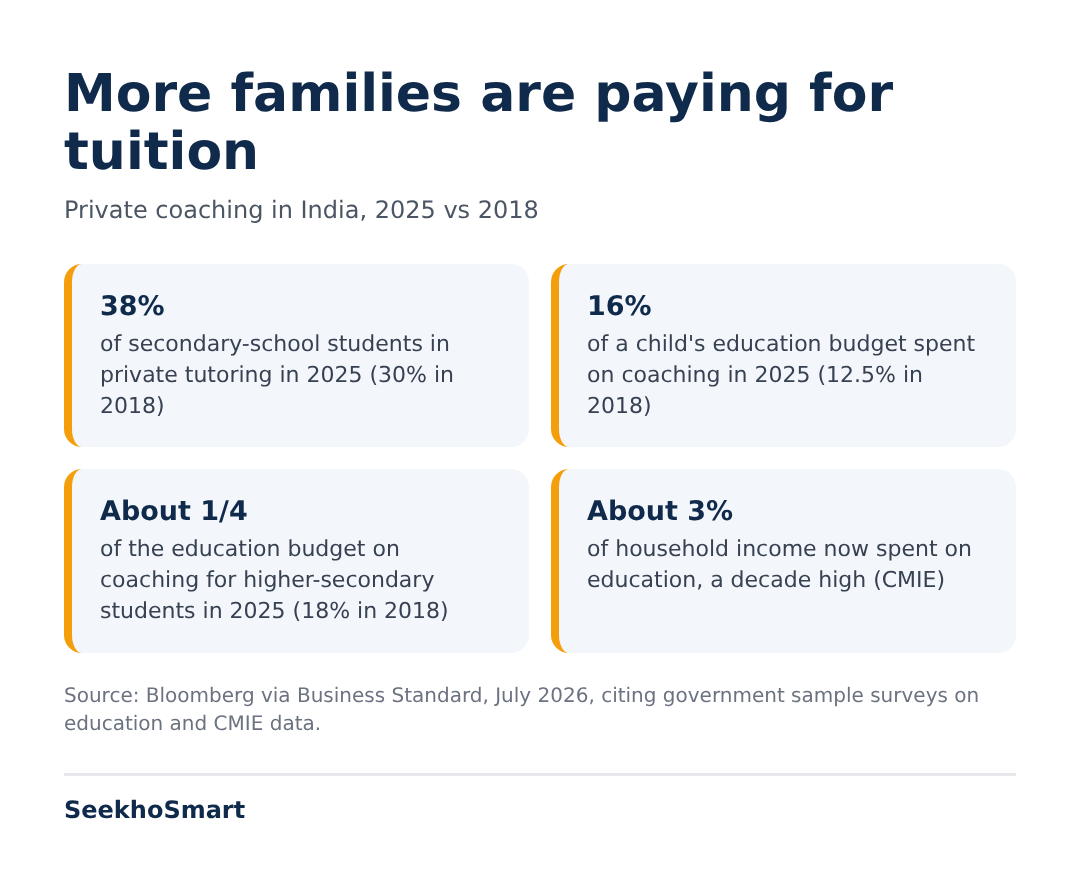
Very common, and growing. A Bloomberg report published by Business Standard in July 2026 cites government sample surveys on education:
- About 38% of secondary-school students were in private tutoring in 2025, up from 30% in 2018.
- Families spent an average of 16% of a child's education budget on private coaching in 2025, up from 12.5% in 2018.
- For higher-secondary students, coaching took nearly a quarter of the education budget in 2025, up from 18% in 2018.
The same report, citing CMIE data, says the average household now spends almost 3% of its income on education, a decade high.
So yes, many families pay for tuition. But "many families do it" is not the same as "my child needs it".
When tuition genuinely helps
Tuition can be worth it when:
- There is a specific gap. Your child understood Maths till Class 8 but is lost in Class 9 algebra, for example.
- School support is not enough. Large classes can leave little time for doubts.
- Your child asks for it. A student who wants help usually uses it well.
- A teacher has flagged a problem. If the subject teacher says the basics are weak, take it seriously.
- Class 11–12 subjects jump in difficulty. Physics, Chemistry and Accountancy can feel very different from Class 10.
When tuition is not the answer
Tuition often fails when it is used to fix the wrong problem:
- Low motivation or poor routine. More classes will not fix a phone habit or late nights.
- No time left to study alone. School plus tuition plus travel can leave no hours for revision, which is where marks are actually made.
- Tuition in every subject "just in case". This is expensive and exhausting.
- Your child is already tired or anxious. Adding pressure can make things worse.
The 5-question check
Before you pay, answer these five questions honestly with your child.
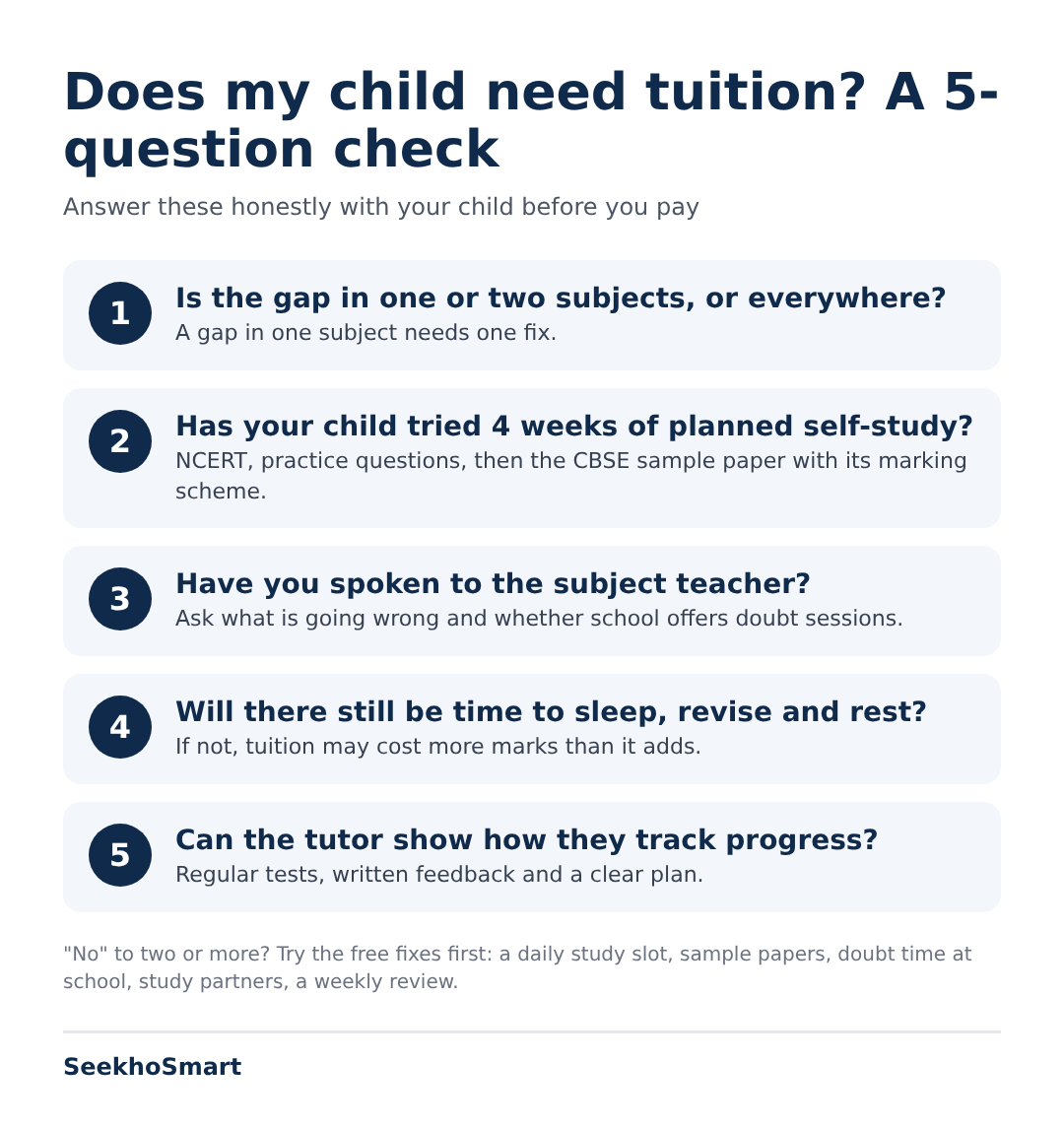
- Is the gap in one or two subjects, or everywhere? A gap in one subject needs one fix.
- Has your child tried four weeks of planned self-study? NCERT first, then practice questions, then the official CBSE sample paper, checked with its marking scheme. CBSE released the 2026-27 sample papers in September 2026 (Careers360).
- Have you met the subject teacher? Ask what exactly is going wrong, and whether the school offers doubt sessions.
- Will there still be time to sleep, revise and rest? If not, tuition may cost more marks than it adds.
- Can the tutor show how they track progress? Regular tests, written feedback and a clear plan.
If you answered "no" to two or more, try the free fixes below first.
Free alternatives to try first
- A fixed daily study slot. Even 90 minutes, same time every day, phone outside the room.
- The CBSE sample paper and marking scheme. They show exactly what the board expects.
- Doubt time at school. Many teachers will help a student who comes with specific questions.
- Study partners. Two friends solving the same paper and checking each other's answers.
- Weekly review at home. Ten minutes on Sunday: what went well, what is stuck, what is next. You don't need to know the subject to ask good questions.

If you do choose tuition
Choose carefully. The Ministry of Education's 2024 guidelines for coaching centres, reported by Careers360, are a useful checklist even for smaller tutors:

- Centres should not enrol students below 16 years; enrolment should be only after the secondary school examination.
- They should not guarantee ranks or marks, or publish misleading results.
- Fees should be fair, with receipts. A student who leaves mid-course should get a pro-rata refund within 10 days.
- Centres should have a counselling system and tutors with at least a graduate qualification.
Note that coaching is regulated mainly by states, so local rules can differ. Whatever you choose, look for:
- A free trial class, and your child's honest opinion of it.
- Small batches, so doubts are actually answered.
- Monthly progress updates you can see.
- Timings that don't clash with sleep or school homework.
Talk to your child, not about them
The best decision comes from a conversation, not a comparison with the neighbour's son. Ask your child: "Which subject worries you most? What would help?" Decide together, subject by subject, and review it after two months. If marks and confidence aren't improving, change the plan. Tuition is a tool, not a rule.
Try SeekhoSmart before you pay for tuition
Most of the checks above come down to one thing: steady, planned self-study on NCERT. That is what SeekhoSmart is built for.
- NCERT-based. Practice follows the same chapters your child's board exam is set from.
- Adaptive. It spots the topics your child is weak in and gives more practice there, so time goes to the real gap, not every subject "just in case".
- Made for Class 9–12. From building the Class 9 base to board-year revision.
Use it for the four weeks of self-study in question 2. If the gap closes, you may not need tuition at all. If it doesn't, you will know exactly which subject needs a tutor.
Sources
- Student protests highlight India's soaring private coaching costs — Business Standard / Bloomberg (30 Jul 2026)
- MoE guidelines for coaching centres — Careers360 / PTI (18 Jan 2024)
- CBSE Class 10 Sample Papers 2026-27 — Careers360
- Google autocomplete, India, checked 17 Oct 2026
Frequently asked questions
Is tuition necessary for Class 10 CBSE?+
Not for every student. If your child studies NCERT regularly, practises the official CBSE sample papers and gets doubts cleared at school, many can manage without it. Tuition helps most when there is a clear gap in one or two subjects.
Is tuition necessary for Class 9?+
Class 9 builds the base for Class 10. Watch for early gaps, especially in Maths and Science, and fix them with targeted help rather than tuition in every subject.
Is tuition necessary for Class 11?+
Class 11 subjects are a big step up. Many students benefit from help in one or two tough subjects, but they still need daily self-study for the help to work.
Is tuition necessary for Class 12?+
It depends on the gap and on whether your child is also preparing for an entrance exam. Make sure tuition still leaves time for revision and sleep.
- Annushka Ahuja / Pexels
- Kiran Pokuri Photography / Pexels
- Mikhail Nilov / Pexels
- SeekhoSmart (infographic)
- SeekhoSmart (infographic)