
If your child is in Class 9 to 12, you may have received a consent form from school about the APAAR ID. Your family WhatsApp group probably has two opinions about it. One says it is compulsory for board exams. The other says you can refuse.
So, is the APAAR ID mandatory or not? Here is what the official documents actually say for this session, in plain words, and how you can decide calmly.
What is the APAAR ID?
APAAR stands for Automated Permanent Academic Account Registry. The official APAAR website describes it as part of the "One Nation, One Student ID" programme, a special identification system for all students in India that stores their academic records.
The site lists these benefits:
- It recognises learning achievements
- It lets students choose their own learning path
- It makes it easier to move between institutions, with more academic flexibility
- Students can share their APAAR ID instead of carrying paper certificates, which also reduces duplication and fraud
How an APAAR ID is made
According to the APAAR website, the process goes like this:
- The school tells parents about APAAR.
- Parents fill the consent form voluntarily.
- The ID is generated through the UDISE+ system against the student's PEN (Permanent Education Number).
- The APAAR ID appears in the student's DigiLocker account.
Two conditions often cause delays. The student's name in UDISE+ records must match the name on their Aadhaar, and a PEN is mandatory.
So, is it mandatory for CBSE students?
This is where the confusion comes from, because the rules have changed over the last year.
Last year (2026 board exams)
For the 2026 board exams, CBSE first tied APAAR to board registration and then eased the rule. Careers360 reported on 9 September 2025 that schools could submit the List of Candidates (LOC) without an APAAR ID. They entered "refused" where parents did not give consent, keeping a copy of the parent's refusal, and "NOGEN" where the ID could not be generated for other reasons. Schools had told CBSE about mismatched data, slow corrections and lack of parental consent.
This year (2027 board exams)
The rule is clearer now. CBSE's LOC circular for 2026-27 explains how schools update the APAAR ID while submitting the LOC. On page 33, the school fills in the APAAR ID along with the consent to share it. The school can also choose an option if the ID is "not available or not to be provided". The final instruction, printed in red, says:
"Filling of APAAR is optional."
In simple words, for the 2027 Class 10 and Class 12 board exam registration, CBSE's own instructions say the APAAR field is optional. Your child's board exam registration does not depend on it.
What about school admission?
An Education for All in India article (April 2026) reports two developments. NCERT clarified that an APAAR ID is not essential for school admission. Separately, the Odisha High Court (Rohit Anand Das v. State of Odisha, 12 December 2025) directed that the consent form include a clear option to not give consent, and the article says a revised form with an opt-out option followed. These are reports, so ask your school which version of the form it is using.
How to decide: a calm checklist
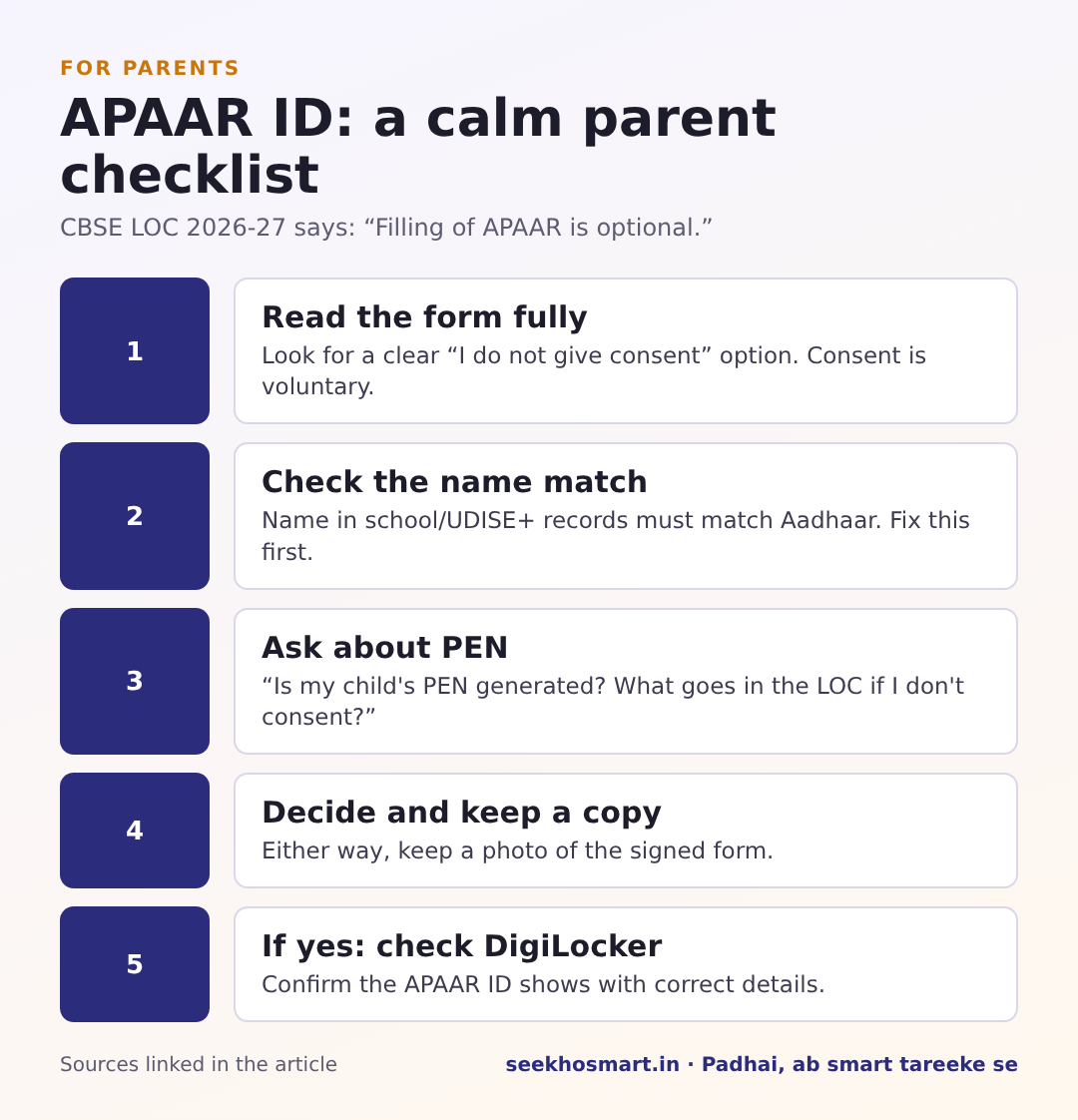
1. Read the form fully before you sign. Check what you are agreeing to and whether there is a clear "I do not give consent" option. The APAAR site itself calls consent voluntary.
2. Check the name match first. If your child's name on Aadhaar and in school records differs (for example, a missing middle name or a spelling difference), ask the school to correct the records before anything else. This mismatch causes most of the trouble, and it also affects board certificates.
3. Ask the school two questions.
- "Has my child's PEN been generated?"
- "If I don't consent, what will you enter in the LOC, and will you keep a copy of my form?"
4. If you consent: After a few weeks, ask your child to log in to DigiLocker and check that the APAAR ID shows up with the correct details.
5. If you don't consent: Give it in writing, keep a photo of the signed form, and confirm with the class teacher that your child's LOC is otherwise complete. Name, date of birth and subjects are what matter for the board exam.
6. Don't let this distract your child. This is a paperwork decision for parents. Your child's energy this term should go into studies, not into forms.
Three myths to ignore
- "Without APAAR, my child can't sit the board exam." For 2027 registration, CBSE's LOC instructions say filling APAAR is optional. What matters is that the LOC is correct: name, date of birth, parents' names and subjects.
- "APAAR replaces Aadhaar." It doesn't. APAAR is an academic record ID that is generated against the student's PEN. Aadhaar is used for identity matching.
- "Someone outside school can make it faster for a fee." According to the APAAR website, the ID is generated through the school and UDISE+. Don't pay agents.
A note on privacy
Whatever you decide, treat your child's Aadhaar, PEN and APAAR details like bank details. Share them only through the school's official process, never with unknown callers or "helpers" who offer to create an ID for a fee.

How SeekhoSmart helps you track your child's progress without nagging
Once the paperwork is done, what really counts this year is steady preparation. Most parents can't sit with their child every evening, and asking "Did you study today?" every night rarely helps. SeekhoSmart makes it easier.
- An adaptive daily study plan. Your child gets a clear, NCERT-based plan for each day, focused on their weaker chapters, so there is no confusion about what to study.
- Streaks and XP. You can see at a glance whether your child is studying consistently, without nagging.
- A Hindi/English switch. You can follow along in the language you are comfortable with.
It is free to start. Padhai, ab smart tareeke se.
Try it free with your child → seekhosmart.in
Frequently asked questions
Is APAAR ID mandatory or not for CBSE board exams 2027?+
CBSE's LOC circular for 2026-27 says, in its APAAR instructions, 'Filling of APAAR is optional.' Schools can choose an option if the ID is not available or not to be provided.
Is the APAAR ID parents consent form compulsory to sign?+
The official APAAR website says parents fill the consent form voluntarily. Read the form and check for a clear option to not give consent.
Is APAAR ID mandatory for students' school admission?+
An April 2026 Education for All in India report says NCERT clarified that an APAAR ID is not essential for school admission.
How is an APAAR ID created?+
After parental consent, the ID is generated through UDISE+ against the student's PEN and appears in the student's DigiLocker. The student's name in UDISE+ must match Aadhaar.
- SeekhoSmart (infographic)
- RDNE Stock project / Pexels
- Anil Sharma / Pexels