If you typed "how to score 95 in class 10" into Google this week, you are not alone. It is one of the top searches Indian students make in October, and the timing makes sense: the CBSE sample papers for 2026-27 are out, school pre-boards are coming up, and the board exams are a few months away.
Here is the honest truth. A 95% is not about studying 14 hours a day. It is about knowing exactly where your marks come from, and losing as few of them as possible. This guide gives you the maths, a four-phase plan from now till the boards, and the habits toppers use to stop losing "easy" marks.
First, understand the 95% maths
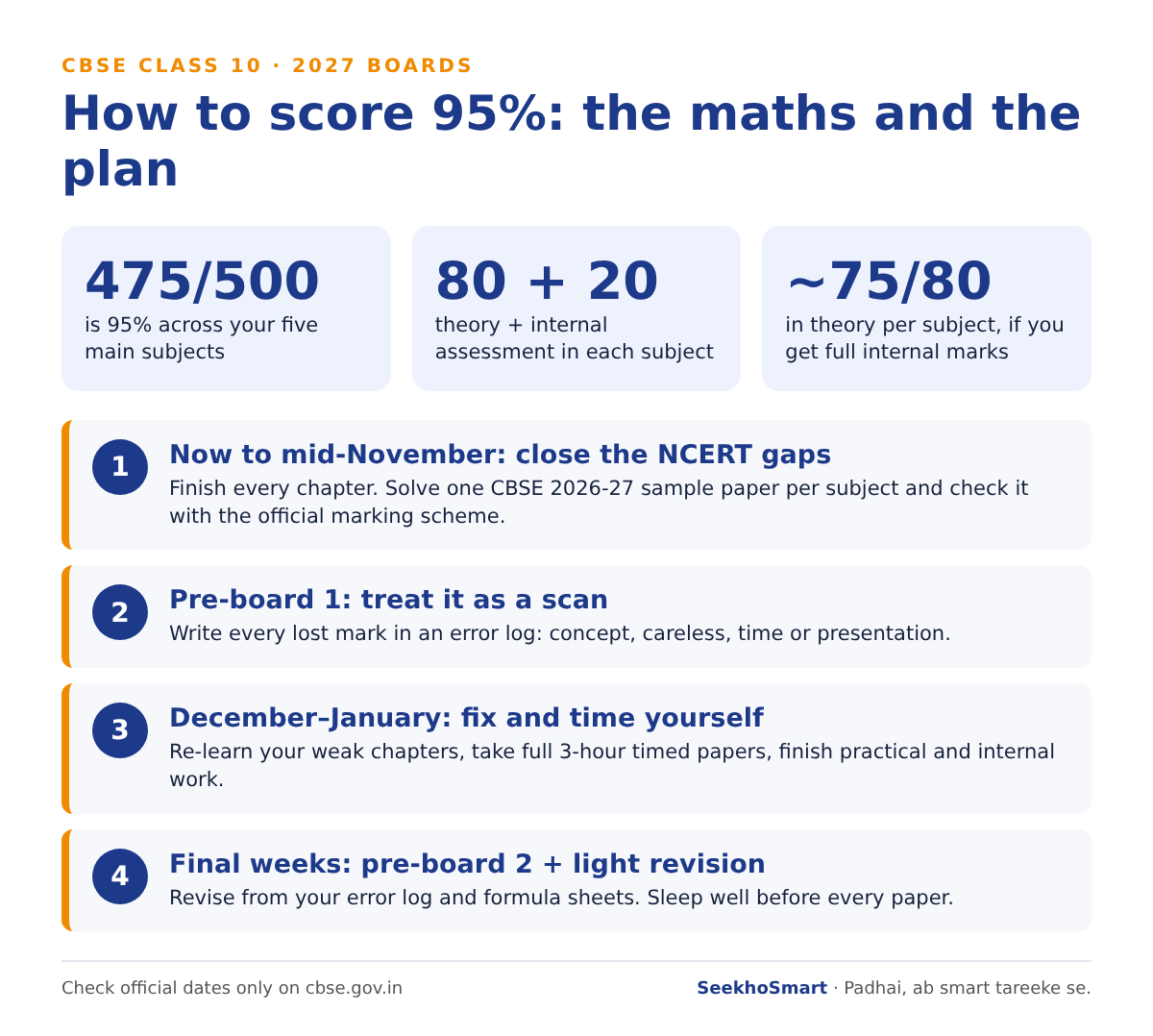
In CBSE Class 10, every main subject is marked out of 100: 80 marks for the theory paper and 20 marks for internal assessment (Careers360, CBSE Class 10 sample papers 2026-27). The theory paper is 3 hours long.
So what does 95% look like?
| What you need | Marks |
|---|---|
| 95% of five subjects | 475 out of 500 |
| If you score full 20/20 internal in each subject | about 75 out of 80 in each theory paper |
| If you score 18/20 internal | about 77 out of 80 in each theory paper |
Two lessons hide in this table:
- Internal marks are the cheapest marks you will ever earn. Projects, practical files, periodic tests and lab work are under your control. Do not lose 2–3 marks per subject here.
- In the theory paper, you can lose only about 5 marks per subject. That is one long answer with a missing step, or two careless MCQs plus a messy diagram. So 95% is mostly about cutting silly losses, not learning "extra" material.
Where things stand right now (October 2026)
- Sample papers are out. CBSE released the Class 10 and Class 12 sample question papers for 2026-27, with marking schemes, on 21 September 2026 on cbseacademic.nic.in (Careers360).
- One sample paper set for both board exams. For Class 10, CBSE has not released separate sample papers for the two board exams, so the same set applies to both (Careers360 live updates). The second exam is held after the first exam's results and is a chance to improve marks.
- Date sheet: as of the latest reports we checked, the official 2027 date sheet had not been released. Board exams are expected in February–March 2027 (Khaleej Times). Only trust dates on cbse.gov.in.
- Pre-boards are set by your school, not by CBSE. Many schools plan one round in November and another in January (same Khaleej Times report).
Your four-phase plan from now to the boards
Phase 1: Now to mid-November — close the NCERT gaps
- Make a list of every chapter in each subject. Mark each one green (confident), yellow (shaky) or red (not done).
- Finish all red chapters from the NCERT textbook first. CBSE follows the NCERT syllabus, so the textbook text, examples and exercises are your base.
- Solve one official sample paper per subject, under time. Then check it with the marking scheme, line by line. Notice where the scheme gives step marks. That is how examiners will check your paper.
Phase 2: Pre-board 1 — treat it as a scan, not a verdict
A pre-board is a free X-ray of your preparation. After each paper, make an error log with four columns:
- Concept — I did not know or understand it.
- Careless — I knew it but made a slip (sign error, unit missing, wrong option).
- Time — I ran out of time.
- Presentation — I knew it but lost step marks, missed a diagram or labelled it wrong.
If a big share of your lost marks sits in "careless" and "presentation", good news: those are the fastest marks to win back.
Phase 3: December to January — fix, then time yourself
- Re-learn every concept error from NCERT and your notes. Then solve 5–10 fresh questions on that topic.
- For careless errors, make a personal checklist (for example: "write units", "re-read the question", "check signs"). Read it before every test.
- Take at least one full 3-hour paper per subject per week. Practise answering in the order: sure questions first, long answers next, doubtful ones last.
- Finish practical files, projects and internal work now. Do not let them pile up near the boards.
Phase 4: Final weeks — pre-board 2 and light revision
- Use pre-board 2 to test whether your error log is shrinking.
- Revise from short notes, formula sheets and your error log — not from fresh books.
- Keep sleep fixed. A tired brain makes the careless mistakes you worked so hard to remove.
Subject-wise quick wins
Maths
Show every step. Draw a neat figure for every geometry question. Learn the standard results from NCERT examples. Practise a few questions from each chapter every day so you don't forget them.
Science
Diagrams and labels carry marks. Learn the balanced chemical equations from NCERT by writing them, not just reading. For numericals, write the formula, put in the values with units, then give the answer.
Social Science
Use headings and point-wise answers. Practise map work every week. Link each answer to the exact NCERT concept the question asks about.
English and Hindi
These are the most "scoring" papers if you follow the format. Learn the formats for letters and other writing tasks from the marking scheme, and practise one writing task every two days.
A simple daily routine that works
- Morning (45–60 min): one tough subject, new learning.
- After school (60–90 min): practice questions, mostly from previous years' papers on the chapter you studied.
- Night (30 min): revise the day's error log and formula sheet.
- Sunday: one full timed paper and a weekly review.
This adds up to 3–4 focused hours on school days. Consistency matters more than marathon days.
How SeekhoSmart helps you get to 95
The plan above has two hard parts: finding the right questions for each chapter, and understanding why you lost marks. SeekhoSmart is built for exactly that.
- 10-year PYQ bank tagged by chapter: when your error log says "Triangles" or "Carbon and its Compounds", practise just those board questions instead of hunting through old papers.
- AI explanations of every answer, including wrong ones: get the reason behind each mistake, so a "concept" error doesn't come back in pre-board 2.
- Adaptive daily study plan: it gives you each day's practice and moves your weak chapters up, so you follow the phases above without planning every evening.
It is NCERT-aligned, works in Hindi or English, and is free to start. Padhai, ab smart tareeke se.
Start your 95% plan free → seekhosmart.in
Frequently asked questions
How to score 95 in Class 10 CBSE?+
Know where your marks come from: 80 theory + 20 internal per subject. Secure full internal marks, then aim to lose no more than about 5 marks per theory paper by finishing NCERT, solving the official 2026-27 sample papers with the marking scheme, and fixing errors from your pre-boards.
How to score 95 in Class 10 in 1 month?+
With one month left, stop learning new material widely. Revise from short notes and your error log, take one timed 3-hour paper per subject per week, and focus on step marks, diagrams and formats, which are the fastest marks to win back.
Has the CBSE Class 10 sample paper 2027 been released?+
Yes. CBSE released the 2026-27 sample question papers with marking schemes on 21 September 2026 on cbseacademic.nic.in. The same set applies to both Class 10 board exams.
When will the CBSE Class 10 date sheet 2027 come out?+
As of the latest reports we checked, the official date sheet had not been released; board exams are expected in February–March 2027. Check only cbse.gov.in for the final dates.
- SeekhoSmart (infographic)
- Samir Kumar / Wikimedia Commons (CC BY-SA 4.0)
- Ambuj Saxena / Wikimedia Commons (public domain)