It's late October. Half your class thinks the boards are "still far away", and the other half has already started panicking. As a Class 10 or 12 teacher, you know the truth sits in between: there is enough time, but only if it is used with a plan.
This post gives you a practical 16-week plan, from now until the February 2027 board exams, that you can run alongside your normal timetable. It is written for CBSE teachers, but the structure works just as well for ICSE and state-board classrooms.
Where things stand right now
Before planning, it helps to be clear about what is and isn't known. As of 20 October 2026, according to Careers360's CBSE 2027 tracker:
- The 2027 date sheet has not been released. Class 10 and 12 exams are expected between February and March 2027.
- CBSE sample question papers (SQPs) for 2026-27 are out on cbseacademic.nic.in, with separate marking schemes.
- Class 12 practicals are held in November–December 2026 for winter-bound schools and January–February 2027 for others.
- The pass mark is 33% in each subject, in both theory and practical components.
For Class 10, there is one more thing to keep in mind. Under CBSE's two-exam system, the first board exam (February–March) is compulsory, and a second exam in May is optional, for improving up to three subjects or clearing a compartment (Allen). Some students quietly treat May as a backup plan. Part of your job is to make sure nobody plans to fail the first one.
Counting back from mid-February, you have roughly 16 weeks. Here's how to split them.
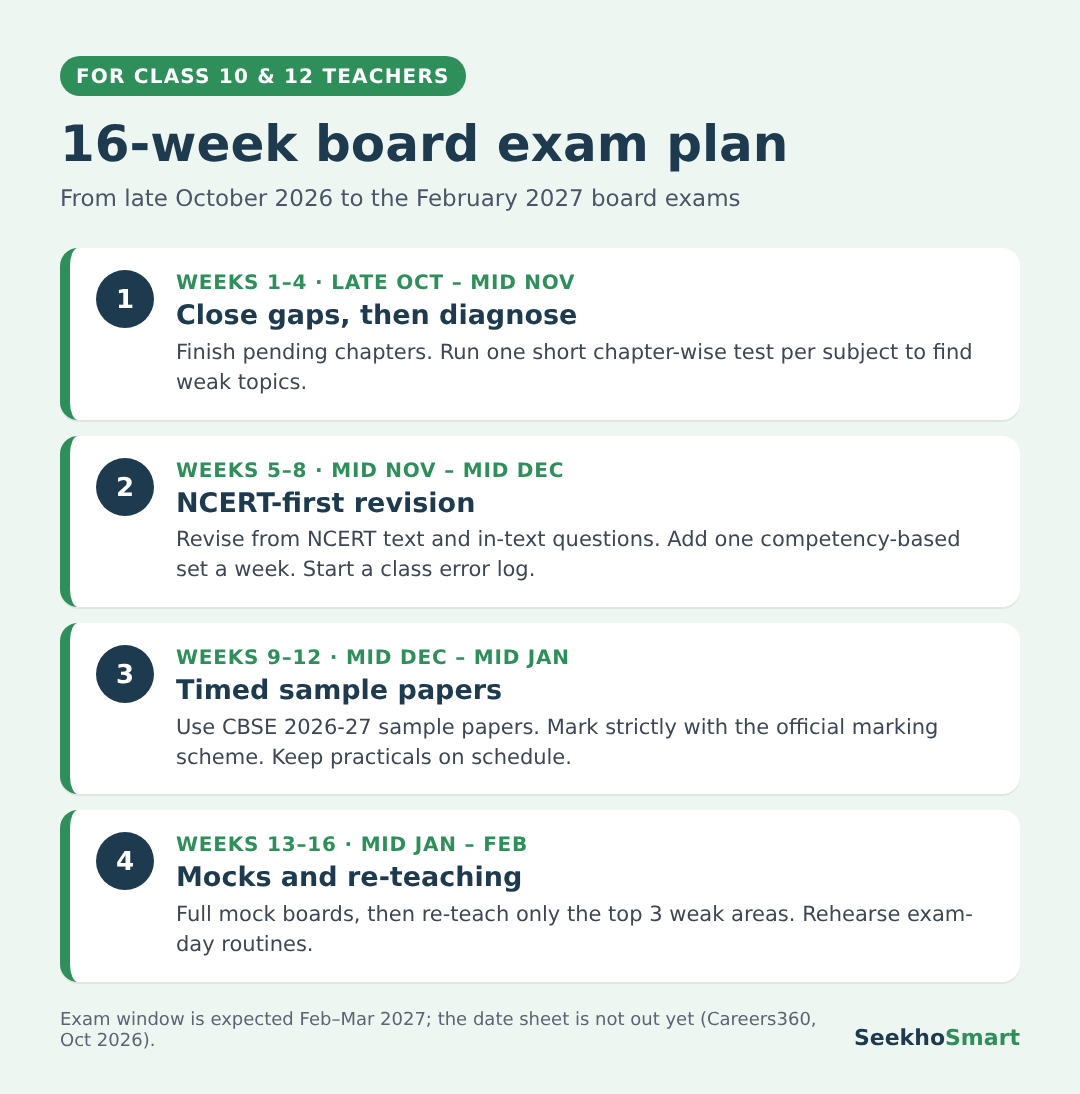
Phase 1 (Weeks 1–4): Close the gaps, then diagnose
Late October to mid-November
Finish what's pending
If any chapters are still incomplete, finish them in this phase. Revision can't start on chapters students have never properly learnt.
Run short diagnostic tests
Give one 20–30 minute test per chapter or unit. Keep it simple: 8–10 questions, mostly from NCERT exercises and in-text questions. The goal is not marks; it's a map. By the end of Week 4 you should be able to say, for each student, "strong in these three chapters, weak in these two."
Sort the class into three groups
- Secure: consistently above 70%. They need challenge and timed practice.
- Borderline: around 40–70%. Most of your marks gains will come from here.
- At risk: close to or below 33%. They need a separate, shorter plan focused on high-weightage, high-scoring chapters.
Phase 2 (Weeks 5–8): NCERT-first revision
Mid-November to mid-December
Revise from the textbook, not around it
For CBSE classes, NCERT is the base. Revise each chapter from the NCERT textbook first: key definitions, diagrams, in-text questions and back exercises. Reference books come after, not before.
Add one competency-based set a week
Open the 2026-27 sample paper and count the case-based and application-style questions in your subject. Then add one short set like that per week. Discussed in class, it builds the habit of reading a passage and applying a concept, which is exactly what weaker students struggle with.
Start a class error log
This is the single most useful habit you can build. After every test, each student writes three columns for every mistake:
| Question | What I wrote | Why it was wrong |
|---|---|---|
| Q7 | Wrong unit | Didn't convert cm to m |
| Q12 | Half answer | Forgot the second part of the question |
Within a month, students start seeing their own patterns: careless errors, concept gaps, or time pressure. Each needs a different fix.
Phase 3 (Weeks 9–12): Timed sample papers
Mid-December to mid-January
Use the official SQPs properly
Give at least two full CBSE sample papers under real timing. Then mark them strictly with the official marking scheme, and show students why marks were cut: missing units, unlabelled diagrams, no final statement. Students who see the marking scheme write better answers.
Teach time management explicitly
Many students lose marks not from lack of knowledge but from leaving the last section half-done. After each timed paper, ask them to note how long each section took. Agree on a target split for the next paper.
Keep practicals on track
If your school holds Class 12 practicals in this window, plan theory revision around them so that one doesn't eat the other.
Phase 4 (Weeks 13–16): Mocks and targeted re-teaching
Mid-January to the exams
Hold full mock board exams
Run them like the real thing: same timings, seating and answer sheets. This lowers exam-day anxiety more than any pep talk.
Re-teach only the top three weak areas
Look at your mock results and error logs together. Pick the three topics where the most students lost the most marks, and re-teach those. Resist the urge to revise everything again.
Rehearse exam-day routines
Reading time, attempting questions in a sensible order, leaving space to come back, and checking the final five minutes. Make these automatic.
A weekly rhythm that fits your timetable
You don't need extra periods to run this plan. Most teachers can fit it into a normal week:
| Day | Focus |
|---|---|
| Mon–Wed | Teach / revise one chapter from NCERT |
| Thu | Short test on that chapter |
| Fri | Discuss errors; students update error logs |
| Sat | Competency-based set or mixed practice |
Supporting at-risk students
For students near the 33% line, a shorter, focused list works better than the full syllabus. Identify chapters they can realistically score in, make sure they can answer the standard NCERT questions from those, and practise answer presentation. Small, visible wins in the first two weeks keep them coming back.
Keep parents in the loop, too. A two-line monthly update ("strong in X, needs work on Y, please make sure 30 minutes of daily practice happens") gets far more support at home than a vague "needs to work harder".
How SeekhoSmart supports your students between classes
The plan above depends on what students do outside your period: regular practice and honest work on mistakes. SeekhoSmart can carry some of that load for you.
- Chapter-tagged 10-year PYQs and NCERT-aligned practice mean you can say "finish this chapter's PYQs on SeekhoSmart" as homework, matched to whatever you taught that week.
- AI explanations for every answer, including wrong ones, give students a first explanation of their mistakes at home, so your Friday error-log discussion starts from understanding, not from scratch.
- An adaptive daily study plan keeps borderline students practising a little every day without you chasing each one.
It's free to start, with a Hindi/English switch for mixed classrooms.
Share SeekhoSmart with your students → seekhosmart.in
Frequently asked questions
How do I prepare students for board exams in the last few months?+
Split the time into phases: close syllabus gaps and run diagnostics, revise from NCERT with an error log, give timed CBSE sample papers marked with the official scheme, then hold mocks and re-teach only the weakest topics.
When will the CBSE 2027 board exam date sheet be released?+
CBSE had not released it as of 20 October 2026. Education sites expect it soon, with Class 10 and 12 exams expected between February and March 2027. Check cbse.gov.in.
How can Class 10 students prepare for board exams in 3 months?+
Use a weekly rhythm: teach or revise one chapter, test it, discuss errors, then do a mixed practice set. Prioritise NCERT exercises and the 2026-27 sample paper with its marking scheme.
Are CBSE Class 10 board exams held twice a year?+
Yes, from 2026. The February–March exam is compulsory; a May exam is optional for improving up to three subjects or clearing a compartment. Confirm the 2027 rules with CBSE.