"He sits with the book for hours but nothing goes in." "She says she'll study after one more video." If you are the parent of a Class 9–12 student, you have probably said something like this. And right now, with pre-boards coming and the 2027 board exams a few months away, the worry is louder.
Google's own suggestions show how common this is. People search "how to motivate teenager to study", "how to motivate child to study at home" and "how to reduce board exam stress" again and again.
This guide is for you. It won't give you a speech to deliver to your child. It gives you small, practical changes at home that make studying easier to start and easier to keep going. Most of them need no money, only a different way of talking.
Why teenagers "lose motivation" in the board years
Before fixing it, understand what is really going on. In Classes 9–12, a lot of "laziness" is actually one of these:
- Overwhelm: the syllabus feels endless, so it's easier not to start.
- Fear of failing: if you don't try, you can't fail. Avoiding study protects their self-respect.
- No control: every hour is planned by school, tuition and parents, so the teen pushes back in the only way they can.
- Tiredness: late nights on the phone, early school, tuition in the evening.
- Not understanding: if a chapter makes no sense, reading it again feels pointless.
Lectures don't fix any of these. Structure, small wins and calm support do.
The 8 changes that actually work at home
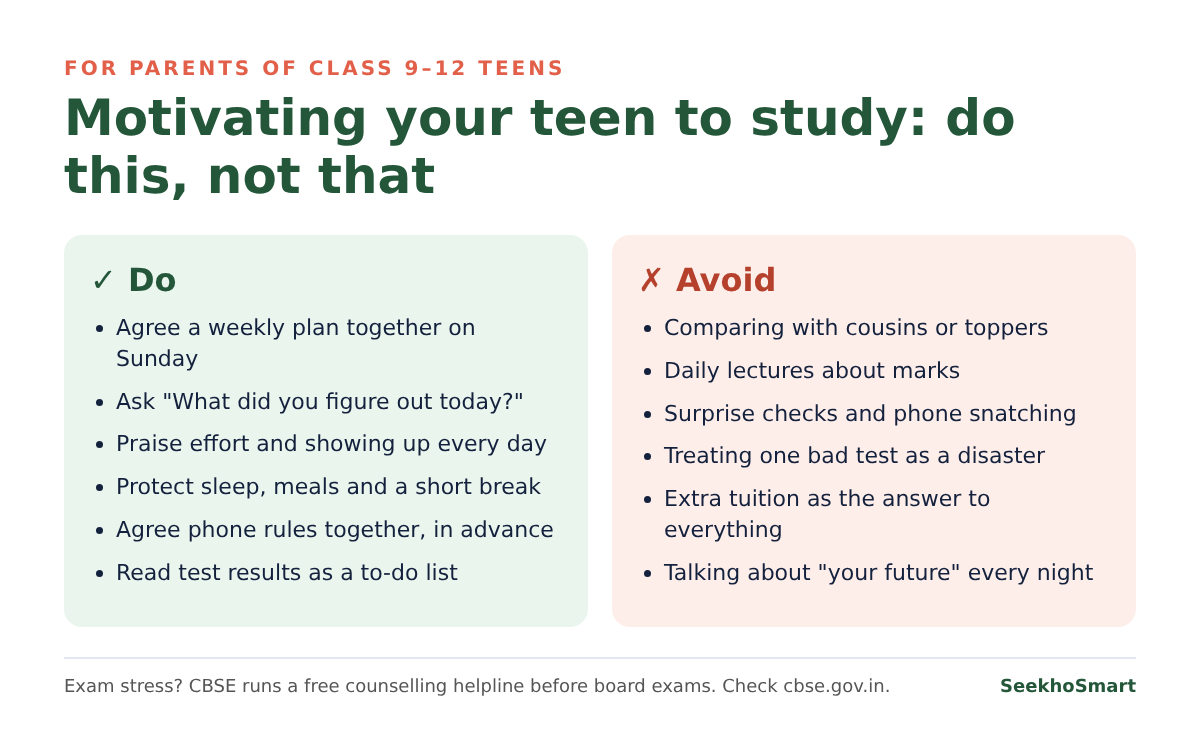
1. Plan the week together, not for them
Sit down for 20 minutes every Sunday. Ask your child to list what's due: tests, chapters, practical files. Then let them propose the plan. Your role is to ask questions ("Is Thursday too full?"), not to dictate. A plan your teen made is a plan your teen owns.
2. Make starting easy
The hardest part of studying is the first five minutes. Agree on a simple rule: "Just 25 minutes, then a 5-minute break." Once a teen starts, they often continue. Keep the study table clear and the books ready the night before.
3. Agree on phone rules in advance
Snatching the phone in anger leads to fights. Instead, agree together on rules such as "phone charges outside the room during study blocks" or "no phone after 10:30 pm". Follow the same rule yourself where you can. Teens notice.
4. Change the questions you ask
Instead of "How many marks?" or "Did you study today?", try:
- "What did you figure out today?"
- "Which chapter feels hardest right now?"
- "What would make this week easier?"
These questions show you care about learning, not just scores. Your child is also more likely to tell you what's really going on.
5. Praise effort and consistency, not only results
"You studied every day this week" is worth saying out loud. Consistency is what builds results in the board year. And praise that's about effort keeps a child going even after a bad test.
6. Read test results as a to-do list
Pre-board results will come home soon. A low score is information, not a disaster. Ask: Which chapters? Was it not knowing, careless mistakes, or running out of time? One school principal described pre-boards as "an important diagnostic exercise", not the final destination (Khaleej Times). Take that attitude home with you.
7. Protect sleep, food and a little fun
A tired brain can't learn. Keep sleep timings fixed, especially in the weeks before exams. Keep short breaks for a walk, a game, or a chat. Cutting out all fun usually makes motivation drop.
8. Don't compare
"Look at Sharma ji's son" has never motivated a single teenager. Comparison makes them anxious and puts them off. Compare your child only with their own last month.
What to say (and not say) on a bad day
| Instead of… | Try… |
|---|---|
| "You never study." | "I noticed you're finding it hard to start. What would help?" |
| "You'll fail at this rate." | "Let's look at which chapters need the most time." |
| "Why can't you be like your cousin?" | "You did better at sticking to your plan this week." |
| "No phone until the boards!" | "Let's agree on phone rules for study time together." |
Know the timeline (so you stay calm too)
Parents worry more when dates are unclear. Here is what's known so far:
- CBSE released the 2026-27 sample papers and marking schemes on 21 September 2026 (Careers360). Ask your child to solve these under time at home.
- The official 2027 date sheet had not been released at the time of the latest reports; the board exams are expected in February–March 2027 (Khaleej Times).
- Students need at least 33% to pass (Careers360 live updates). Check final dates only on cbse.gov.in and your school notices.
When it's more than motivation
Sometimes a teen is not lazy but genuinely stressed or low. Watch for changes in sleep or appetite, pulling away from friends, or frequent headaches before tests. Talk gently, and get help if it continues.
CBSE runs a free psycho-social counselling service before board exams. In the 2026 cycle it started on 6 January 2026, with a toll-free helpline (1800-118-004) giving round-the-clock IVRS guidance in Hindi and English. A panel of 73 trained counsellors, principals and psychologists was available for students and parents (Careers360). Watch cbse.gov.in for the 2027 announcement, and speak to your school counsellor anytime.
How SeekhoSmart helps your child stay consistent
Motivation grows when studying feels doable and progress is visible. SeekhoSmart helps with both, without you having to nag.
- Adaptive daily study plan: your child gets a short, clear task list each day built around their weak chapters, so "where do I start?" stops being an excuse.
- Streaks and XP: small daily wins add up and are easy to see. You can check the streak instead of asking "Did you study today?"
- AI explanations, even for wrong answers: when a chapter makes no sense, your child gets a clear explanation instead of giving up, in Hindi or English.
It is NCERT-aligned for Class 9–12 and free to start.
Try it free with your child → seekhosmart.in
Frequently asked questions
How to motivate a teenager to study?+
Plan the week together, make starting easy with short 25-minute blocks, agree phone rules in advance, praise effort and consistency, and read test results as a to-do list instead of a verdict.
How to motivate a child to study at home?+
Keep a clear study space, fixed sleep and meal times, and a weekly plan your child helped make. Ask what they figured out today rather than how many marks they got.
How to reduce board exam stress?+
Break revision into small daily tasks, protect sleep, avoid comparisons, and use support: in the 2026 cycle CBSE ran a free counselling helpline (1800-118-004) for students and parents. Watch cbse.gov.in for the 2027 announcement.
How to encourage a child to study well without nagging?+
Swap reminders for structure: a shared weekly plan, visible daily progress, and effort-based praise. Teens resist control but respond to ownership.
- SeekhoSmart (infographic)
- Pratham Books / Wikimedia Commons (CC BY 2.0)
- Nayakyashraj / Wikimedia Commons (CC BY-SA 4.0)