If you teach Class 9 or 11, someone has probably handed you a thick PDF and said, "From this year, we fill the HPC." Then came the questions. Who fills which page? How do I rate 45 students on "sensitivity"? When will I find the time?
This guide answers those questions using the official secondary-stage card from PARAKH, NCERT. It explains what each part is for, who fills it, and a simple term plan so the Holistic Progress Card becomes part of your teaching instead of extra paperwork.
What is a Holistic Progress Card?
NEP 2020 asked schools to replace the marks-only report card with a "multidimensional report that reflects in great detail the progress" of each learner (Careers360). PARAKH, the assessment centre at NCERT, designed the HPC templates for each school stage.
In the words of PARAKH's CEO, Prof. Indrani Bhaduri, assessment becomes "a continuous and inclusive process" that brings in self-assessment, peer assessment and teacher feedback (Careers360).
It is spreading. On 1 October 2026, Manipur's Council of Higher Secondary Education launched the secondary-stage HPC in 46 schools in phases, with PARAKH-NCERT. Its board exam stays as the year-end summative assessment, and the HPC covers continuous assessment through the year (The Frontier Manipur).
That split is the most useful way to think about it. Board marks show what a student scored. The HPC shows how they learn, plan and work with others.
What is inside the secondary-stage HPC
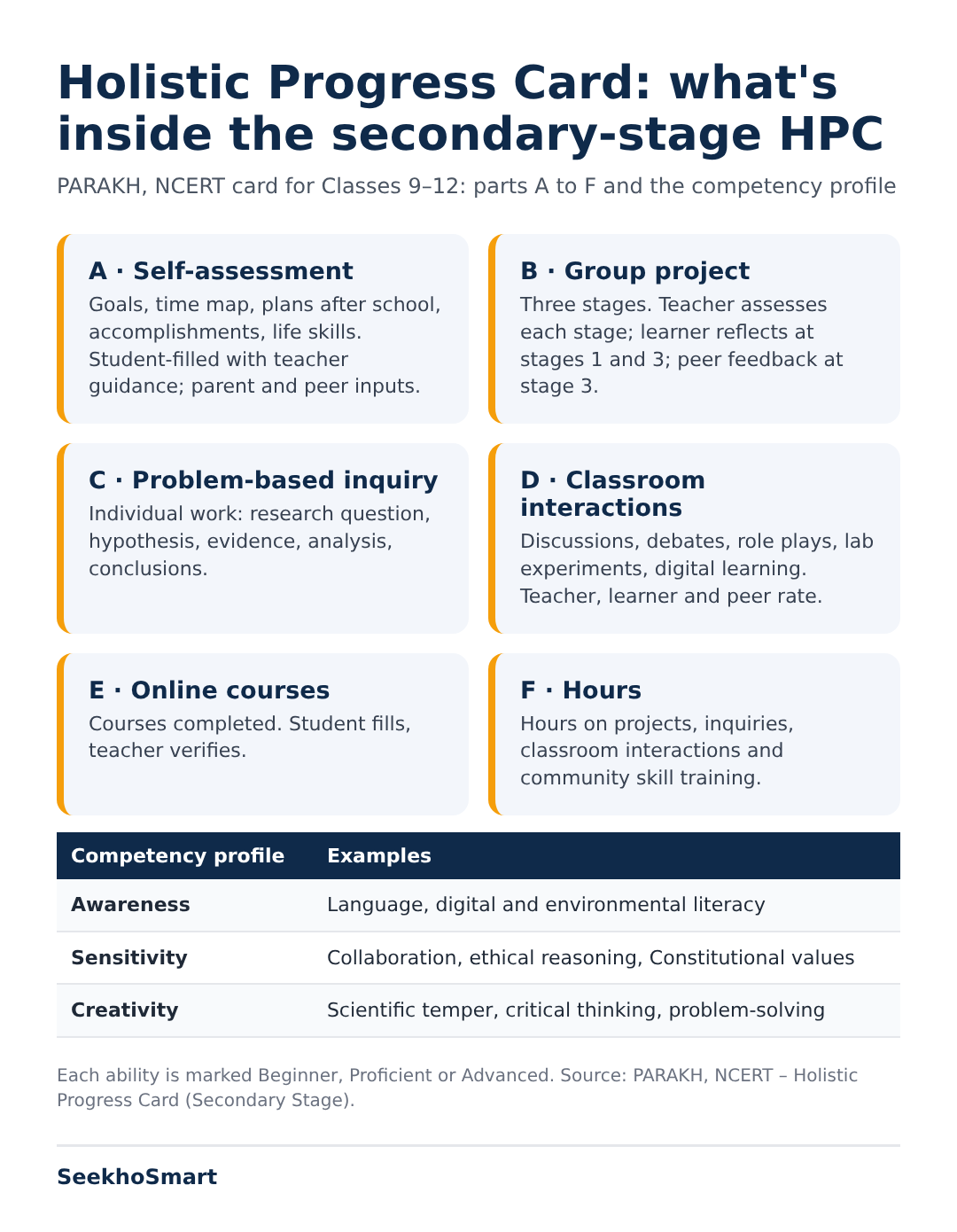
The official Classes 9–12 card has these parts:
Part A: Self-assessment and planning
The student fills this in with your guidance. It covers general information and attendance, goals (short, medium and long term), a time-management checklist and "time map", plans after school, an accomplishments inventory and life skills. Parents add feedback on the "Future Self" page, and a peer comments on the student's schedule.
Part B: Group project work
Each project runs in three stages. You assess at every stage. The learner reflects at stages 1 and 3, and peers give feedback at stage 3. You also note the pedagogy (art-integrated, experiential, skill-based), the curricular goals and the competencies targeted.
Part C: Problem-based inquiry
Individual work with a research question, hypothesis, evidence, analysis and conclusions. It follows the same stage structure as Part B.
Part D: Classroom interactions
An observation template for discussions, debates, role plays, lab experiments and digital learning. Teacher, learner and peer forms each rate the activity.
Parts E and F: Hours
Online courses completed (Part E), and hours spent on projects, inquiries, classroom interactions and community skill training (Part F).
The competency profile
Across Classes 9–12, students are rated on three abilities: Awareness (for example language, digital and environmental literacy), Sensitivity (for example collaboration, ethical reasoning and Constitutional values) and Creativity (for example scientific temper, critical thinking and problem-solving). Each is marked Beginner, Proficient or Advanced.
Who fills what: a quick reference
| Part | Mainly filled by | Your role |
|---|---|---|
| A – Self-assessment | Student, with parent and peer inputs | Explain, guide, check once |
| B – Group project | Teacher, learner, peers | Assess each stage, add brief comments |
| C – Inquiry | Teacher, learner | Assess each stage, add brief comments |
| D – Classroom interactions | Teacher, learner, peers | Observe and rate |
| E, F – Hours | Student | Verify |
The card itself says Part A should be filled "in the guidance of teacher". Your job is to coach students to reflect honestly, not to write it for them.
A term plan that keeps the HPC manageable
The biggest mistake is treating the HPC as a form to fill in the last week of term. Spread it across the term instead.
- Week 1–2: Set up Part A. Spend one period explaining goals and the time map. Students fill it at home and discuss with parents.
- Weeks 3–8: Run one group project (Part B). Pick a chapter you already teach through an activity. Fill the stage 1, 2 and 3 assessments as the project runs, not after.
- Every two weeks: One Part D observation. Choose an activity you were doing anyway, such as a debate or lab practical, and rate only the students in that group.
- Weeks 9–12: Problem-based inquiry (Part C) for older classes, or a second project.
- End of term: Overview pages and the competency profile. By now you have evidence, so the ratings take minutes, not days.
Tips to save time
- Rate groups, not the whole class, each day. Five students per observation is realistic.
- Use the card's own descriptors. The parameters are illustrative, and the card lets you adapt them to your task and classroom.
- Let students hold the evidence. A simple folder or notebook per student, with project sheets and reflections, saves you from hunting later.
- Split the work across subjects. If the Science teacher runs a project and the Social Science teacher runs an inquiry, no one carries the whole card.
Writing comments that actually help
The card asks for "brief comments and pedagogical interventions recommended" at each stage. Keep them short, specific and forward-looking. Here are examples you can adapt:
- "Collected good data in stage 2. Next step: explain what the data means, not just list it."
- "Leads discussion well. Next step: invite quieter group members before giving your view."
- "Strong idea, missed two deadlines. Next step: use the time map to plan project work weekly."
Avoid labels like "weak" or "careless". Parents read this card, and a clear next step helps them support their child at home.
Common doubts teachers raise
"Is the HPC replacing marks?" No. In Manipur's rollout, for example, the board exam remains the summative assessment and the HPC sits alongside it. Check your own board's and school's instructions on how the two are combined.
"What if students rate themselves too high?" That is useful information too. Compare their self-rating with your observation and talk about the gap. That conversation is the point of self-assessment.
"Do I need software?" Not to start. The PARAKH PDF works on paper. If your school wants, it can move to your ERP or a spreadsheet later.
How SeekhoSmart helps with the HPC and day-to-day practice
The HPC asks students to own their learning, plan their time and reflect on mistakes. SeekhoSmart can support that outside class. Its adaptive daily study plan and streaks give each student a concrete record of how consistently they practise, which is useful when they fill their goals and time-management pages in Part A. Its AI explanations of every answer, including wrong ones, mean students can understand an error at home instead of bringing every doubt to you the next morning. And the NCERT-aligned practice and chapter-tagged PYQs let you point a class to the exact chapter you just taught. It is free to start, so you can share it with your students without asking the school for a budget.
Share SeekhoSmart with your students → seekhosmart.in
Padhai, ab smart tareeke se.
Frequently asked questions
Holistic progress card kya hai (what is it)?+
It is a report card designed by PARAKH, NCERT under NEP 2020 that records a student's self-assessment, projects, inquiry work, classroom participation and competencies, not just marks.
Where can I find a holistic progress card sample or PDF?+
The official secondary-stage (Classes 9–12) card is on the PARAKH website at parakh.ncert.gov.in. Separate cards exist for the earlier stages.
Who fills the holistic progress card?+
Students, peers, parents and teachers all contribute. Students fill most of Part A with teacher guidance. Teachers assess projects, inquiries and classroom interactions and complete the competency profile.
How are students rated in the HPC?+
On three abilities (Awareness, Sensitivity and Creativity) at three levels: Beginner, Proficient and Advanced.