Two CBSE circulars from the past few weeks give secondary and senior secondary teachers free tools for the rest of this session. The first points you to more than 845 curriculum-aligned DIKSHA virtual labs, mostly for Science and Maths. The second opens Cycle 2 of NISHTHA courses for 2026-27, which runs until March 2027.
Both can easily become "one more circular" that gets forwarded on WhatsApp and forgotten. This guide explains what each one offers, then gives you a simple way to use them this term without adding hours to your week.
What the CBSE circulars actually say
Virtual labs on DIKSHA (Circular TRG-16/2026, 13 August 2026)
According to CBSE Circular TRG-16/2026, the Ministry of Education and the Ministry of Electronics and IT, through CIET-NCERT, have built a repository of more than 845 virtual labs, mostly in Science and Mathematics. They are mapped to NCERT curricula, learning outcomes, classes, subjects and chapters.
The circular lists five ways to reach them:
- The DIKSHA portal and mobile app, organised grade-wise, subject-wise and chapter-wise
- QR codes in NCERT textbooks, printed at the beginning of chapters
- Grade-wise QR codes that link to labs for every subject and chapter
- Ask DIKSHA, an AI-powered search feature
- DIKSHA PAL (Personalised Adaptive Learning) courses
Principals have been asked to share this and encourage students and teachers to use it.
NISHTHA Cycle 2 (Circular TRG-21/2026, 7 October 2026)
CBSE Circular TRG-21/2026 announces Cycle 2 of NISHTHA courses for October 2026 to March 2027. NISHTHA is the Ministry of Education's flagship professional development programme for teachers and school heads.
The FLN and ECCE courses in Category II are meant for foundational and preparatory stage teachers (up to Grade 5). For Class 9–12 teachers, the relevant ones are the Category III (Advanced) courses, which are open to all school heads and teachers. The CIET-NCERT NISHTHA page lists their durations:
| Course | Duration |
|---|---|
| Cyber Hygiene Practices: Personal Digital Devices | 5 hours |
| Environmental Hazards of Electronic Waste (E-waste) | 2 hours |
| Action Research | 15 hours |
| Catch the Rain (English and Hindi) | 2 hours |
Key dates: the courses started on 1 October 2026, enrolment closes on 10 March 2027, and the courses close on 15 March 2027. Courses open on the DIKSHA learning portal. For help, the circular gives the NISHTHA helpdesk at nishtha.helpdesk@ciet.nic.in and the toll-free number 8800440559.
Why these two belong together
Virtual labs and the NISHTHA Action Research course fit together naturally. Action research means picking one real classroom problem, trying a change, collecting simple evidence and reflecting on it. "Do virtual labs help my Class 9 students understand this practical better?" is a perfect, small action research question, and you would be taking the course anyway.
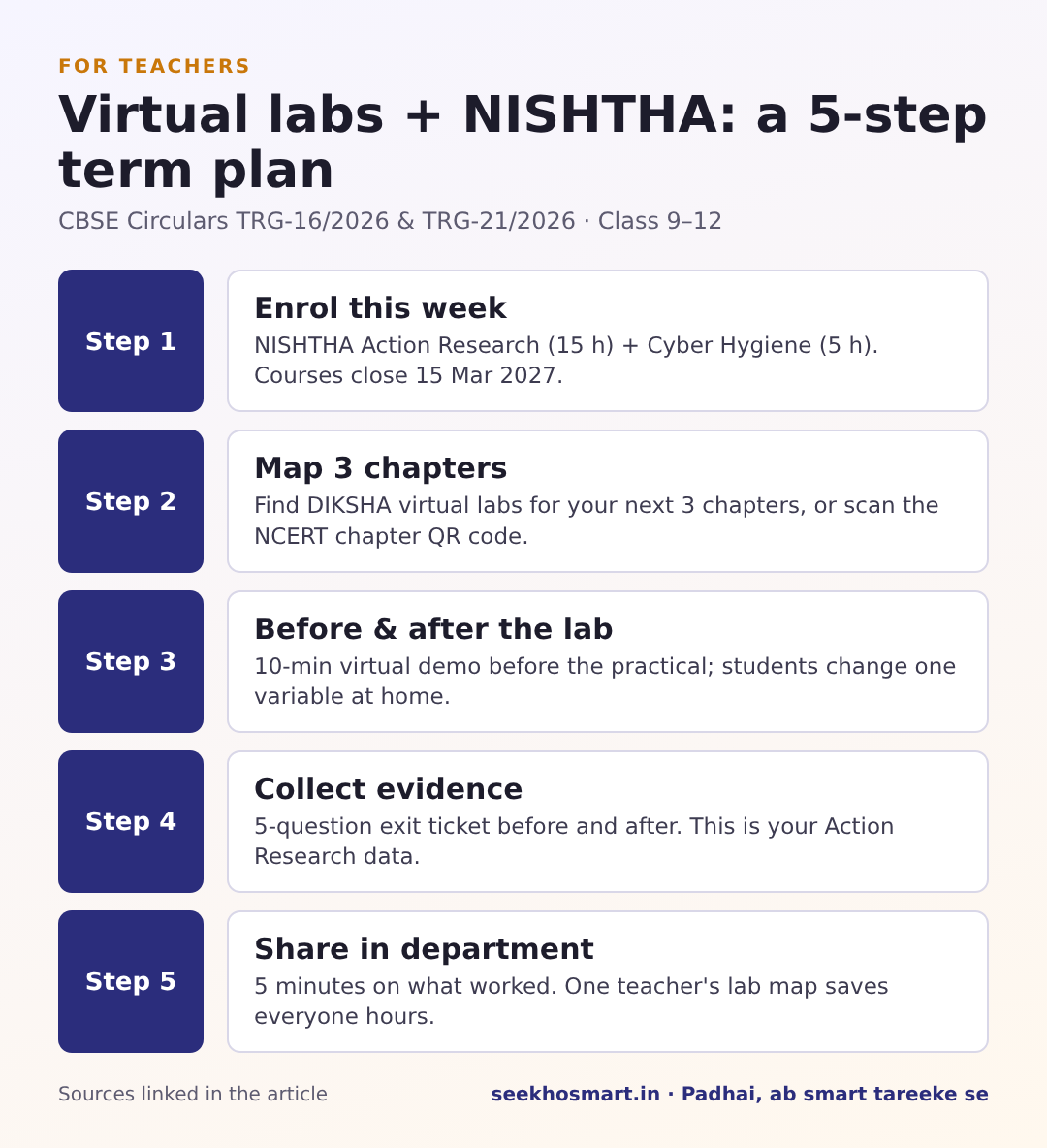
A five-step plan for this term
Step 1: Enrol this week, then go slow
Enrol in the Action Research course (15 hours) and one short course, such as Cyber Hygiene (5 hours), on DIKSHA. Spread them across the term at one hour a week. Enrolment is open until March, but the courses close on 15 March, so finishing early avoids the board-exam rush.
Step 2: Map labs to your next three chapters
Open DIKSHA, search for your class and subject, and list the virtual labs for the next three chapters you will teach. Or scan the QR code at the start of the NCERT chapter. Fifteen minutes now saves you searching on the day.
Step 3: Use labs before and after the real practical
Virtual labs work best alongside the physical lab, not as a replacement. A simple pattern:
- Before the lab (10 minutes): Show the virtual lab on the classroom projector. Students predict what will happen and note the steps.
- In the physical lab: Students now spend their time observing and recording, not working out the procedure.
- After the lab (homework): Students revisit the virtual lab on a phone and change one variable to see what happens. This is very useful where lab time is limited.
For Class 10 and 12, this also helps with case-based and experiment-based questions, which ask students to reason about a set-up they may not have handled themselves.
Step 4: Collect simple evidence
Keep it light. A five-question exit ticket before and after the virtual lab lesson is enough. Note how many students could explain the procedure, the precautions or the result. This becomes the evidence for your Action Research project.
Step 5: Share in your department meeting
Spend five minutes in a department meeting on which labs worked and which didn't. One teacher's mapping of labs to chapters can save the whole Science department hours.
Practical tips
- Low bandwidth? Download what you need on school Wi-Fi the day before. Don't count on streaming during class.
- Phones at home: Not every student has a device. Make the at-home virtual lab optional and offer a lab-period slot for those who need it.
- Don't over-do it: One virtual lab per chapter, used well, beats five rushed ones.
- Cyber Hygiene for you, too: Teachers handle student data on phones and laptops. That short course is worth two hours of your time.
How SeekhoSmart supports your students between classes
Virtual labs help students see a concept. They still need regular practice to answer board questions on it, and you can't check every student's practice by hand. SeekhoSmart can take part of that load.
- NCERT-aligned practice with a chapter-tagged PYQ bank. After your lab lesson, students can practise exactly the board questions from that chapter, covering ten years of PYQs.
- AI explanations of every answer, including wrong ones. Students get a clear explanation the moment they slip, so fewer of the same doubts reach you the next day.
It is free to start and has a Hindi/English switch, which helps mixed-medium classes. Padhai, ab smart tareeke se.
Share it with your students → seekhosmart.in
Frequently asked questions
What are DIKSHA virtual labs?+
They are a repository of 845+ curriculum-aligned virtual labs, mostly in Science and Maths, built by CIET-NCERT for MoE and MeitY and mapped to NCERT classes, subjects and chapters (CBSE Circular TRG-16/2026).
Which NISHTHA courses are running in 2026-27 Cycle 2?+
Category II: FLN and ECCE (for teachers up to Grade 5). Category III, open to all teachers and heads: Cyber Hygiene, E-waste, Action Research and Catch the Rain (CBSE Circular TRG-21/2026).
What is the last date for NISHTHA Cycle 2 2026-27?+
Courses started on 1 October 2026. Enrolment closes on 10 March 2027 and courses close on 15 March 2027.
How long is the NISHTHA Action Research course?+
The CIET-NCERT NISHTHA page lists it as 15 hours.
- SeekhoSmart (infographic)
- worldsikhorg / Pexels
- Fahad Puthawala / Pexels