If your Class 10 students can recite every definition but freeze when a question starts with a newspaper clipping or a graph, you are not alone. The board paper now rewards students who can use what they learnt, and that skill is built in everyday periods, not in a revision week in February.
This guide covers what CBSE means by competency based questions (CBQs), their share in the 2027 paper, free CBSE resources, and a simple weekly classroom routine.
What CBSE means by competency based questions
CBSE's Competency-Based Education resource portal describes competency-based education as an approach that "focuses on the student's demonstration of learning outcomes", with an emphasis on "real-world applications of knowledge and skills". Simply put, a CBQ checks whether a student can apply a concept in a new situation.
The same portal quotes NEP 2020, which calls for a shift away from assessment that "primarily tests rote memorization skills" to one that "is more competency-based" and "tests higher-order skills, such as analysis, critical thinking and conceptual clarity".
According to CBSE's Secondary Curriculum 2026-27 (Part 1), competency-focused questions in board papers include:
- Case-based questions built around a short situation or passage
- Source-based questions using an extract, map, table or document
- Integrated questions that join ideas from more than one chapter
- Data interpretation from graphs and tables
- Situational and application-oriented questions set in real-life contexts
The sample papers also use assertion-reason items, which test whether a student understands why something is true, not just that it is true.
How much of the 2027 board paper is competency-focused
Section 3.1 of the 2026-27 secondary curriculum says that "presently, approximately 50% of the questions are competency-focused". The rest are MCQs and short- and long-answer questions. CBSE adds that "this structure may be reviewed periodically", so keep an eye on cbseacademic.nic.in.
The same document asks schools to make at least one of the three periodic assessments "competency-based and application-oriented". So CBQ practice is now part of your internal assessment as well as the board exam.
What the 2026-27 sample papers show
CBSE's notification of 21 September 2026 releasing the 2026-27 Sample Question Papers says, "There is no change in the question paper design and assessment pattern for the Academic Session 2026-27", and it tells schools to use SQPs in classroom teaching "with an overall focus on promoting the application of concepts in real-life".
From the Class X SQP page:
- Maths Standard: 38 questions. Q19–20 are assertion-reason (1 mark each), and Section E has three case study-based questions of 4 marks each.
- Science: 39 questions in three sections (Biology, Chemistry, Physics), with assertion-reason items in each section and many MCQs set around experiments and observations.
What about Class 12?
The Class XII 2026-27 SQPs follow the same idea. The Physics SQP, for example, has four assertion-reason questions and two 4-mark case study-based questions. The Senior Secondary Curriculum 2026-27 (Part 2) says board papers "will have more questions based on real-life situations", but this document does not give a percentage for Class 12.
Free CBQ resources CBSE has already made for you
You don't need to write every question yourself. CBSE already offers:
- CBSE Question Bank for Class X – separate PDFs for English, Maths and Science. The Science file is a set of sample case studies with answer keys.
- CBE Assessment resources – curriculum-aligned competency based test items in Maths, Science and English for Classes 6–10, developed with Sri Aurobindo Society and ACER, plus item banks from CBSE's project with the British Council.
- Teacher Energised Resource Manuals (TERMs) – Grade 10 Maths and Science manuals aligned to NCERT learning outcomes, with sample assessments and strategies. Science is also available in Hindi.
- SQPs and marking schemes – the marking scheme is your best guide to how CBSE gives step marks.
A weekly CBQ routine that fits your normal timetable
The aim is small, regular practice without extra periods:
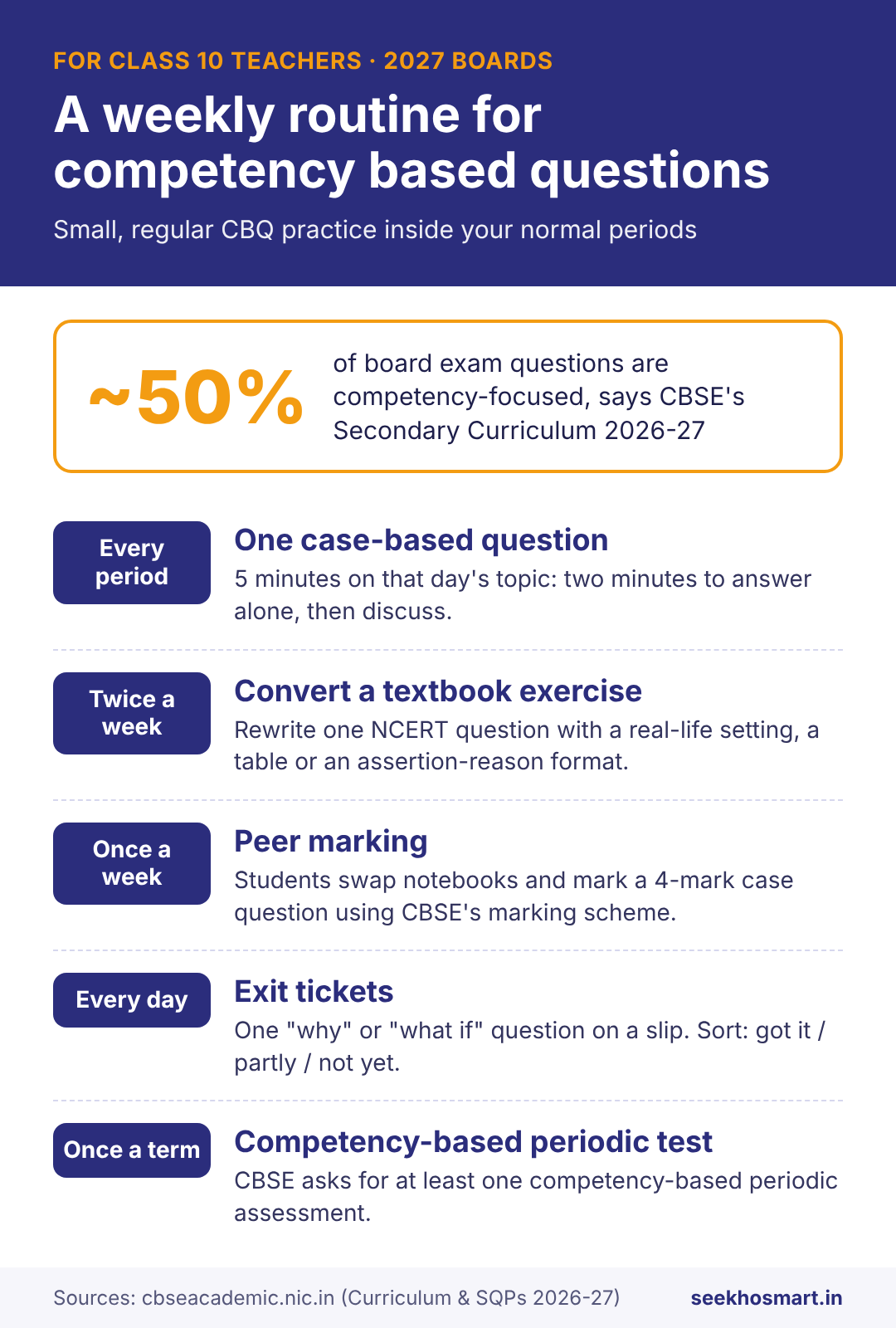
Every period: one case-based question (5 minutes)
Open or close the period with one short case or data question on that day's topic. Give two minutes to answer alone, then discuss. Use the CBSE question bank or TERMs at first, then your own questions.
Twice a week: convert one textbook exercise
Pick one NCERT exercise question and rewrite it with a real-life setting, a table, or an assertion-reason format. Students soon see that the concept is the same and only the packaging has changed.
Once a week: peer marking with the marking scheme
Give a 4-mark case question from an SQP. Students swap notebooks and mark each other's answers using CBSE's marking scheme. They learn where marks are given for steps, units and keywords, and you save checking time.
Every day: exit tickets
In the last two minutes, ask one "why" or "what would happen if" question. Students write the answer on a slip. Sorting the slips into "got it", "partly" and "not yet" tells you what to reteach the next day.
Once a term: one competency-based periodic test
Since the curriculum asks for at least one competency-based periodic assessment, plan it early and use the same formats students have practised all term.
How to write a good CBQ from an NCERT paragraph
A good CBQ has three parts: a short, believable context, a task that needs the concept to solve, and a clear answer you can mark consistently. Follow these steps:
- Choose a paragraph with a real-life link.
- Write a three- or four-line situation that does not give away the answer.
- Ask 3–4 sub-questions that move from recall to application to reasoning.
- Write the marking points before you give the question to students.
Worked example: Class 10 Science, pH and tooth decay
NCERT Class 10 Science, Chapter 2 "Acids, Bases and Salts" (section 2.3.1, chapter PDF) says that tooth decay starts when the pH of the mouth is lower than 5.5, that bacteria produce acids by breaking down sugar and food particles, and that toothpastes, which are generally basic, can neutralise the excess acid.
Case: Riya eats a toffee after lunch and goes back to class without rinsing her mouth. A school health check finds early tooth decay in many students of her class.
- (a) Below what pH does tooth enamel start to corrode? (1 mark – recall)
- (b) Explain how the toffee leads to a fall in pH in Riya's mouth. (1 mark – understanding)
- (c) Riya says, "I brush every morning, so my teeth are safe." Do you agree? Give a reason using the idea of neutralisation. (2 marks – application and reasoning)
Assertion-reason version: Assertion: Brushing with toothpaste after eating helps prevent tooth decay. Reason: Toothpastes are generally basic and neutralise excess acid in the mouth. (Both true; R explains A.)
One paragraph has become a full 4-mark case and a 1-mark assertion-reason item.
Saving time while drafting CBQs
Google has expanded its free AI training for Indian teachers. Business Today reported on 16 October 2026 that the AI Educator Series is a free, self-paced online course, that Google says it has trained more than 80,000 educators since May, and that Hindi and other language versions are expected later in October. Tools like these can help with first drafts, but always check every fact and answer against NCERT before using a question in class.
How SeekhoSmart helps your students practise CBQs
Students need more practice than class time allows. SeekhoSmart can carry that practice outside the classroom:
- 10-year PYQ bank tagged by chapter: after you finish a chapter, students can attempt past board questions from that chapter, so CBQ practice continues at home.
- AI explanations of every answer, including wrong ones: a student who picks the wrong option sees why it is wrong, so you spend less time on repeated doubts.
- Hindi/English switch: students in Hindi-medium or bilingual classes can read explanations in the language they think in.
It is NCERT-based and free to start. Padhai, ab smart tareeke se.
Give your Class 10 students daily CBQ practice → seekhosmart.in
Frequently asked questions
What is the meaning of competency based questions?+
They are questions that test whether a student can apply a concept in a new or real-life situation. CBSE lists case-based, source-based, integrated, data interpretation, situational and application-oriented questions as competency-focused.
How many competency based questions are there in the Class 10 board exam?+
CBSE's 2026-27 secondary curriculum says approximately 50% of board exam questions are competency-focused. The exact format varies by subject, so check that subject's 2026-27 sample paper.
Where can I get competency based questions for Class 10 Science and Maths in PDF?+
CBSE's Class X Question Bank page and its CBE Resources portal have free PDFs for Maths, Science and English, and the Grade 10 TERMs for Maths and Science include sample assessments.
Has the CBSE board exam pattern changed for 2027?+
No. CBSE's notification of 21 September 2026 says there is no change in the question paper design and assessment pattern for the 2026-27 session, and the passing criteria stay the same as in 2025-26.
- CBSE – Competency-Based Education (CBE) Resources
- Ministry of Education – National Education Policy 2020
- CBSE Secondary Curriculum 2026-27 (Part 1)
- CBSE Notification: Sample Question Papers for Classes X & XII, 2026-27 (21 Sep 2026)
- CBSE Sample Question Papers Class X 2026-27
- CBSE Sample Question Papers Class XII 2026-27
- CBSE Senior Secondary Curriculum 2026-27 (Part 2)
- CBSE Question Bank Class X
- CBSE CBE Resources – Assessment
- CBSE CBE Resources – Teacher Resources (TERMs)
- CBSE TERM Grade 10 Mathematics
- CBSE TERM Grade 10 Science
- NCERT Class 10 Science, Chapter 2: Acids, Bases and Salts
- Business Today – Google expands free AI training for teachers (16 Oct 2026)
- SeekhoSmart (infographic)
- Nikhita S / Unsplash
- Nikhita S / Unsplash
- Nikhita S / Unsplash