You have read the NCERT chapter twice. You know the formula. Then the question gives you a paragraph about a farmer, a bar graph and four options, and suddenly nothing feels familiar. That is a competency-based question, and it is now the biggest part of your CBSE board paper.
The good news: these questions are not harder than the old ones. They are just different. Once you know what they test and how to read them, they become some of the most predictable marks on the paper. This guide shows you exactly how.
What has changed in the CBSE paper, and what hasn't
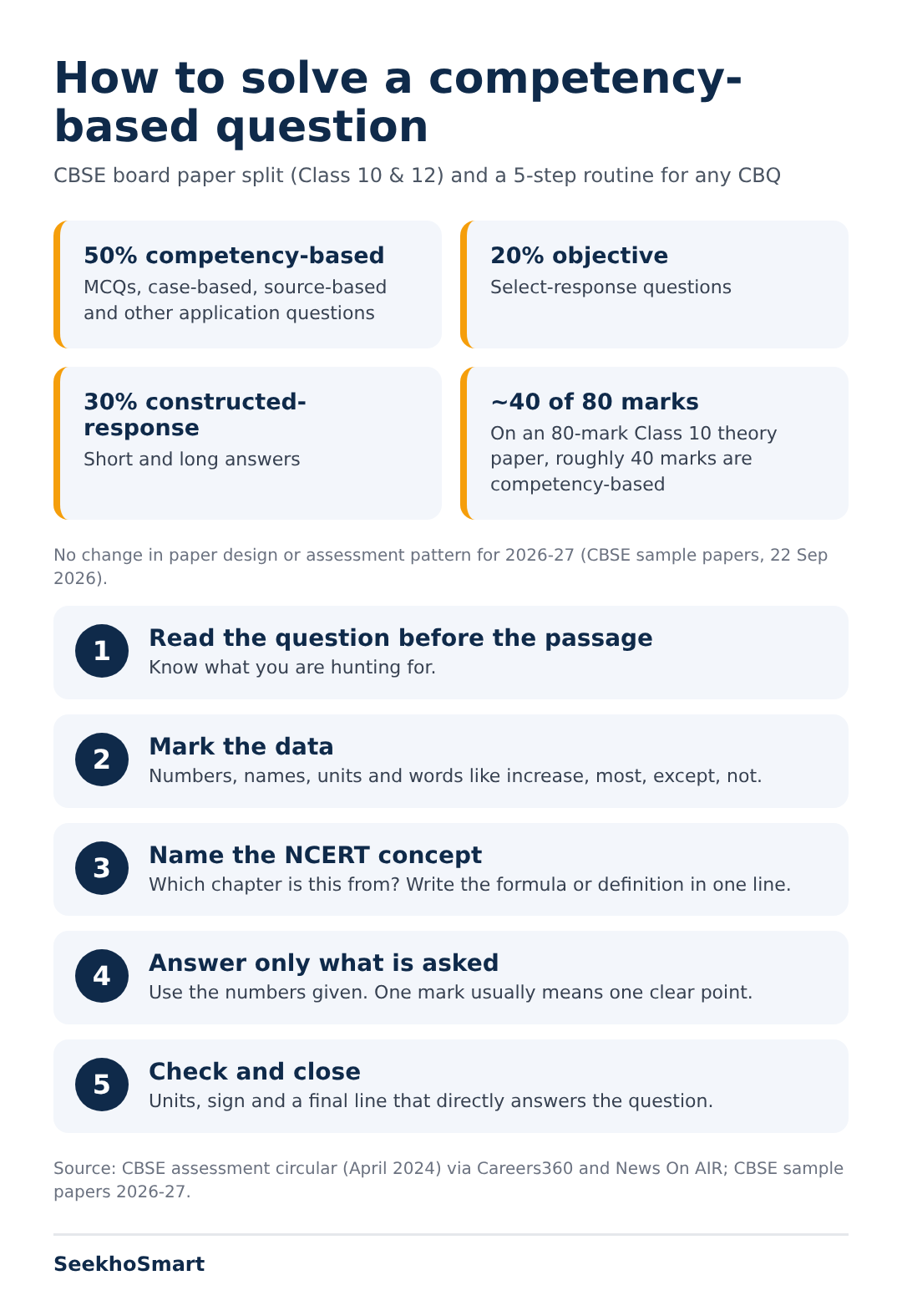
In April 2024, CBSE told schools that board papers would be split like this (Careers360, News On AIR):
- 50% competency-based questions: MCQs, case-based, source-based and other application questions
- 20% objective (select-response) questions
- 30% constructed-response questions: short and long answers
When CBSE released the 2026-27 sample papers on 22 September 2026, it said there is no change in the question paper design or assessment pattern for this session (ummid.com, CareerIndia). So the 50/20/30 split is what you should prepare for.
A few more facts worth knowing:
- In Class 10 English, Hindi, Maths, Science and Social Science, the theory paper is 80 marks and internal assessment is 20 (Careers360 live updates). On an 80-mark paper, roughly 40 marks are competency-based.
- Class 10 students get two board exam attempts. The first is expected from mid-February to early March 2027 and the optional second in May–June 2027. Your marksheet shows the better score (FindMyCollege).
- Dates are not final yet. Check cbse.gov.in before you plan around them.
What counts as a competency-based question?
A competency-based question (CBQ) gives you a situation and asks you to use a concept, not just recall it. You will usually see one of these:
Case-based questions
A short passage about a real situation, such as a family's electricity bill, a cricket ball's path or a village's water problem. Then 3–4 linked sub-questions. Maths and Science use these heavily.
Source-based questions
Common in Social Science and English. You get an extract from a text, a map, a newspaper report or a speech, and answer questions from it.
Assertion–reason questions
Two statements. You decide whether each is true and whether the reason correctly explains the assertion. These look easy but trap students who read too fast.
Data and diagram questions
A table, graph or labelled figure. You read values, compare them or draw a conclusion.
The key point: every CBQ is still built on an NCERT concept. The story around it is new. The science or maths inside it is not.
A 5-step method for any competency-based question
Use the same routine every time, and it becomes automatic by February.

- Read the question before the passage. Know what you are hunting for. A 4-mark case often has one sub-question that needs only the first two lines.
- Mark the data. Underline numbers, names, units and words like increase, most, except and not. In most CBQs, the answer is sitting in the text.
- Name the NCERT concept. Ask yourself which chapter this is from. Write the formula or definition in one line in the margin. This step turns a confusing story into a familiar question.
- Answer only what is asked. Use the numbers given, not the ones you remember from a solved example. One mark usually means one clear point.
- Check and close. Units, sign and a final line that directly answers the question. In Science, add a small labelled diagram if it helps.
For assertion–reason, add one extra check: decide if each statement is true on its own first, before you ask whether the reason explains the assertion.
Subject-by-subject tips
Maths: Most case studies hide a familiar chapter, such as quadratic equations in a garden-area problem or trigonometry in a tower-height problem. Draw a rough figure every time. Show steps, because marking schemes give step marks.
Science: Expect experiments, observations and everyday situations. Practise reading tables of readings and explaining why something happens, not just what happens.
Social Science: Source-based and map questions reward careful reading. Quote a phrase from the source in your answer to show you used it.
English: Reading comprehension and extract-based literature questions are competency-based by nature. Practise answering in your own words within the word limit.
A weekly practice plan from now to the boards
If session 1 starts in mid-February as expected, you have about 17 weeks. Two habits matter most, and both are backed by research on how memory works: testing yourself (retrieval practice) and spacing out your revision instead of cramming. Studies show both beat simple re-reading (Chartered College of Teaching).

Here is a simple weekly rhythm:
- Monday to Friday: Finish your NCERT chapter work as usual, then solve 3–5 CBQs from that chapter. Use the CBSE sample paper and marking scheme on cbseacademic.nic.in and previous-year questions.
- Saturday: Mixed set of 10 CBQs from older chapters. This is the spacing part. It feels harder, and that is why it works.
- Sunday: Check every wrong answer against the marking scheme. Write one line on why you got it wrong: misread, wrong concept or calculation slip.
From December, replace the Saturday set with one full timed section from a sample paper each week.
Common mistakes that cost marks
- Writing a long theory answer when the case asked for one value
- Ignoring the data in the passage and using a textbook example instead
- Marking assertion–reason answers without checking whether each statement is true
- Skipping the case because it "looks long", even though half its sub-questions are 1-mark
- Practising only chapter-end exercises and never a mixed set
How SeekhoSmart helps you practise competency-based questions
The hard part of CBQs is not finding questions. It is knowing why you got one wrong and practising the right chapter next. SeekhoSmart is built for exactly that. Its 10-year PYQ bank is tagged by chapter, so after you finish a topic in school you can pull up real board questions from that chapter in seconds. Every answer comes with an AI explanation, including the ones you got wrong, so you can see whether you misread the case or missed the concept. And the adaptive daily study plan brings older chapters back at the right time, giving you the spaced revision this guide recommends without making a timetable yourself. It's NCERT-aligned, works in Hindi or English, and is free to start.
Try SeekhoSmart free → seekhosmart.in
Padhai, ab smart tareeke se.
Frequently asked questions
What are competency-based questions in CBSE Class 10?+
They are questions that give you a real-life situation, passage, table or diagram and ask you to apply an NCERT concept. They include case-based, source-based and assertion–reason questions, and make up 50% of the theory paper.
Are competency-based questions in CBSE Class 10 Maths difficult?+
Not usually. Most Maths case studies use familiar chapters such as quadratic equations, trigonometry or statistics. Draw a rough figure, pick out the numbers and show your steps.
Do Class 12 CBSE papers also have competency-based questions?+
Yes. Since the 2024-25 session, Class 12 papers also follow the 50% competency-based, 20% objective and 30% constructed-response split.
Where can I get competency-based questions for Class 10 Science and Social Science?+
Start with the official CBSE sample papers and marking schemes on cbseacademic.nic.in, then move to previous-year board questions sorted by chapter.
- SeekhoSmart (infographic)
- Swastik Arora / Pexels
- Faisal Qureshi / Unsplash
- Shantanu Kumar / Pexels