If you teach Class 9 to 12, you have probably heard that ChatGPT is now "free for teachers". Then you tried to sign up and got stuck at verification. You are not alone. Many teachers in India are searching for exactly this.
Here is the short answer, and then the more useful part: how to actually use ChatGPT to save time on lesson plans, question papers and feedback, without risking student privacy or accuracy.
Is "ChatGPT for Teachers" free in India?
Not officially, as of now. OpenAI launched ChatGPT for Teachers on 19 November 2025. It is free for verified U.S. K–12 educators, and verification is done by a third party, SheerID. The page does not list India or any other country. That is why Indian teachers get stuck at the verification step.
The page also says content shared in that teacher workspace is not used to train OpenAI's models by default. Keep that in mind when you compare it with a personal account.
What Indian teachers can use instead
There are other routes worth knowing about.
- OpenAI Learning Accelerator. OpenAI announced 5 lakh free ChatGPT licences for teachers and students in India, to be distributed across schools and colleges over six months, with the Ministry of Education, AICTE and ARISE member schools as partners, according to Geekflare. The licences include training for teachers on lesson planning. Ask your principal whether your school is part of it.
- ChatGPT Go promotion. In October 2025, PTI reported that OpenAI would offer ChatGPT Go free for one year to users in India who signed up during a limited promotional period starting 4 November 2025 (Outlook Money). Go offers higher message limits and file uploads. Check the current offer in the app before you plan around it.
- The free ChatGPT plan, or other assistants. For most of the tasks below, the free plan is enough. Google's Gemini and Anthropic's Claude can do similar work; try the same prompt on each and keep the one that suits your subject.
Why this matters now: the Ministry of Education plans to bring AI into the school curriculum from Class 3 from the 2026-27 session, and a pilot already has teachers using AI tools to prepare lesson plans, according to a PTI report on Careers360. The same report says over one crore teachers need to be oriented. Teachers who learn the basics early will lead that change in their schools.
Rules to follow before you start
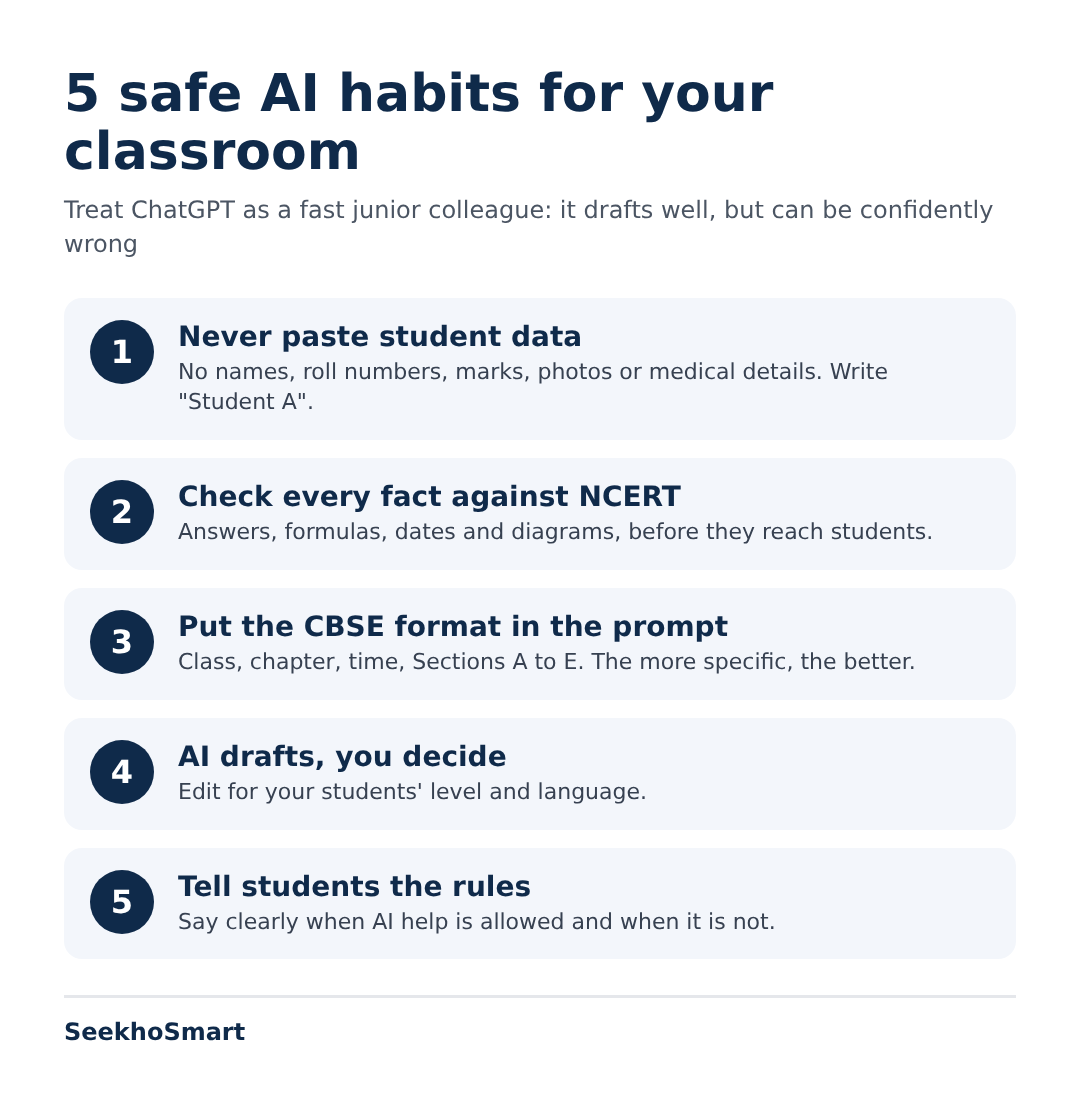
Think of ChatGPT as a fast junior colleague. It drafts well, but it can be confidently wrong. So:
- Never paste student data. No names, roll numbers, marks, photos or medical details. Write "Student A" instead.
- Check every fact. Verify answers, formulas, dates and diagrams against the NCERT textbook before they reach students.
- Give it the format. The more specific your prompt, the better the output.
- You make the final call. Edit for your students' level and language.
- Tell students your AI rules. Say clearly when AI help is allowed and when it is not.
8 ways to use ChatGPT for Class 9–12

1. Lesson plans in 10 minutes
Prompt: "Make a 40-minute lesson plan for CBSE Class 9 Science, Chapter: Motion. Include a 5-minute hook from Indian daily life, two activities for a class of 45, three check-for-understanding questions and a homework task."
2. Question papers in the CBSE board format
The 2026-27 CBSE Class 10 Maths and Science sample papers use Sections A to E: MCQs, very short, short, long and case-based questions, as summarised by Educart. Put that structure in your prompt.
Prompt: "Create a 40-mark unit test for Class 10 Maths, Chapter: Quadratic Equations, with Sections A–E like the CBSE sample paper: 8 MCQs, 2 very short, 2 short, 1 long and 1 case-based question. Add a marking scheme with step marks."
3. Case-based and competency questions
These are hard to write from scratch. Ask for real Indian contexts: "Write a case-based question on electricity bills in an Indian home for Class 10 Science, with four sub-questions of increasing difficulty."
4. One topic at three levels
For a mixed class: "Explain photosynthesis at three levels: for a student who is struggling, an average student and a strong student. Keep each under 150 words."
5. Worksheets and quick quizzes
Ask for ten MCQs with answer keys, or a fill-in-the-blanks revision sheet for the last chapter you taught.
6. Feedback rubrics
"Make a 4-level rubric for a Class 11 English argumentative essay: content, structure, language and conclusion." Use it to mark faster and more fairly.
7. Hindi and regional-language support
Ask ChatGPT to explain a concept in simple Hindi, then check the terms against the NCERT Hindi-medium textbook.
8. Parent messages and circular drafts
Draft a polite PTM reminder or a note about a weak test result. Remove any student details before you paste, and add them yourself afterwards.
Where ChatGPT gets it wrong
- Numbers and calculations: always re-solve maths and physics answers yourself.
- Syllabus details: it may not know this year's deleted or added topics. Your CBSE curriculum document is the authority.
- Diagrams: it describes them better than it draws them.
- Homework copying: students use it too. Ask for handwritten steps, oral follow-ups and questions linked to your own class discussion.
Start small this week
Pick one task that eats your evenings, such as making a unit test. Try it with ChatGPT once, check it carefully, and note how much time you saved. Then add a second task next week. In a month, you will know exactly where AI helps you and where your own judgement must stay in charge.
Let SeekhoSmart handle the practice, so you can teach
ChatGPT saves you time on drafts, but you still have to check every answer against NCERT, track this year's syllabus, and chase students who copy homework. SeekhoSmart is built to take that load off you.
- NCERT-based from the start. Practice follows the NCERT chapters your board exam is set from, so you are not fact-checking a general chatbot.
- Adaptive for a mixed class. Each student gets more practice on the topics they are weak in, the same "one topic at three levels" idea, without you writing three versions.
- Made for Class 9–12. From the Class 9 base to board-year revision.
Share it with your class for after-school practice, and spend your evenings on teaching, not on worksheets.
Sources
- A free version of ChatGPT built for teachers — OpenAI (19 Nov 2025)
- 5 lakh free ChatGPT licences and ₹4.5 cr grant: OpenAI's India plan — Geekflare
- OpenAI offers ChatGPT Go free for 1 year to users in India — Outlook Money / PTI (28 Oct 2025)
- Centre to introduce AI in school curriculum from Class 3 — Careers360 / PTI (11 Oct 2025)
- CBSE Class 10 Sample Papers 2026-27 — Educart
- Google autocomplete, India, checked 17 Oct 2026
Frequently asked questions
Is ChatGPT for Teachers free in India?+
OpenAI's free ChatGPT for Teachers plan is for verified U.S. K–12 educators. India is not listed. Indian teachers can use the free ChatGPT plan, or ask whether their school is part of OpenAI's Learning Accelerator licences.
How does ChatGPT for Teachers verification work?+
OpenAI uses a third-party partner, SheerID, to verify that you work at a U.S. K–12 school or district. That is why verification fails for teachers outside the U.S.
Is there a ChatGPT for teachers course?+
OpenAI says the Learning Accelerator licences in India include training for teachers on planning lessons and engaging students. Ask your school or check with CBSE and your state's teacher-training body for AI courses.
Can I make lesson plans with AI for free?+
Yes. The free ChatGPT plan can draft lesson plans, worksheets and tests. Give it the class, chapter, time and format, and check the output against NCERT.
- A free version of ChatGPT built for teachers — OpenAI
- 5 lakh free ChatGPT licences and ₹4.5 cr grant: OpenAI's India plan — Geekflare
- OpenAI offers ChatGPT Go free for 1 year to users in India — Outlook Money / PTI
- Centre to introduce AI in school curriculum from Class 3 — Careers360 / PTI
- CBSE Class 10 Sample Papers 2026-27 — Educart
- Yan Krukau / Pexels
- William Fortunato / Pexels
- SeekhoSmart (infographic)