If your child is in Class 9 in a CBSE school this year, you have probably heard the words "R3" and "third language" at a PTM or in the school WhatsApp group. Some parents are worried, some are confused, and many are simply not sure what has actually changed.
This guide explains the rule in plain words, using CBSE's own circulars wherever possible, and then gives you practical steps to help your child without adding stress.
What the CBSE three-language rule says
The rule was first announced in CBSE Circular Acad-33/2026, dated 15 May 2026. It says that from 1 July 2026, Class 9 students must study three languages, called R1, R2 and R3, and at least two of them must be native Indian languages. CBSE says the change aligns its scheme with NEP 2020 and the National Curriculum Framework (NCF-SE 2023).
A later circular, Acad-49/2026 dated 10 July 2026, added detailed guidelines and examples. Both are listed on the official CBSE academic circulars page.
R1, R2 and R3 in plain words
Think of them as language 1, language 2 and language 3. R1 and R2 are the languages your child already studies. R3 is the third language. CBSE calls native Indian languages "Bhartiya Bhashas" and gives examples such as Hindi, Sanskrit, Tamil, Telugu, Kannada, Malayalam, Marathi, Bengali, Punjabi, Gujarati, Odia and Assamese.
Where English and foreign languages fit
This is the part most parents ask about. In the circular, English is listed as a non-native language, along with French, German, Arabic and Spanish. A non-native language can be the third language only if the other two are Bhartiya Bhashas. A foreign language can also be taken as an additional fourth language.
CBSE's own examples in Acad-49 make it clearer:
- Hindi + Tamil: the third language can be another Indian language, or English or French.
- Tamil + English: the third language must be an Indian language.
- English + French: see the one-time relaxation below.
Which languages can your child choose?
Schools choose which languages they offer from CBSE's list of subjects. Careers360 reported that the board lists 44 languages in total. In practice, your child's options depend on the teachers your school has, so ask the school for its actual list.

How R3 is assessed: no Class 10 board exam
Many parents will find this the most reassuring part. Acad-33 states that no board exam will be held for R3 at the Class 10 level, and that "all assessments for R3 shall be entirely school-based and internal." It also says no student will be barred from the Class 10 board exams because of R3. The R3 result will still appear on the CBSE certificate.

The R3 Assessment Framework for Class 9 (Acad-46/2026, 2 July 2026) gives a total of 100 marks, all school-based:
- Listening and speaking: 40 marks (eight classroom activities of 5 marks each, such as introducing yourself, describing a picture or role play)
- Creative writing: 15 marks
- Reading: 20 marks and writing: 10 marks, based on the learning resource used in class
- Project work: 15 marks, including a viva
CBSE says R3 follows an "oral-first" approach, which means speaking and listening come before reading and writing. That is good news for a child who is starting a new script from zero. For study material, CBSE says NCERT is putting Class 9 "R3 Language Learning Resources" on ncert.nic.in.
The one-time relaxation for today's Class 9 students
Acad-49 gives special relief to students who are in Class 9 during 2026-27:
- They continue the same three-language combination they studied in Class 8, and simply mark one of those languages as R3.
- If a child has been studying two non-native languages (for example English and French), they may keep both, but must add one Bhartiya Bhasha as R3. This is described as a special one-time relaxation.
- Students in Class 10 in 2026-27 are not affected. They stay on the old two-language system.
- If your family moves to another state, your child may continue the same R3 language, and the school is expected to arrange support.
Children with Special Needs can get relaxations under the RPwD Act, 2016. CBSE schools outside India and foreign students returning to India are also exempted from studying a native Indian language as R3.
What if your child does not clear R3?
According to Acad-49, a current Class 9 student who does not clear the R3 school assessment will still be promoted to Class 10 in 2027-28. However, they must clear the Class 9 R3 assessment while in Class 10. To get the Class 10 pass certificate, students must clear R3 in the school-based assessment, and those who don't will be reassessed by the school before results are declared. News24 also summarised these rules.
Latest news: the Supreme Court case
The policy has been challenged before the Supreme Court. LiveLaw reported that on 14 July 2026 the Court declined to stay the policy while it heard the petitions. In a later hearing on 28 September 2026, LiveLaw reported that the Court directed CBSE to give current Class 6 students the same relaxation as Class 7, and asked CBSE to file a counter-affidavit. The main case is still pending.
Until the Court or CBSE says otherwise, the circulars apply. Keep an eye on LiveLaw's CBSE page and your school's notices, but don't let news headlines unsettle your child's routine.
What parents can do this term
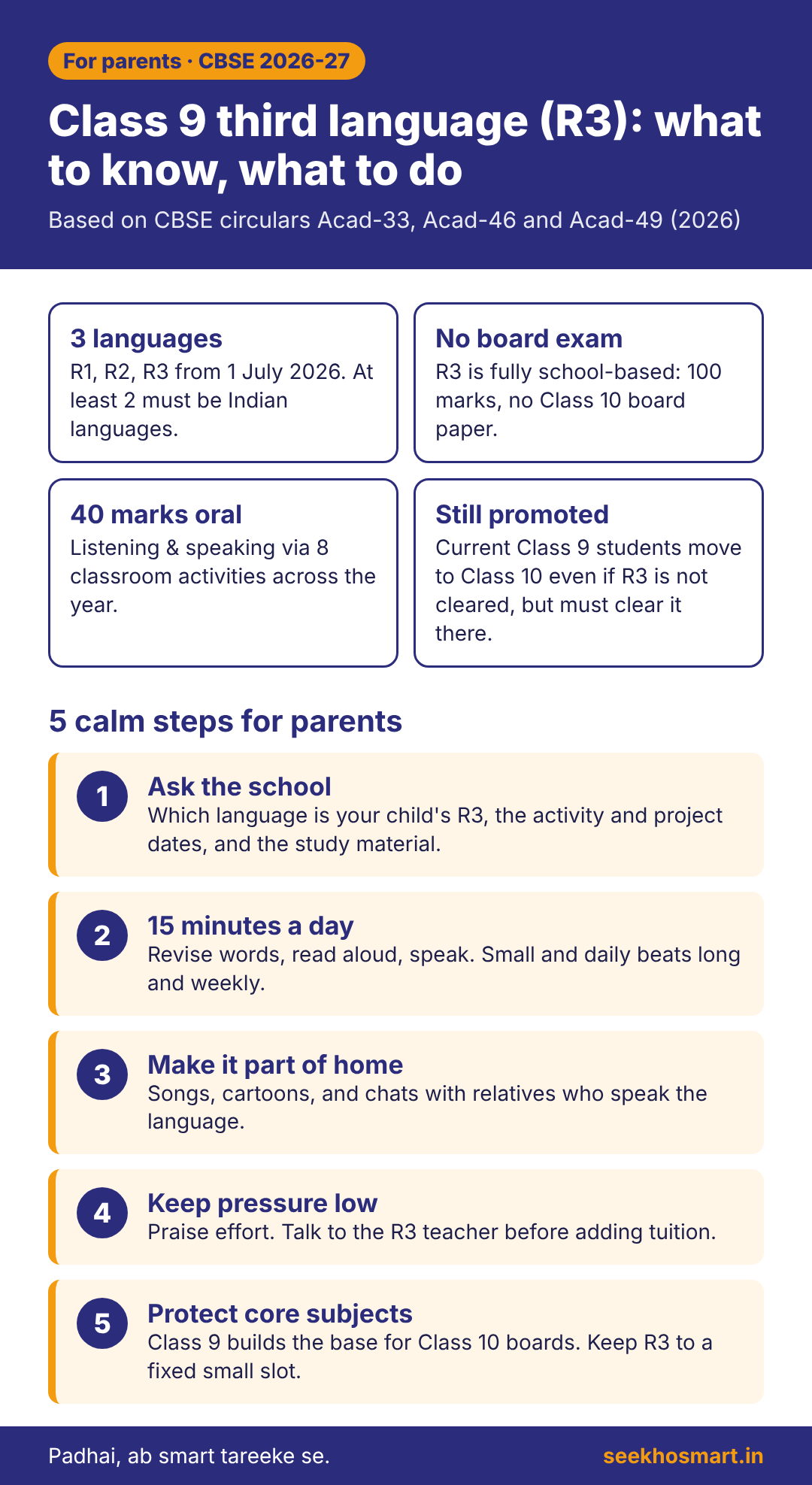
1. Talk to the school, early and specifically
Ask the class teacher or coordinator three things: which language is recorded as your child's R3, what the activity and project schedule looks like across the year, and what material is being used. Since 40 marks come from eight speaking and listening activities spread through the year, knowing the dates helps your child prepare calmly instead of at the last minute.
2. Give the new language 15 minutes a day
If R3 is new for your child, short daily practice works better than a long weekend session. Fifteen minutes is enough: five minutes revising words, five minutes reading aloud, five minutes speaking. Let your child teach you a few words. Children often remember best when they explain something.
3. Bring the language into daily life
Play songs, cartoons or short videos in that language. If a grandparent, neighbour or relative speaks it, ask them to chat with your child for a few minutes on the phone. For the project, CBSE suggests themes like local festivals, folk songs and stories, and it encourages students to gather information from family and the local community, so your family can genuinely help.
4. Keep the pressure low
The board itself says the focus is on "joyful, meaningful language learning, not on examination." Praise effort, not marks. If your child struggles with pronunciation or a new script, that is normal in the first few months. Avoid extra tuition in a panic. Talk to the R3 teacher first.
5. Protect the Class 9 foundation
Class 9 is the base for the Class 10 boards. Maths, Science, Social Science, English and your child's main languages still need steady daily attention. A simple rule: keep R3 to a fixed small slot each day so it never eats into core subject time.
How SeekhoSmart helps with balance in Class 9
The real challenge this year is not one language. It is keeping every subject moving while R3 takes some of your child's time. SeekhoSmart helps with that balance:
- An adaptive daily study plan keeps core NCERT subjects like Maths and Science on track in short, focused sessions, so time spent on R3 doesn't mean falling behind.
- AI explanations of every answer, including wrong ones, help your child understand mistakes on their own instead of waiting for the next tuition class.
- Streaks and XP let you see at a glance whether your child is studying regularly, without having to ask every evening.
It is free to start. Padhai, ab smart tareeke se.
Try SeekhoSmart free with your child → seekhosmart.in
Frequently asked questions
What is the CBSE three-language policy for Class 9?+
From 1 July 2026, Class 9 students study three languages (R1, R2, R3), with at least two native Indian languages. A foreign language can be the third only if the other two are Indian languages.
Is there a board exam for the R3 language in CBSE Class 9 or 10?+
No. CBSE says R3 is assessed only through school-based internal assessment, out of 100 marks in Class 9. There is no Class 10 board exam for R3 for current batches.
What is the latest news on the CBSE three-language policy in the Supreme Court?+
LiveLaw reported that the Court did not stay the policy in July 2026. In September 2026 it directed CBSE to give Class 6 the same relaxation as Class 7. The case is still pending.
What are the CBSE third language rules for students already in Class 9?+
They continue their Class 8 language combination and mark one language as R3. If they don't clear R3, they are still promoted to Class 10 but must clear it there.
- CBSE Circular Acad-33/2026 (15 May 2026): Alignment of Scheme of Studies for Languages in Classes IX & X
- CBSE Circular Acad-49/2026 (10 July 2026): Guidelines for Implementation of Three-Language Scheme
- CBSE Circular Acad-46/2026 (2 July 2026): R3 Language Assessment Framework for Class IX
- CBSE Academic – Circulars 2026
- Careers360 – CBSE changing Class 9, 10 syllabus from 2026-27; 3rd language compulsory
- NCERT – R3 Language Learning Resources
- News24 – CBSE releases fresh 3-language circular: R3 passing rules, migration relief
- LiveLaw – Supreme Court refuses to stay CBSE's 3 language policy (14 July 2026)
- LiveLaw – CBSE 3-language formula: grant Class 6 same relaxation as Class 7 (28 Sept 2026)
- LiveLaw – CBSE tag page
- SeekhoSmart (infographic)
- RDNE Stock project / Pexels
- Anil Sharma / Pexels
- Sanket Mishra / Pexels