Every CBSE teacher knows the line by now: 50 hours of training every year. What is less clear is where those hours should come from, which programmes count, and how to fit them around classes, copies and board-exam duties.
October is a good time to sort it out. The CBSE Training Unit's Prashikshan Triveni portal posted two new circulars on 5 and 7 October 2026, and a fresh cycle of NISHTHA online courses opened on 1 October. This guide explains the rule, where to find hours this session, and a simple plan to finish without a December rush.
The 50-hour CPD rule in plain words
CBSE asks every teacher and school head in affiliated schools to complete 50 hours of Continuous Professional Development (CPD) each year. The circulars, announced on 1 April 2025, link this to NEP 2020 and the National Professional Standards for Teachers, as reported by Gulf News.
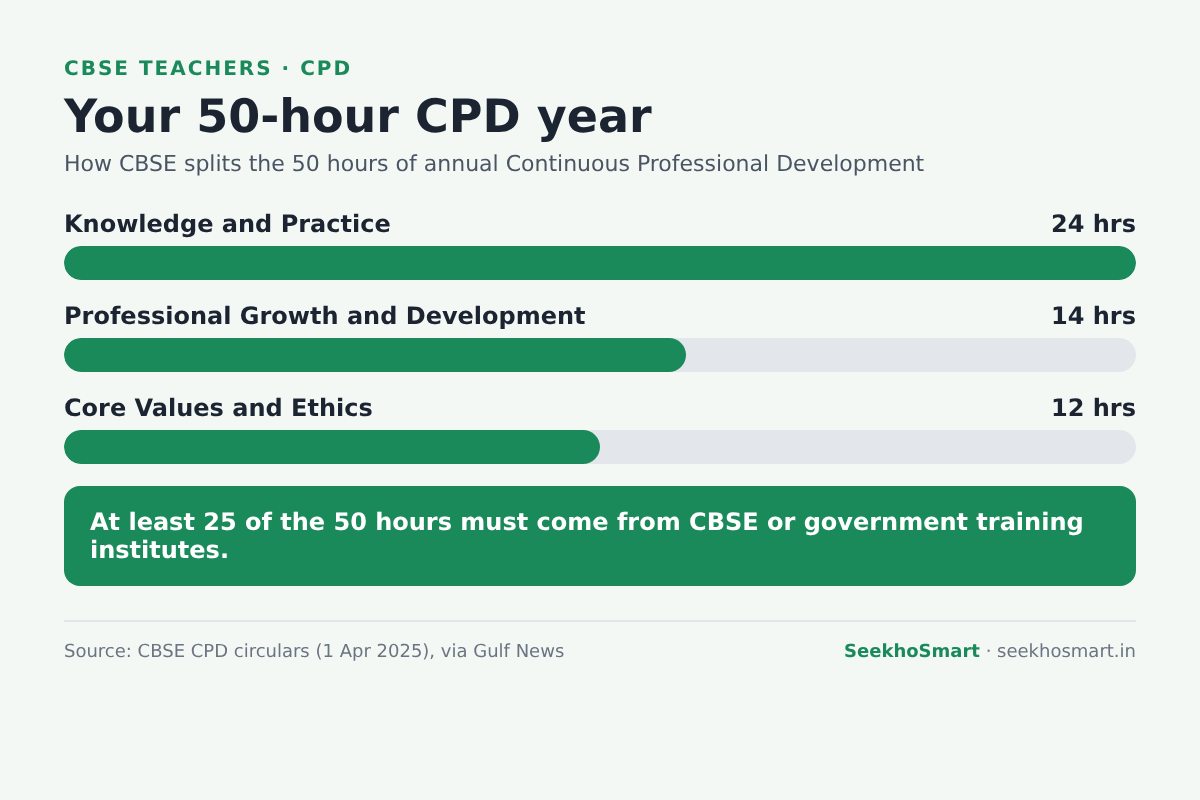
The 50 hours are split across three areas:
| Area | Hours |
|---|---|
| Knowledge and Practice | 24 |
| Professional Growth and Development | 14 |
| Core Values and Ethics | 12 |
Two more points from the same report:
- At least 25 hours must come from CBSE or government training institutes. The rest can be in-house or collaborative sessions.
- Academic work can count too, such as board exam duties, research projects, conference participation, curriculum development and e-content creation.
Heads of schools are expected to lead by example, and CBSE calls the norm mandatory for all affiliated institutions.
Where to find your hours in 2026-27
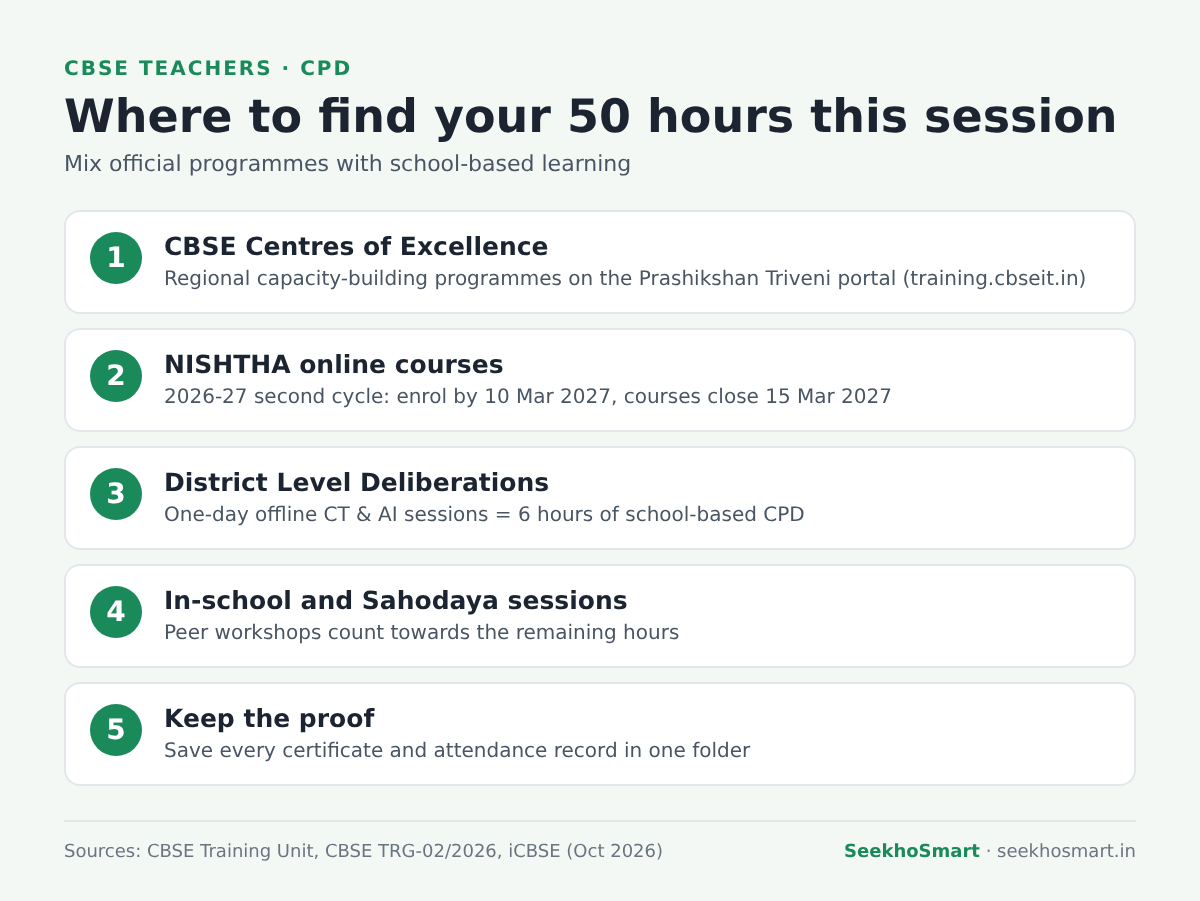
1. CBSE Centres of Excellence (Prashikshan Triveni)
CBSE runs its capacity-building programmes through its Centres of Excellence, with registration on the Prashikshan Triveni portal. In September 2025 the board launched 14 new programmes. For Class 9–12 teachers, the useful ones include:
- Competency-based assessment (case studies) in Science, Mathematics and Social Science for Grades 9–10
- A modular Economics programme for Class 12
- STEM education in teaching and learning
- Value education through sports
Check the portal's announcements page every two weeks. Recent circulars listed there include:
| Date | Circular | What it is about |
|---|---|---|
| 7 Oct 2026 | TRG-21-2026 | Rerun of the second cycle of NISHTHA courses |
| 5 Oct 2026 | TRG-20-2026 | Inclusive Education sensitisation module for school staff |
| 7 Sep 2026 | TRG-19-2026 | Using Virtual Labs in teaching, learning and assessment |
| 1 Sep 2026 | TRG-18-2026 | Registration extended for National Teachers' Conference 2026 (CT and AI) |
| 13 Aug 2026 | TRG-16-2026 | 845+ curriculum-aligned Virtual Labs and resources on DIKSHA |
2. NISHTHA online courses
The second cycle of NISHTHA courses for 2026-27 is free and online. As per iCBSE's summary of the circular, courses started on 1 October 2026, enrolment closes on 10 March 2027 and courses close on 15 March 2027.

For secondary teachers, the "Advanced" courses are open to all, whatever class you teach: Cyber Hygiene Practices, Environmental Hazards of E-waste, Action Research, and Catch the Rain (English and Hindi). Enrol through the NISHTHA courses page.
Tip: Action Research is worth picking. It turns a real classroom problem, like low Class 9 Maths scores, into a small study you can also present at a Sahodaya meet.
3. District Level Deliberations on CT and AI
The 2026-27 training theme is Computational Thinking and Understanding AI. CBSE's DLD guidelines (TRG-02, 9 April 2026) describe one-day, offline sessions where teachers present short case papers. One day counts as 6 hours of school-based CPD. These are aimed at Grades 3–8 teachers, but secondary teachers can attend as participants or help the school's presenters.
4. In-school and Sahodaya sessions
Peer-led workshops in your own school or Sahodaya cluster fill the rest of the 50 hours. Good topics for a Class 9–12 department: framing competency-based questions, sharing board-paper analysis, or a session on using the DIKSHA virtual labs.
A simple plan: 50 hours without the December rush
Break the year into small, fixed blocks:
- This week: List the hours you already have this session. Save every certificate in one folder (phone + Google Drive).
- October–November: Enrol in one NISHTHA course and register for one CoE programme in your subject. That alone can cover a large share of your 25 official hours.
- December–January (pre-boards): Count your board-related academic work, such as paper setting or curriculum work, if your school records it.
- February–March: Finish the NISHTHA course before 15 March. Use one staff meeting for an in-house session.
- Every month: Spend 10 minutes checking the portal's announcements.
Keep the proof
Hours you cannot prove do not help you. For each activity, keep the certificate, the circular number, the date and the hours. Your school will need this when it reports CPD, and it helps you in appraisals too.
Making room for training when you also have 45 students
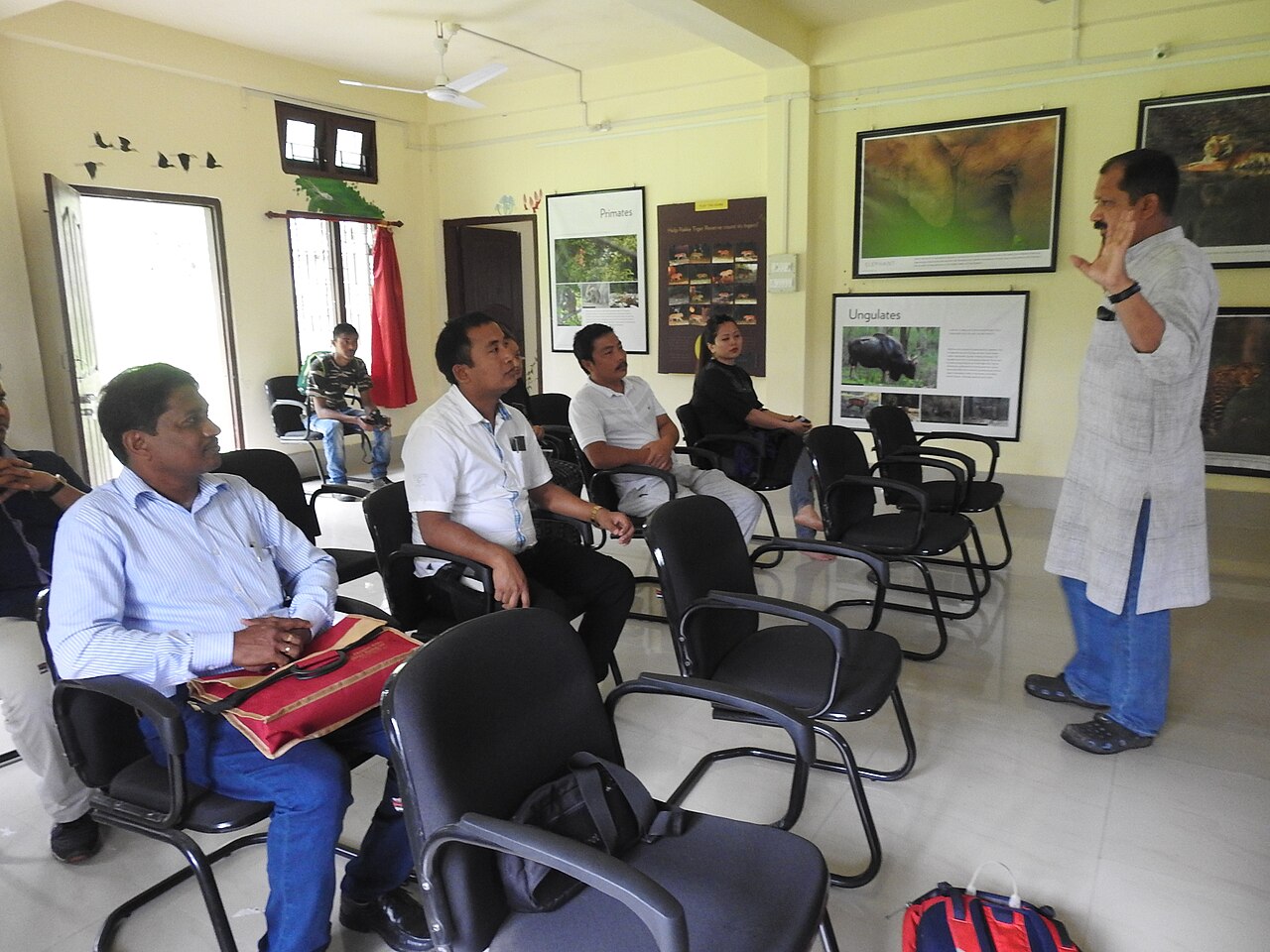
The honest problem is time. Training hours compete with correction, remedial classes and doubt-solving. One fix is to move routine practice and basic doubt-clearing out of class time, so students keep working while you are in a workshop. Another is to share training in your department: one teacher attends, then runs a 30-minute recap for the others.
How SeekhoSmart helps you free up time for training
CPD hours are easier to find when routine practice does not depend on you. SeekhoSmart gives your Class 9–12 students NCERT-aligned practice with a 10-year PYQ bank tagged by chapter, so you can simply say, "Do the Chapter 5 PYQs tonight", even on a day you are at a CoE workshop.
When a student gets a question wrong, the AI explanation walks them through the mistake step by step. That means fewer repeated "Ma'am, how did this come?" doubts the next morning, and more class time for the discussion only you can lead. It is free to start and works in Hindi or English.
Share SeekhoSmart with your students → seekhosmart.in
Frequently asked questions
How do I download my CBSE teacher training certificate?+
Certificates come from the platform that ran the programme: the Prashikshan Triveni portal for CBSE Centre of Excellence programmes and the NISHTHA portal for NISHTHA courses. Log in to the same account you registered with and save a copy in one folder as soon as it is issued.
How many training hours are compulsory for CBSE teachers?+
50 hours of CPD every year: 24 for Knowledge and Practice, 14 for Professional Growth and 12 for Core Values and Ethics, with at least 25 hours from CBSE or government institutes.
What courses are on the CBSE teacher training portal?+
CBSE's Centres of Excellence offer capacity-building programmes such as competency-based assessment for Grades 9–10, modular Economics for Class 12, and STEM education. The announcements page lists new circulars.
Where can I find the latest CBSE teacher training circular?+
On the announcements page of the Prashikshan Triveni portal (training.cbseit.in). The most recent, TRG-21-2026 dated 7 October 2026, covers the NISHTHA second-cycle rerun.
- Prashikshan Triveni: CBSE Training Unit announcements
- CBSE mandates 50 hours of annual training for all school teachers (Gulf News)
- CBSE launches 14 new capacity building programmes for teachers (Careers360)
- CBSE NISHTHA Courses 2026-27: Enrolment Open for Teachers (iCBSE)
- NISHTHA courses (CIET-NCERT)
- CBSE DLD guidelines on CT and AI 2026-27 (TRG-02)
- SeekhoSmart (infographic)
- SeekhoSmart (infographic)
- Nikhita S / Unsplash
- Soundtrap / Unsplash
- Tra Nguyen / Unsplash