CBSE has opened registrations for the Science Challenge 2026-27, a free, two-round science competition for students of Classes 8, 9 and 10. Students can't sign up on their own. Only the school can register them, and the window for Round 1 closes on 30 October 2026.
If you run or lead a CBSE school, this is a low-cost, high-visibility opportunity. It gives your science department a reason to push inquiry-based learning, gives students a national-level stage, and gives you something real to share with parents. Here is everything you need to act on this week.
What the Science Challenge is
According to CBSE's academic circular of 13 October 2026, as reported by Careers360 and Education Post:
- Who: Students of Classes VIII, IX and X in CBSE-affiliated schools.
- Aim: To encourage scientific curiosity, critical thinking, inquiry and problem-solving.
- Format: Two rounds. Round 1 is held inside your school using a CBSE-provided MCQ paper. Round 2 is an inter-school, computer-based challenge run by CBSE.
- Cost: Free for both rounds.
The official circular (PDF) is on the CBSE Academic website. Download it and share it with your science head.
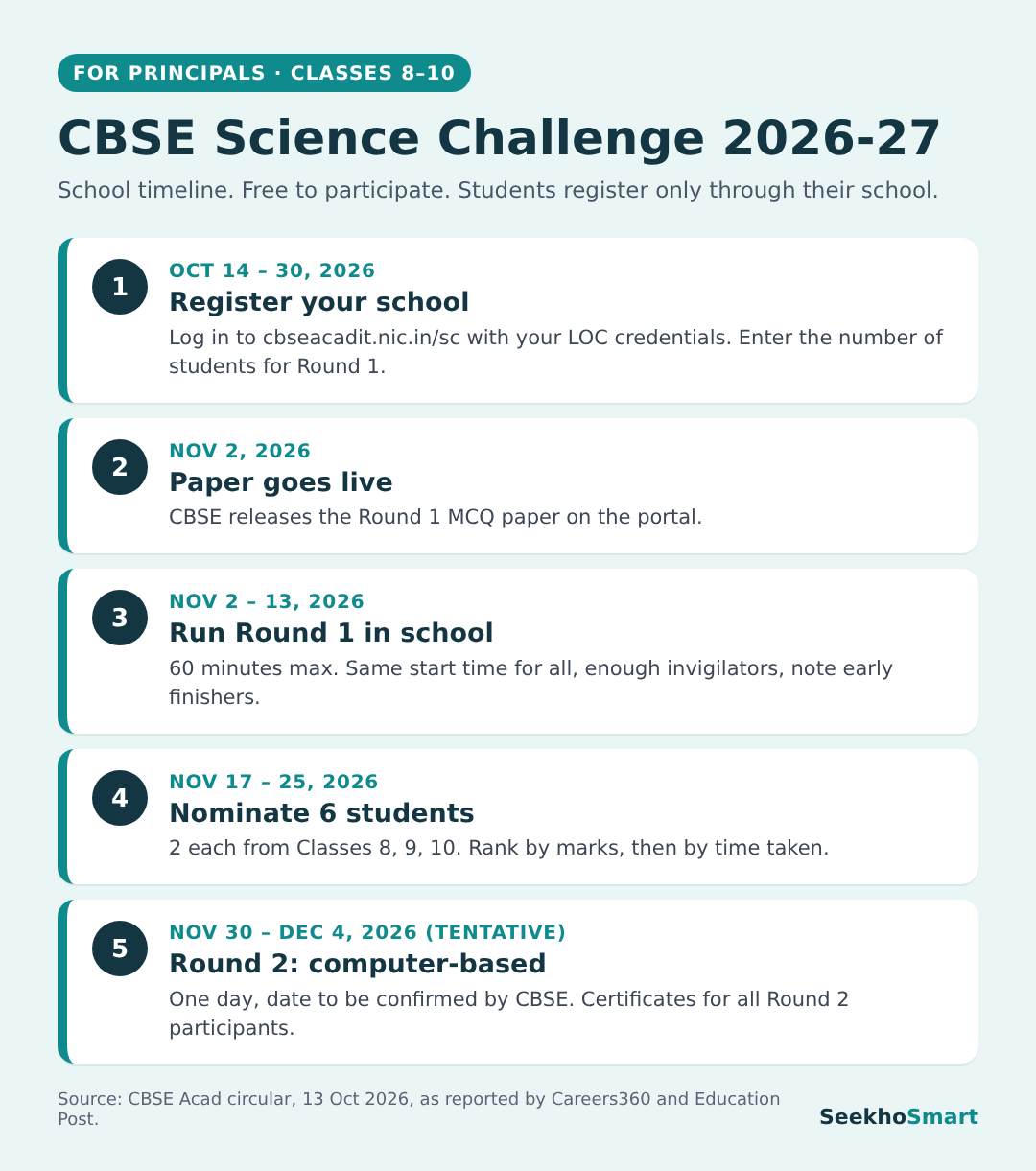
The key dates
| Step | Dates | Who acts |
|---|---|---|
| Register school for Round 1 | 14–30 October 2026 | School (LOC login) |
| Round 1 paper available on portal | 2 November 2026 | CBSE |
| Conduct Round 1 in school | 2–13 November 2026 | School |
| Register 6 students for Round 2 | 17–25 November 2026 | School |
| Round 2 (computer-based, one day) | 30 November – 4 December 2026 (tentative) | CBSE |
CBSE will confirm the exact Round 2 date and instructions to schools registered for that round.
Before 30 October: the registration checklist
1. Find your LOC login
Registration is on the Science Challenge portal at cbseacadit.nic.in/sc, using the same credentials your school uses for the List of Candidates (LOC). Your exam cell already has these. Make sure the person registering can actually log in today, not on 30 October.
2. Decide how many students will take part
You enter the number of students taking part in Round 1. There is no fee, so there is little reason to keep it small. A good rule: open it to every interested student in Classes 8–10, and actively invite those who enjoy science even if their marks are average. Competitions like this often reveal curious students that regular tests miss.
3. Appoint one coordinator
Name a single science teacher as the Science Challenge coordinator. They own the portal, the Round 1 schedule, the invigilation roster and the Round 2 nominations. One owner avoids missed deadlines.
4. Tell students and parents
Send a short note through your usual channel: what the challenge is, that it's free, the Round 1 window, and that six students from the school will go to Round 2. Parents appreciate being told early, and students prepare better when they know it's real.
A light preparation plan for interested students
The circular does not prescribe a syllabus, so avoid over-promising "important topics". Instead, ask your science teachers to run two or three short practice sessions in the last week of October:
- Session 1: a 20-minute MCQ quiz from recent Class 8–10 science chapters, discussed right after.
- Session 2: "explain why" questions, where students must justify the right option, not just pick it.
- Session 3: a short timed quiz, so students get used to working accurately against the clock.
These sessions cost nothing, help students walk into Round 1 with confidence, and give teachers an early read on who is likely to make the final six.
2–13 November: running Round 1 fairly
The paper is released on the portal on 2 November. As reported by Careers360:
- Students get a maximum of 60 minutes.
- Teachers must record the start time, ensure everyone starts together, and note who submits early.
- Schools must assign enough invigilators for fair conduct.
Why the timing record matters
Selection for Round 2 depends on both marks and time taken. Students who answer all questions correctly are preferred, and when marks are tied, the student who finished faster gets priority. That makes careful time records essential. Prepare a simple sheet for each room with columns for student name, class, start time and submission time, signed by the invigilator.
Practical tips
- Book rooms and slots in the first week of the window, so Round 1 doesn't clash with periodic tests.
- Do a dry run of how invigilators will record times.
- Keep the answer data safe until Round 2 nominations are complete.
17–25 November: picking your six
Each school nominates six students: two each from Classes 8, 9 and 10, ranked on marks and then time. Register them on the portal within the window. Inform the selected students and their parents, and give them a short orientation for a computer-based test, especially if some haven't taken one before.
All Round 2 participants receive an online participation certificate from CBSE, and the best performers receive appreciation certificates.
Why this is worth a principal's attention
- It costs nothing, apart from a few hours of staff time.
- It builds a culture of inquiry. A school-wide event gives science teachers a reason to run problem-solving sessions beyond the textbook.
- It's good for your school's story. Round 2 participation and certificates are concrete achievements to share with parents and in your school newsletter.
Need help?
PW's summary lists the CBSE contact for the challenge as cbsesciencechallenge@cbseshiksha.in and 011-43354916. Check the circular for the latest contact details before you write.
How SeekhoSmart supports your science students beyond the challenge
The Science Challenge rewards students who understand concepts, not just memorise them, and that needs regular practice that your teachers can't always supervise. SeekhoSmart adds that layer at no upfront cost.
- NCERT-aligned practice with AI explanations of every answer, including wrong ones, helps your Class 9 and 10 students see why an answer is right, which is exactly the thinking the challenge tests.
- An adaptive daily study plan, with streaks and XP, keeps students practising consistently after the competition ends, so the interest it sparks carries into board preparation.
It's free to start and has a Hindi/English switch for every student.
Try SeekhoSmart for your school → seekhosmart.in
Frequently asked questions
How do schools register for the CBSE Science Challenge 2026-27?+
Log in to the Science Challenge portal (cbseacadit.nic.in/sc) with the school's LOC credentials and enter the number of students taking part in Round 1.
What is the last date for CBSE Science Challenge 2026-27 registration?+
Round 1 school registration runs from 14 to 30 October 2026. Round 2 nominations are from 17 to 25 November 2026.
Is there a fee for the CBSE Science Challenge?+
No. Participation is free in both rounds.
Can students register for the CBSE Science Challenge on their own?+
No. Only schools can register students of Classes 8, 9 and 10. Students should speak to their science teacher or school office.
- SeekhoSmart (infographic)