If you are in Class 10 or Class 12 this year, the most useful document you can download right now is not a guidebook or a "most important questions" PDF. It is the official CBSE sample paper 2027, the Sample Question Paper (SQP) for the 2026-27 session, along with its marking scheme.
Most students treat the SQP like a test to finish once and forget. Toppers use it differently. They use it as a map of the board paper and a guide to how examiners award marks. This post shows you how to do the same, with a six-week plan you can start this week.
What CBSE has released for 2026-27
CBSE released the 2026-27 SQPs and marking schemes for Classes 10 and 12 on 21 September 2026, as reported by iCBSE and Careers360. The official download pages are on CBSE's academic website:
- Class 10: cbseacademic.nic.in/SQP_CLASSX_2026-27.html
- Class 12: cbseacademic.nic.in/SQP_CLASSXII_2026-27.html
The CBSE academic site is sometimes slow or down. If a page does not open, try again later. Please don't download "official" papers from random Telegram groups.
Two points from the reports matter for your planning:
- No change in design. According to iCBSE, CBSE has confirmed there is no change in the question paper design or the assessment pattern for 2026-27, and the passing criteria stay the same as 2025-26. So last year's SQP and this year's are close cousins, and your teachers' experience from 2026 still applies.
- Marking schemes come with every paper. This is the part most students skip, and it is where the marks are.
For Class 10, Careers360 lists SQPs for subjects including Science, Social Science, Maths Standard, Maths Basic, English Language & Literature, English Communicative, Hindi Course A and Home Science. Check the official page for your exact subject code.
Sample paper or PYQ: which is better?
This is one of the most searched questions right now, and the honest answer is: you need both, for different jobs.
| Sample paper (SQP) | Previous year questions (PYQs) | |
|---|---|---|
| What it tells you | The current pattern: sections, marks per question, types of questions | What CBSE has actually asked over many years |
| Best use | Understanding format, timing and the marking scheme | Finding repeated topics and building chapter-wise practice |
| How many | One per subject per year | Many years' worth |
| When to use | Early (to learn the format) and late (as a full mock) | Throughout, chapter by chapter |
Think of it this way. The SQP tells you how you will be tested, and PYQs tell you what tends to be tested. If you use only PYQs, an old pattern can surprise you. If you use only the SQP, you get too little practice.
A six-week plan to use the sample paper properly
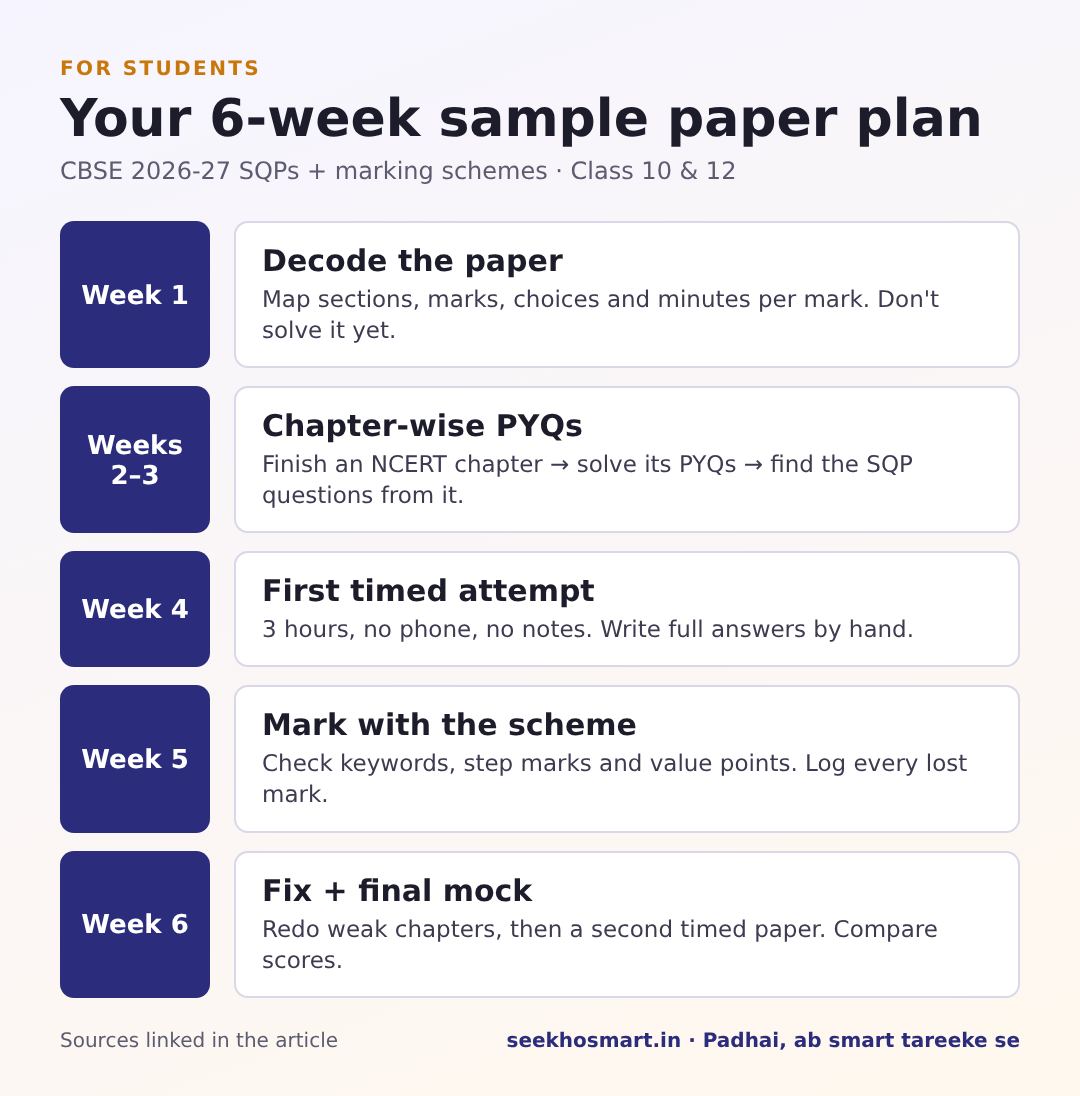
Week 1: Decode the paper (don't solve it yet)
Open the SQP and the marking scheme side by side for one subject. Without answering anything, note down:
- How many sections there are and what each one carries
- Which questions are MCQs, short answers, long answers and case-based
- Where there is internal choice
- How long you can spend per mark (in a 3-hour paper, divide 180 minutes by the total marks)
Make a one-page "paper map" for each subject and stick it inside your notebook. It takes 20 minutes per subject and saves you panic in the exam hall.
Weeks 2–3: Chapter-wise practice with PYQs
Now go chapter by chapter through NCERT. After each chapter, solve the PYQs for that chapter, then find the SQP questions from the same chapter. You will start to see how one concept gets asked in three different ways: as an MCQ, as a 3-mark reasoning question and as a case study.
Week 4: First full attempt, under real conditions
Pick one subject and sit for exactly three hours. Phone in another room, no notes, a clock in front of you. Write the full answers by hand, not just the key points. Many students know the answers but run out of time or space, and only a timed attempt shows you that.
Week 5: Mark yourself with the official marking scheme
This step makes the biggest difference. Mark your own answer sheet strictly with the marking scheme, and look for:
- Keywords the scheme expects (a correct answer missing its key term can lose marks)
- Step marks in Maths and Physics (did you show the formula, the substitution and the units?)
- Value points in Social Science and English (did you write enough distinct points for the marks?)
Write every lost mark into a "mistake log" with the reason: concept gap, silly error, time, or presentation.
Week 6: Fix, then do a final mock
Go back to the chapters behind your biggest losses and redo those PYQs. Then do a second full timed attempt, using last year's SQP or a fresh paper from your teacher, and compare your score with Week 4.
Common mistakes to avoid
- Solving the SQP on day one. You waste your best "unseen" mock. Decode it first, and attempt it fully once you have covered most of the syllabus.
- Checking only the final answer. Board marks are given for steps and keywords. Read the marking scheme for every question, even the ones you got right.
- Ignoring the case-based questions. These test whether you can apply a concept to a new situation. Practise reading the passage first, then the question.
- Collecting 20 unofficial "sample papers". One official SQP studied deeply is worth more than a pile of guesses. If you need more practice, use PYQs and NCERT exercises.
Small habits that make this work
- Do one subject's paper map per day this week. In five days you will know every paper's format.
- Keep your mistake log in one notebook for all subjects, and read it every Sunday.
- For Class 12 students preparing for entrance exams as well, the SQP still matters. Board marks and entrance prep use the same NCERT concepts, so chapter-wise PYQ practice helps both.

How SeekhoSmart helps you use sample papers and PYQs together
The plan above needs a lot of chapter-wise PYQ practice, plus an honest look at why you lost marks. That is where SeekhoSmart fits in.
- 10-year PYQ bank tagged by chapter. Finish an NCERT chapter and practise exactly the questions CBSE has asked from it, without hunting through PDFs.
- AI explanations of every answer, including wrong ones. When you get a question wrong, you see why, which turns your mistake log into real learning.
- An adaptive daily study plan. It pushes your weak chapters forward, so Weeks 5 and 6 of your plan happen without guesswork.
It is NCERT-based, works in Hindi or English, and is free to start. Padhai, ab smart tareeke se.
Start practising free → seekhosmart.in
Frequently asked questions
Is the CBSE sample paper 2027 out for Class 10 and 12?+
Yes. CBSE released the 2026-27 sample question papers and marking schemes for Classes 10 and 12 on 21 September 2026, as reported by iCBSE and Careers360. Download them only from cbseacademic.nic.in.
Sample paper or PYQ: which is better?+
Use both. The sample paper shows the current pattern and how marks are given. PYQs show what CBSE has actually asked over the years. Decode the SQP first, practise PYQs chapter-wise, then attempt the SQP as a timed mock.
How do I solve a sample paper in Class 10?+
Sit for the full 3 hours with no notes, write complete answers by hand, then mark yourself strictly with the official marking scheme. Note every lost mark and its reason in a mistake log.
Has the CBSE paper pattern changed for 2026-27?+
According to iCBSE, CBSE confirmed there is no change in question paper design or assessment pattern for 2026-27, and passing criteria are the same as 2025-26.
- SeekhoSmart (infographic)
- Shantanu Kumar / Pexels
- Sanket Mishra / Pexels