The CBSE sample papers for the 2027 board exams are out. CBSE put the Class 10 sample question papers (SQPs) and their marking schemes on cbseacademic.nic.in on 21 September 2026, according to Careers360. Class 12 papers are out too.
Most students download them, glance at them, and save them for "later". Later usually means the week before pre-boards. This guide shows you how to use the CBSE sample paper 2027 for Class 10 properly, starting this month.
What are CBSE sample papers, and why do they matter?
A sample paper is a model question paper made by CBSE itself. It shows you the exact layout of your board paper: sections, question types, marks and time. The marking scheme that comes with it shows how examiners give marks, step by step.
This year, the board has confirmed there is no change in the question paper design or assessment pattern from 2025-26, as reported by PW and iCBSE. So the SQP is the most reliable preview of your real paper that you will get.
One more point. Class 10 now has two board exams. According to Educart, one official SQP per subject applies to both attempts.
Key dates for the 2026-27 board year
Here is what is fixed so far, from the Careers360 CBSE 2027 live updates:
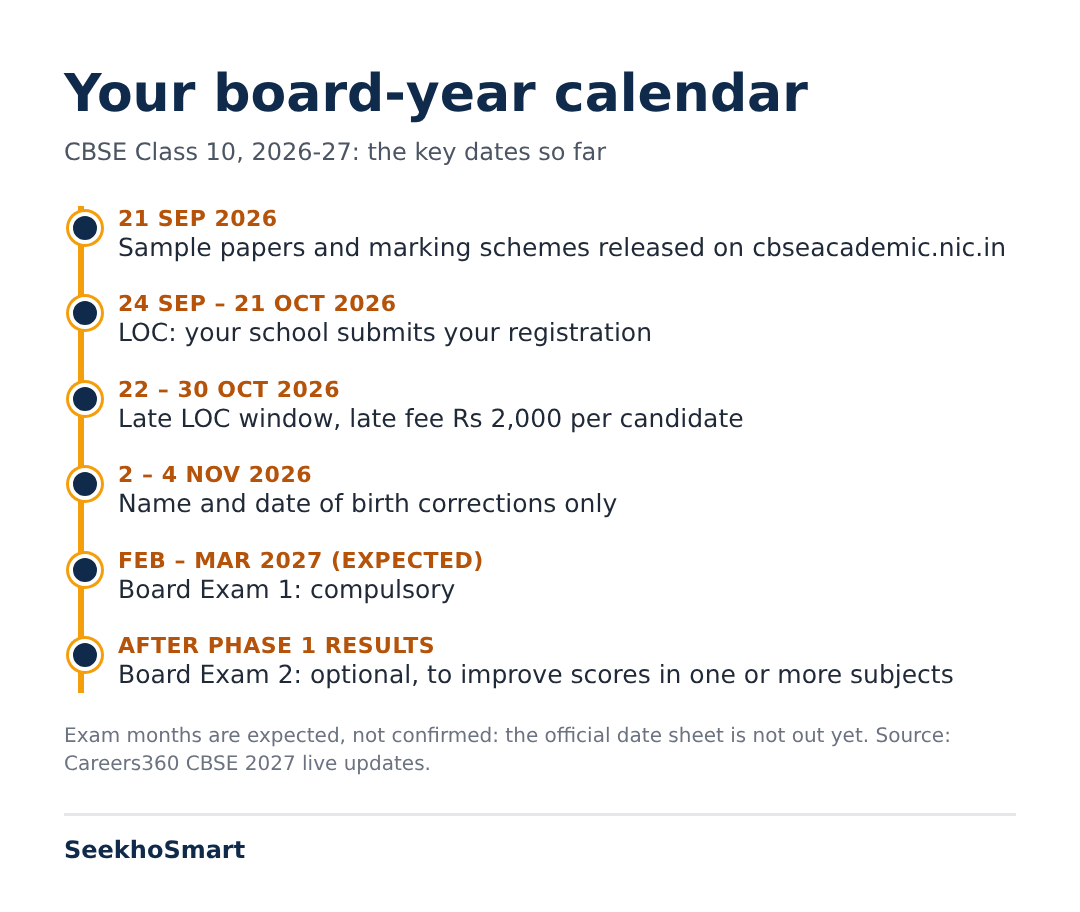
- LOC (List of Candidates): your school submits your registration between 24 September and 21 October 2026. A late window runs from 22 to 30 October, with a late fee of Rs 2,000 per candidate.
- Corrections: name and date of birth can be corrected only from 2 to 4 November 2026. Check your details with your class teacher before then.
- Board Exam 1 (Class 10): compulsory, expected in February–March 2027.
- Board Exam 2 (Class 10): optional, for improving scores in one or more subjects. It will be held after Phase 1 results.
The official date sheet has not been released yet. Treat the exam months as expected, not final.
How to download the CBSE sample paper 2027 for Class 10
Use only the official website. Third-party "sample papers" are fine for extra practice, but the CBSE paper is the one that sets the pattern.
- Go to cbseacademic.nic.in.
- Click "SQPs" in the menu bar.
- Choose 2026-27 and Class X.
- Download each subject's sample paper and its marking scheme.
Careers360 lists Class 10 papers for Social Science, Science, Mathematics Standard, Mathematics Basic, Home Science, Hindi Course A, English Language & Literature and English Communicative, among others.
Read the paper design before you write a single answer
Spend 15 minutes just studying the layout. For Class 10 Maths and Science, the theory paper is 80 marks and 3 hours, with 20 marks for internal assessment, according to Educart's summary of the official papers.
| Section | Maths (Standard and Basic) | Science |
|---|---|---|
| A | 20 MCQs, 20 marks | 20 MCQs and Assertion-Reason, 20 marks |
| B | 5 very short answers, 10 marks | 6 very short answers, 12 marks |
| C | 6 short answers, 18 marks | 7 short answers, 21 marks |
| D | 4 long answers, 20 marks | 3 long answers, 15 marks |
| E | 3 case-based, 12 marks | 3 case-based, 12 marks |
Notice two things. First, Section A alone is a quarter of the theory marks, so careless MCQ errors are expensive. Second, case-based questions in Section E test whether you can apply a concept to a real situation, not just repeat it.
The 4-step method
Step 1: Finish the chapter in NCERT first
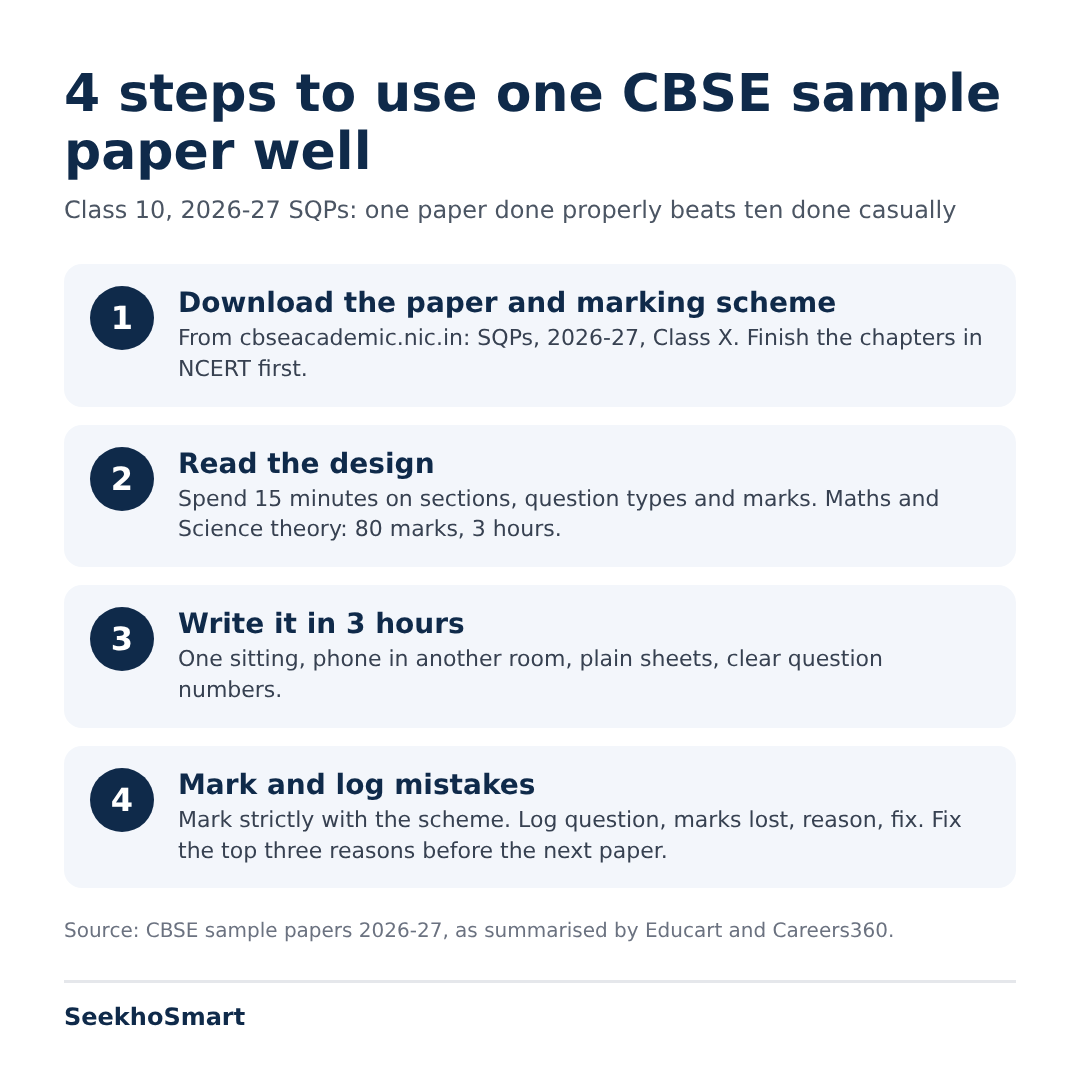
Don't attempt a full sample paper on a syllabus you haven't covered. You will only feel low. Use chapter-wise questions until you have covered most of the syllabus.
Step 2: Write it like the real exam
Sit for 3 hours in one go. Phone in another room. Use plain sheets, not your notebook. Write the question number clearly, as you would in the board exam.
Step 3: Mark yourself honestly with the marking scheme
This is the step most students skip. The marking scheme shows where marks are given for steps, formulas, units and diagrams. Be strict. If your answer is "almost" right, give yourself what the scheme gives.
Step 4: Keep a mistake log
Make a simple table with four columns: question, marks lost, reason, fix. Reasons usually fall into four groups:
- Concept not clear
- Calculation or silly error
- Step or unit skipped
- Ran out of time
Before your next paper, fix the top three reasons. This is how marks actually go up.
NCERT, sample papers or previous-year papers?
You need all three, but at different times.

| When | What to use | Why |
|---|---|---|
| Now to December | NCERT textbook and exemplar, chapter by chapter | Board questions are built on NCERT concepts |
| As each unit finishes | Section-wise questions from the SQP | Learn the question style early |
| December to January | Full SQP under timed conditions, then previous-year papers | Build speed and stamina |
| Last 3 weeks | Re-attempt the SQP and your mistake log | Confirm the gaps are fixed |
A simple plan for the next 8 weeks
- Weeks 1–2: Download all SQPs and marking schemes. Read every paper's design. Check your LOC details with your teacher.
- Weeks 3–6: Finish pending NCERT chapters. Each Sunday, do one section of one subject's SQP and mark it.
- Weeks 7–8: Attempt your first full paper in your weakest subject. Start your mistake log.
Common mistakes to avoid
- Solving papers without checking the marking scheme.
- Doing ten papers casually instead of three papers properly.
- Practising only MCQs and leaving case-based and long answers.
- Ignoring internal assessment. Those 20 marks carry over from your first attempt and are not retaken, per Educart.
One sample paper done carefully, marked honestly and learned from is worth more than a pile of PDFs you never open. Start with one subject this weekend.
Practise and revise on SeekhoSmart
The 4-step method works, but finding the right chapter-wise questions and spotting your weak topics takes time. SeekhoSmart does that part for you.
- Tests built on the current curriculum. Chapter-wise tests follow this year's NCERT syllabus, so you practise what is actually in your board exam.
- Revision that finds your gaps. It is adaptive: topics you get wrong come back for more practice, like a mistake log that updates itself.
- Made for Class 9–12. Use it for Step 1 while you finish chapters, then for revision before each sample paper.
Do one chapter test on SeekhoSmart this weekend, then attempt the CBSE sample paper with fewer gaps.
Sources
- CBSE Class 10 Sample Papers 2026-27 — Careers360 (updated 25 Sep 2026)
- CBSE Class 10 Sample Papers 2026-27 Released — Educart
- CBSE 10th, 12th Sample Papers 2027 Released — PW
- CBSE Sample Question Papers 2026-27 Released — iCBSE
- CBSE Date Sheet 2027 live updates — Careers360 (updated 9 Oct 2026)
- CBSE LOC deadline reminder — Shiksha (15 Oct 2026)
- Google autocomplete, India, checked 17 Oct 2026
Frequently asked questions
Is the CBSE sample paper 2027 for Class 10 released?+
Yes. CBSE released the 2026-27 Class 10 sample papers and marking schemes on cbseacademic.nic.in on 21 September 2026. Class 12 papers are also out.
Where can I find the CBSE sample paper 2027 Class 10 Maths and Science?+
On cbseacademic.nic.in, under SQPs, then 2026-27 and Class X. Maths has separate Standard and Basic papers.
Has the CBSE paper pattern changed for 2027?+
No. The board has said the question paper design and assessment pattern stay the same as 2025-26.
Is the CBSE sample paper 2027 for Class 12 out too?+
Yes, Class 12 SQPs and marking schemes were released for the 2026-27 session on the same website.
- World Sikh Organization of Canada / Pexels
- Sanket Mishra / Pexels
- SeekhoSmart (infographic)
- SeekhoSmart (infographic)