Pre-board season is about to begin. Across CBSE schools, Class 10 and 12 teachers are setting papers, planning invigilation, and getting ready for the stacks of answer sheets that follow. Searches for "cbse pre board exam 2027" are rising for the same reason.
Here is the problem with pre-boards in many schools: they work like a second board exam. Students write, teachers mark, marks go into a register, and the class moves on. The paper gets checked, but nobody uses it to find out what students still don't understand.
This playbook shows how to run your 2027 pre-boards as a diagnostic. You get information you can act on in the few weeks before the boards, without adding hours to your week.
What we know about the 2027 cycle so far
- Sample papers and marking schemes are out. CBSE released the 2026-27 sample question papers and marking schemes for Classes 10 and 12 on 21 September 2026 (Careers360). Each Class 10 subject is 80 marks theory plus 20 marks internal assessment, with a 3-hour paper.
- One Class 10 sample paper set for both board exams. CBSE has not released separate sample papers for the two Class 10 board exams, so one set covers both (Careers360 live updates).
- Passing rule: students need at least 33%, and the same live updates report it applies separately to theory and practical.
- Practicals: Class 12 practicals for winter-bound schools are scheduled for November–December 2026; for other schools, January–February 2027 (same source).
- Board dates: the 2027 date sheet had not been released at the time of the reports we checked. Exams are expected in February–March 2027 (Khaleej Times).
- Pre-boards are a school decision. In the same Khaleej Times report, some CBSE schools planned a first pre-board in November and a second round in January.
As one principal put it in that report: "Pre-boards should not be treated as the final destination but as an important diagnostic exercise." That is the idea this playbook is built on.
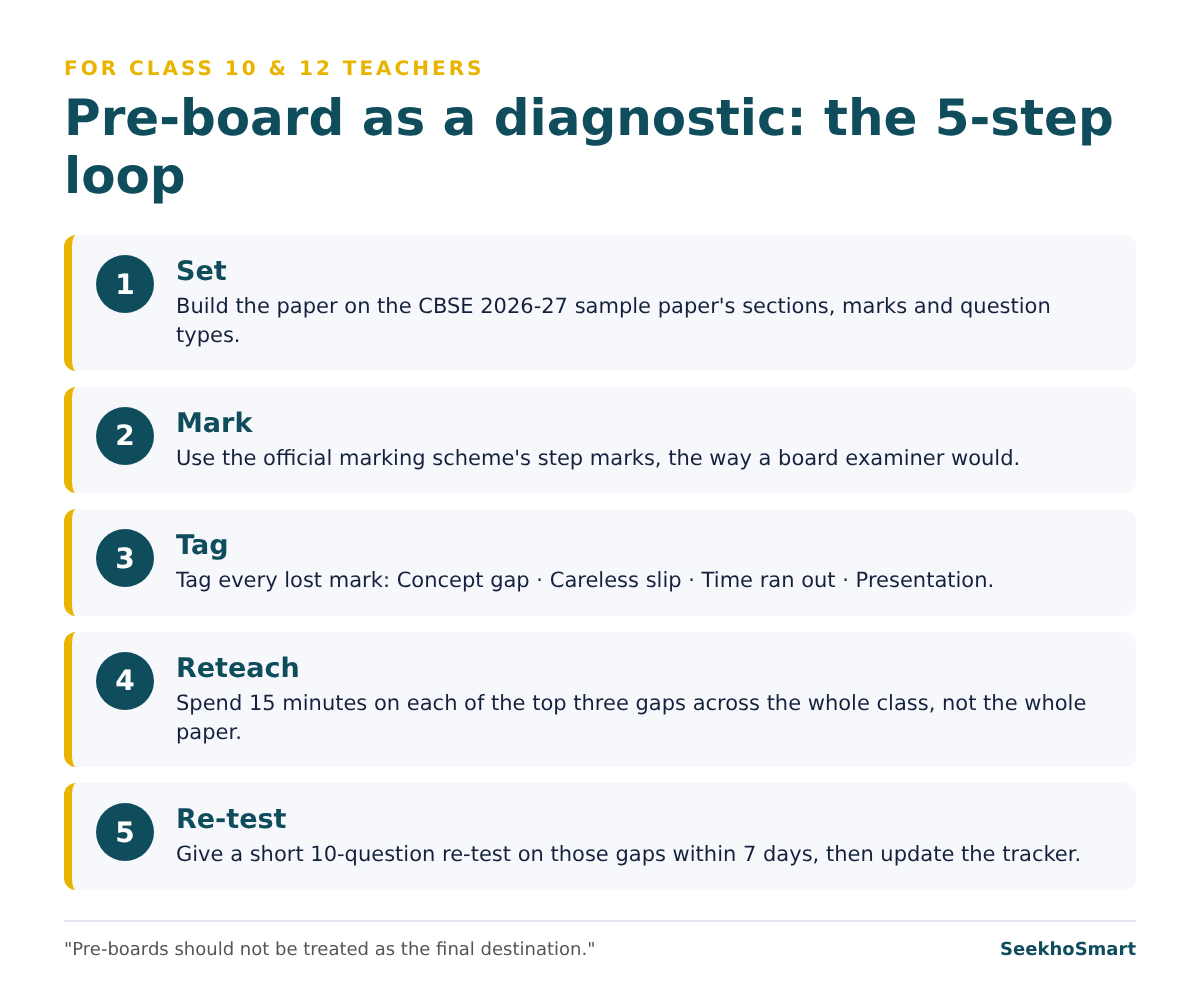
The 5-step diagnostic loop
Step 1: Set — mirror the sample paper, not your favourite questions
Build your pre-board on the 2026-27 sample paper's structure: the same sections, mark distribution, question types and internal choices. If the sample paper has case-based or source-based questions, your paper should too.
Tips:
- Pick most questions from NCERT exercises, examples and in-text questions. Add a few previous-year board questions so students meet real board wording.
- Make one blueprint table per paper: chapter × question type × marks. It takes 20 minutes and lets you check later which chapters went wrong.
- Keep the difficulty close to the board. A paper that's much harder or much easier than the board doesn't tell you where students really stand.
Step 2: Mark — use the marking scheme the way the board does
Mark with the official marking scheme logic: step marks, value points, and the right answer reached by a different correct method. Students should see exactly where a mark was lost. A red cross with no comment does not help anyone.
If several teachers mark the same subject, spend 15 minutes before marking going through two sample scripts together, so everyone marks the same way.
Step 3: Tag — classify every lost mark
This is the step most schools skip, and it is the most valuable. While marking, put a small code next to each lost mark:
- C — Concept gap: the student does not understand the idea.
- S — Careless slip: knew it, made an error (sign, unit, misread question).
- T — Time: left blank or rushed at the end.
- P — Presentation: missing steps, diagram, labels, keywords or format.
Then make a simple class tracker in a spreadsheet: one row per student, one column per chapter, with the C/S/T/P counts. You will quickly see patterns such as "half the class lost marks in Electricity numericals" or "most students ran out of time in Section E".
Step 4: Reteach — the top three gaps, not the whole paper
Don't spend a week "discussing the paper" question by question. Instead:

- Pick the three biggest class-wide gaps from your tracker.
- Teach each one again in a focused 15-minute session, using a different explanation or example from the first time.
- For presentation and time errors, teach the skill directly: model a full-marks answer, and show students how to plan their time across the paper's sections.
- Give individual students a short note: "Your top two areas: X and Y."
Step 5: Re-test — close the loop within a week
Within seven days, give a short 10-question re-test on just those gaps. Update the tracker. Then you will know whether the reteaching worked before pre-board 2, instead of finding out from the board results.
Planning the season: a sample timeline
| When | What to do |
|---|---|
| Late October | Blueprint and set pre-board 1; agree on marking as a team |
| November | Pre-board 1, marking with C/S/T/P tags |
| Within 2 weeks | Top-3 gap reteach and re-tests |
| December | Practicals (winter-bound schools), targeted practice |
| January | Pre-board 2, compare trackers |
| Before boards | Light revision, individual feedback notes |
Adjust this to your school's calendar and the official CBSE date sheet when it is released on cbse.gov.in.
Keep the human side in mind
Pre-boards can make students anxious and push parents to panic. A few habits help:
- Share what to fix, not only the score. "You lost 9 marks to presentation" is something a student can act on.
- In parent-teacher meetings, show the C/S/T/P breakdown. It turns a tense talk about marks into a plan.
- Point students and families to official support. In the 2026 cycle, CBSE ran a free psycho-social counselling service and a helpline (1800-118-004) for Class 10 and 12 students and parents (Careers360). Watch for the 2027 announcement.
How SeekhoSmart helps after the pre-board
The hardest part of the loop is Step 4 and Step 5 for every student: you can reteach the top three gaps in class, but each child also has their own gaps. SeekhoSmart can carry that load outside class.
- 10-year PYQ bank tagged by chapter: after you share each student's weak chapters, they can practise real board questions on exactly those chapters. You don't have to make separate worksheets.
- AI explanations of every answer, including wrong ones: students get a clear explanation of why their answer was wrong. Your doubt-clearing time can go to the C-type concept gaps that really need you.
- Adaptive daily study plan: each student gets a short daily practice plan built around their weak areas, between pre-board 1 and 2.
It is NCERT-aligned, available in Hindi and English, and free to start.
Share it with your students → seekhosmart.in
Frequently asked questions
When is the CBSE pre-board exam 2027?+
CBSE does not set pre-board dates; each school does. Many CBSE schools plan a first pre-board in November and a second in January, ahead of board exams expected in February–March 2027.
Should the pre-board exam 2027 for Class 10 follow the sample paper?+
Yes. Mirror the 2026-27 sample paper's sections, marks and question types, and mark with the official marking scheme, so the result tells you how students would actually do in the board.
When are CBSE Class 12 practicals for 2027?+
As reported, practicals for winter-bound schools are scheduled for November–December 2026 and for other schools January–February 2027. Confirm with CBSE's official circulars.
Where can I find the CBSE sample paper 2027?+
CBSE released the 2026-27 sample question papers and marking schemes on 21 September 2026 on cbseacademic.nic.in.
- SeekhoSmart (infographic)
- Byronkhiangte / Wikimedia Commons (CC BY-SA 4.0)
- Ailiajameel / Wikimedia Commons (CC BY-SA 4.0)