If you are in Class 10 this year, you have probably seen confusing messages on WhatsApp groups and YouTube: "Now you need 33% in theory and 33% in internals separately!" Many students searched "cbse passing marks out of 80" in panic.
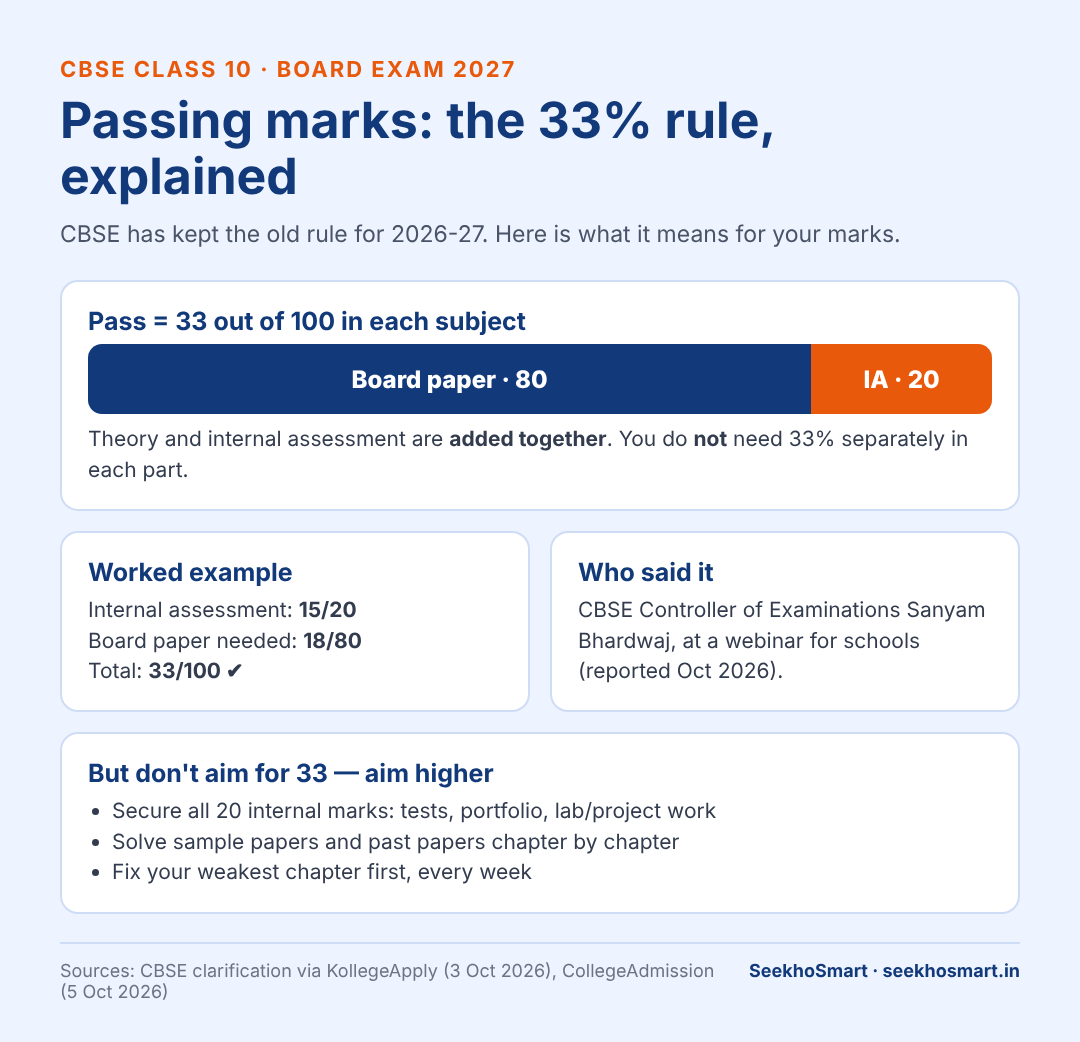
Here is the good news. In October 2026, CBSE clarified that the old rule stays. You need 33% in each subject, and your board paper and internal assessment marks are added together. Let's understand exactly what that means, and then talk about why you should not be aiming for 33 at all.
What CBSE actually said about passing marks for 2027
The confusion started from wording in the 2026-27 Class 9–10 curriculum, which some people read as separate passing marks for the written exam and the internal assessment. CBSE has said this was a misreading.
According to KollegeApply's report (updated 3 October 2026), students need a minimum of 33% marks overall in each subject, with theory and internal assessment combined, and the rule is unchanged for Board Exams 2027.
CollegeAdmission (5 October 2026) reported that CBSE Controller of Examinations Sanyam Bhardwaj explained this during a CBSE webinar for schools on the 2027 board exams. The key line:
"Students do not need to achieve 33 per cent separately in the written examination and internal assessment."
So if you read an older blog that says "27 out of 80 in theory and 7 out of 20 in internals", treat it as outdated for 2027.
How the 33% rule works: out of 80 and out of 20
For most main subjects in Class 10 (Maths, Science, Social Science, English, Hindi), the marks are split like this, as listed on Careers360's CBSE Class 10 exam pattern page:
| Part | Maximum marks |
|---|---|
| Board theory paper | 80 |
| Internal assessment (IA) | 20 |
| Total | 100 |
| Pass mark (combined) | 33 |
A worked example
CollegeAdmission gives this example: if you score 15 out of 20 in internal assessment, you need just 18 out of 80 in the board paper to reach 33 out of 100.
Let's try two more on our own, using the same rule:
- IA 20/20 → you need 13/80 in the paper.
- IA 10/20 → you need 23/80 in the paper.
See the pattern? Every mark you earn in internals reduces the pressure on the board paper. That's why internal assessment is the easiest place to protect yourself.
What about skill subjects and Class 12?
Not every subject uses the 80 + 20 split. Careers360's exam-pattern page warns that subject-wise schemes differ, and skill subjects can have a different theory–practical split. Class 12 subjects with practicals also follow their own scheme. Always check your subject's latest curriculum PDF on the CBSE academic website, or ask your subject teacher, instead of trusting a forwarded message.
Why you should not aim for 33
Passing is the floor, not the goal. Your Class 10 marks shape your stream choice in Class 11, and many schools use them for admission to Science or Commerce sections. Aim for at least 60–70% as a safe target, and higher if you have a particular stream in mind.
Here's a simple, realistic plan for the months left before the board exams.
Step 1: Lock in your internal assessment marks
Internal assessment for most subjects has four parts — periodic tests, multiple assessments, portfolio and subject enrichment (lab work, projects). The Careers360 page shows, for example, that Science IA is made of periodic assessment (5 + 5), subject enrichment/practical work (5) and portfolio (5).
What this means for you this week:
- Finish pending notebooks, lab files and projects. A neat, complete file is the easiest 5 marks you'll ever get.
- Don't skip periodic tests. Each one feeds your IA.
- Ask your teacher what is still missing. One honest conversation now can save marks later.
Step 2: Use the official sample papers
CBSE has released Sample Question Papers and Marking Schemes for Classes 10 and 12 for 2026-27, as KollegeApply notes. Solve one full paper under a timer, then check it with the marking scheme. You'll learn:
- which question types carry the most marks,
- how examiners award step marks,
- where you lose time.
Step 3: Practise past board questions chapter by chapter
Board papers repeat ideas and question styles. Instead of solving random questions, pick one chapter, solve its past board questions, and mark every mistake. Then fix the reason, not just the answer — was it a concept gap, a calculation slip or a reading error?
Step 4: Fix your weakest chapter first
Make a list of chapters in each subject and mark them green (strong), yellow (okay) or red (weak). Every week, move one red chapter to yellow. Small, steady progress beats a last-month panic.
Step 5: Revise in short daily blocks
Two focused 45-minute blocks a day with a 10-minute break work better than a 5-hour marathon on Sunday. Keep one block for your weak subject and one for revision of what you studied earlier in the week.
A quick weekly checklist
- All IA files, projects and lab records up to date
- One full sample paper solved and checked with the marking scheme
- Past board questions for 2–3 chapters
- One red chapter moved to yellow
- Mistakes written in a "mistake notebook" and revised on Sunday
How SeekhoSmart helps you go beyond 33
Knowing the pass mark is easy; scoring well needs focused practice. SeekhoSmart is built for exactly this stage of Class 10.

- 10-year PYQ bank tagged by chapter — pick your red chapter and practise only the past board questions from it, instead of hunting through PDFs.
- AI explanations of every answer, including wrong ones — when you get a question wrong, you see why, so the same mistake doesn't repeat in the board exam.
- Adaptive daily study plan — it notices which chapters you're weak in and puts them in your plan, so your daily blocks are always spent where they count.
Everything is NCERT-aligned, works in Hindi or English, and is free to start. Padhai, ab smart tareeke se.
Start practising free → seekhosmart.in
Frequently asked questions
What are CBSE passing marks out of 80?+
For Class 10 in 2027 there is no separate minimum in the 80-mark paper. You need 33 out of 100 in each subject, with the board paper and the 20 internal marks added together. With 15/20 in internals, 18/80 in the paper is enough.
What is the CBSE Class 10 passing criteria for 2027?+
A minimum of 33% overall in each subject, combining theory and internal assessment. CBSE has said this rule is unchanged for the 2027 board exams.
Are there new rules for Class 10 2027 passing marks?+
No. Some 2026-27 curriculum wording was read as a separate 33% in theory and internals. CBSE's Controller of Examinations said at a schools webinar that students do not need 33% separately in each part.
What are CBSE passing marks out of 70?+
A 70 + 30 split is used for some subjects with practicals, mostly in Class 12. The October 2026 clarification was reported for Class 10, so check your Class 12 subject's scheme with your school instead of assuming.
- SeekhoSmart (infographic)
- Samir Kumar / Wikimedia Commons (CC BY-SA 4.0)
- Nayakyashraj / Wikimedia Commons (CC BY-SA 4.0)