Every Class 10 teacher knows the board paper is 80 marks. But the other 20 — internal assessment (IA) — are entirely in our hands. This year they matter even more. In October 2026, CBSE confirmed that the pass mark stays at 33 out of 100, with theory and internal assessment added together (CollegeAdmission, 5 October 2026). For a struggling student, fair and complete IA marks can be the difference between passing and a compartment.
This guide covers what the 20 marks are made of, a practical plan for the weeks before marks upload, and the rules that can get a school into trouble if ignored.
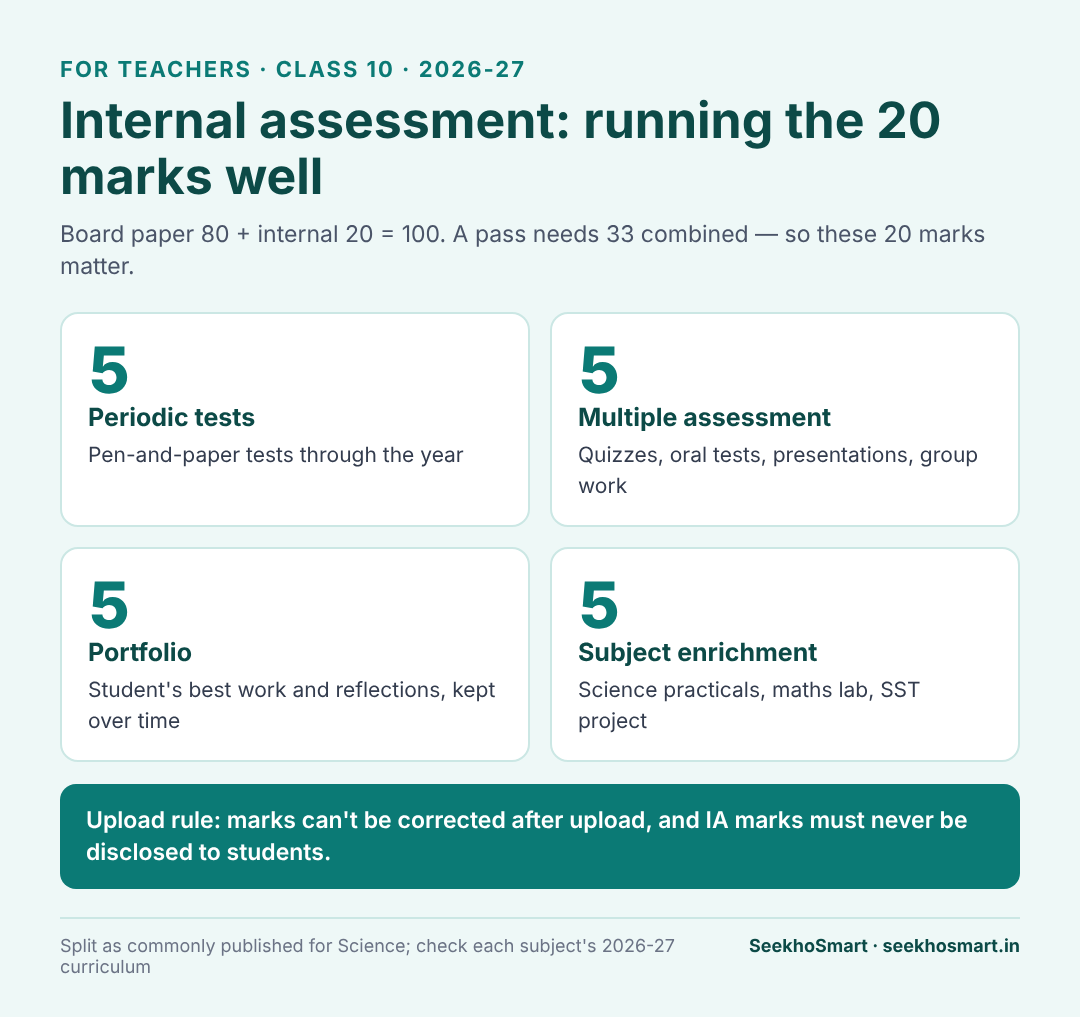
What the 20 internal marks are made of
For main subjects, the split published on Careers360's CBSE Class 10 exam pattern page (updated 25 September 2026) looks like this:
| Subject | Internal assessment components (20 marks) |
|---|---|
| Science | Periodic assessment 5 + 5, subject enrichment/practical work 5, portfolio 5 |
| Mathematics | Pen-and-paper test and multiple assessment 5 + 5, lab practical 5, portfolio 5 |
| Social Science | Periodic test 5, multiple assessment 5, subject enrichment project 5, portfolio 5 |
| English | 20 marks through assignments and projects |
eSaral's 2027 exam pattern guide describes the same four building blocks — periodic tests, multiple assessments, portfolio and subject enrichment activities — and notes that these marks are submitted by schools and are not re-evaluated at board level. That last point is a responsibility worth taking seriously.
Always cross-check your own subject's 2026-27 curriculum document on the CBSE academic website before finalising your scheme; skill subjects in particular follow a different split.
Why IA deserves a plan, not a last-week scramble
Last session, CBSE's Guidelines and SOP for Practical Examinations/Project/Internal Assessment 2025-26 set the conduct window for regular schools as 1 January to 14 February 2026, with marks uploaded on the same day each assessment is conducted. The 2026-27 circular may differ, but if the pattern holds, we have roughly ten weeks of teaching before the window opens. That's enough time to do IA properly — if we start now.
The same SOP is very clear on three points:
- No corrections after upload. "No correction in the marks will be allowed once marks are uploaded."
- IA marks are confidential. They "have the same sanctity as the marks scored in the Board's Annual Theory Examinations" and "shall not be disclosed to the students or any person under any circumstances."
- No answer books to send for Class 10. CBSE doesn't supply practical answer books for Class 10 and doesn't appoint external examiners — the school runs it. That means our records are the only evidence.
A 6-step plan for the next ten weeks
Step 1: Audit what you already have (this week)
Make a simple sheet for each section: student name, periodic tests done, multiple assessment entries, portfolio status, subject enrichment status. Mark gaps in red. You'll quickly see which students have missing work.
Step 2: Share the rubric with students
Students do better when they know what "good" looks like. For the portfolio, for example, write down 4–5 criteria — completeness, neatness, reflection, corrections of mistakes, creativity — and give each a score range. Paste it inside the portfolio cover. It also protects you if a parent later asks how marks were given.
Step 3: Vary your multiple assessment tools
Multiple assessment works best when it uses a variety of tools, not just another written test. In one week you could run:
- a 5-minute oral quiz at the start of class,
- an exit ticket with one competency-style question,
- a pair activity where students explain a concept to each other,
- a short presentation on a real-life application.
Record a quick score for each in your register. Over a few weeks, you have a fair, varied picture of every student.
Step 4: Plan practical and project work backwards
For Science, list the experiments in the curriculum and fix dates for each, leaving the last two weeks free for absentees. For Social Science, give the project topic now and set two check-in dates — outline and draft — before the final submission. Students who leave projects to the last weekend usually copy; check-ins prevent that.
Step 5: Keep dated evidence
For every component, keep something you can show: test papers with dates, a photo of the activity board, the portfolio itself, the lab record with your signature. If marks are ever questioned, dated evidence settles it quickly.
Step 6: Double-check before upload
Because uploaded marks can't be changed, build in a two-person check. One teacher enters, another verifies against the register, and both sign the printout. Check the maximum marks for each component so no student is entered above the limit.
Common mistakes to avoid
- Giving everyone 20/20. It's tempting, but it removes the value of IA for both students and the school, and stands out in results analysis.
- Telling students their IA marks. The SOP says these must not be disclosed. Share feedback and grades of individual pieces of work, not the final IA total.
- Ignoring absentees until the end. Schedule makeup tests early.
- Treating the portfolio as a file of worksheets. It should show growth — first attempts, corrections, reflections.
Helping weak students use IA well
For students at risk of failing, IA is a lifeline. Remember the arithmetic: if a student earns 15/20 in IA, they need only 18/80 in the paper to reach 33 (CollegeAdmission's worked example). So:

- Meet these students one-on-one and list exactly what is pending.
- Give them small, achievable targets — "finish two lab records by Friday."
- Pair them with a stronger classmate for the subject enrichment activity.
- Celebrate completion, not just scores.
How SeekhoSmart can support your students outside class
Internal assessment shows us which students need more practice — but there's never enough class time to give each one individual attention. SeekhoSmart can carry some of that load after school.
- NCERT-aligned practice with a 10-year PYQ bank tagged by chapter — you can point a student to the exact chapter they struggled with in a periodic test, and they practise board-level questions on it at home.
- AI explanations of every answer, including wrong ones — students understand why an answer is wrong without waiting for you to explain it again, which saves you repeated doubt-clearing.
- Hindi/English switch — helpful for students who understand concepts better in Hindi.
It's free to start, so there's no cost to your students or school.
Share it with your students → seekhosmart.in
Frequently asked questions
What are the CBSE internal assessment guidelines for Class 10?+
Main subjects carry 20 internal marks built from periodic tests, multiple assessments, portfolio and subject enrichment (lab work or projects). Schools conduct it, upload the marks on CBSE's portal, and must keep the marks confidential.
What is the CBSE internal assessment marks distribution?+
In Science, for example: periodic assessment 5 + 5, subject enrichment/practical work 5 and portfolio 5. Maths and Social Science use a similar 5-mark structure; check each subject's 2026-27 curriculum.
Can internal marks be changed after upload?+
No. CBSE's SOP says no correction is allowed once marks are uploaded, so verify every entry before you finalise.
What is the CBSE internal assessment criteria for passing?+
There is no separate pass mark for internals in Class 10 for 2027. Internal and board marks are added, and the student needs 33 out of 100 in each subject.
- SeekhoSmart (infographic)
- RJ Raawat / Wikimedia Commons (CC BY-SA 4.0)
- Byronkhiangte / Wikimedia Commons (CC BY-SA 4.0)