If your child is in Class 10 this year, you have probably heard some version of this at the school gate: "Don't worry, there are two board exams now. If the first one goes badly, there's always May."
That is only half true, and the half that's missing matters. This guide explains, in plain language, how CBSE's two-exam system for Class 10 has worked, what is still to be confirmed for 2027, and what you can do at home this term so that the second exam stays an option, not a rescue plan.
What changed, in one paragraph
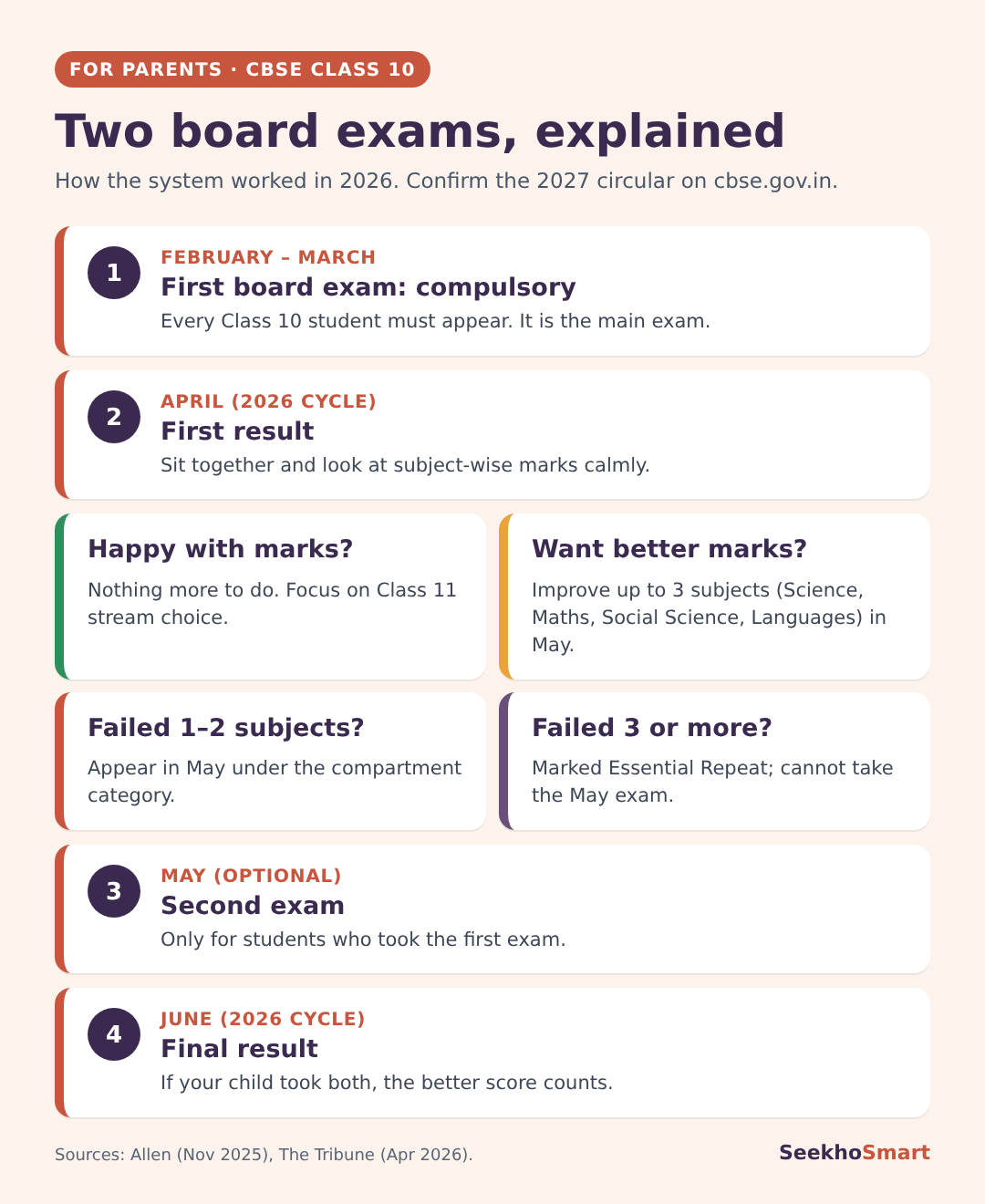
Starting with the 2026 exams, CBSE Class 10 students got two board exam opportunities in one academic year. The first exam, in February–March, is compulsory for every student. A second exam in May is optional: it is meant for students who want to improve their marks or need to clear a subject they failed (Allen, The Tribune). For 2027, education sites report that the system continues, with the main exam in February–March 2027 (Careers360). CBSE has not yet published the 2027 date sheet.
How it worked in 2026
Here are the rules as they applied in the first year of the system. Expect 2027 to follow a similar pattern, but always confirm with the official circular on cbse.gov.in or through your child's school.
The first exam is the main exam
Every Class 10 student must appear. Students who skip it cannot take the second exam.
The second exam is limited
- It is optional.
- Students could reappear in up to three subjects for improvement.
- Improvement applied to subjects where the board exam carries more than 50% weightage, mainly Science, Mathematics, Social Science and Languages (Allen).
The better score counts
If your child takes both exams in a subject, the better of the two scores goes into the final result.
The timeline
In 2026, the first-exam results were due in April and the second exam was held from 15 to 21 May, with results in June (The Tribune). Students could register for the second exam only after the first results came out.
The four situations after the first result
It helps to know these in advance, so that results day isn't the first time you think about them.
| After the first exam | What it means |
|---|---|
| Happy with the marks | Nothing more to do. Focus on Class 11 stream choice. |
| Want better marks in 1–3 subjects | Can appear in the optional May exam for those subjects. |
| Failed 1 or 2 subjects | Can appear in May under the compartment category. |
| Failed 3 or more subjects | Marked "Essential Repeat"; cannot take the May exam and must reappear in the main exam the next year. |
That last row is the one most families don't know about. The second exam is a chance to improve, not a guaranteed safety net.
What's still to be confirmed for 2027
As of 20 October 2026, CBSE has not announced:
- the 2027 date sheet for the first exam,
- the dates for the May 2027 second exam,
- any changes to the rules above.
Please don't act on forwarded messages about dates. Check the CBSE website or ask the school.
What you can do at home this term
1. Treat the February exam as the only exam
The best use of the second exam is to fix one or two subjects that went slightly wrong, not to re-sit everything. Children who prepare as if February is the only chance usually do better and spend May on rest, Class 11 preparation or a short course.
2. Help set a small, steady routine
Thirty to sixty focused minutes every day beats a six-hour Sunday. Agree on a fixed time and place with your child. Phones go in another room for that slot.
3. Ask about sample papers and pre-boards
CBSE has released sample papers for 2026-27 (Careers360). Ask your child's teachers when the school will hold pre-boards, and ask your child to show you the marked papers. Look at where marks were lost, not just the total.
4. Talk about mistakes without drama
When a test goes badly, ask "Which questions went wrong and why?" instead of "Why so low?" Children who feel safe discussing mistakes are the ones who actually fix them.
5. Watch sleep and health in January and February
Late-night cramming in the last month usually hurts more than it helps. Regular sleep, meals and a little outdoor time keep your child's mind clear.
6. Keep in touch with the class teacher
A short check-in once a month is enough. Ask three questions: Which subject needs the most attention right now? Is homework being submitted on time? Is there anything we should do at home? Teachers notice patterns in class that parents can't see, and an early heads-up in November is far more useful than a surprise in February.
Should your child take the second exam?
When the first results come, sit down together and look subject by subject. The May exam is worth it if:
- the gap is in one to three subjects only,
- your child genuinely believes they can do better with focused revision,
- the extra preparation won't overshadow the start of Class 11 work.
If marks are already good enough for the stream your child wants, it is perfectly fine to skip it.
How SeekhoSmart helps your child (and you) through Class 10
The real goal is a strong first exam, built on small daily practice. That is hard to keep up without nagging, and that's where SeekhoSmart can help.
- An adaptive daily study plan tells your child exactly what to practise each day, so the routine doesn't depend on you reminding them.
- Streaks and XP let you see at a glance whether practice is happening regularly, without standing over their shoulder.
- AI explanations of every answer, including wrong ones, turn "Why so low?" conversations into "I've understood that mistake now."
Everything is NCERT-aligned, there's a Hindi/English switch, and it's free to start.
Try SeekhoSmart free with your child → seekhosmart.in
Frequently asked questions
Is the CBSE Class 10 board exam held twice a year?+
Yes. Since 2026, Class 10 students get a compulsory main exam in February–March and an optional second exam in May. Reports say this continues in 2027; confirm with CBSE.
Is the second board exam compulsory?+
No. It is optional, for students who want to improve marks or clear a failed subject. Only students who took the first exam can appear.
How many subjects can be improved in the second exam?+
Up to three subjects under the 2026 rules, mainly Science, Mathematics, Social Science and Languages.
Which marks count if my child takes both exams?+
The better of the two scores in each subject goes into the final result.
- SeekhoSmart (infographic)