AI is no longer an optional extra for CBSE schools. From the 2026-27 session, CBSE has introduced a curriculum framework for Computational Thinking (CT) and Artificial Intelligence for Classes 3 to 8. Parents are already asking about it at admission counters.
For school owners and principals, the question is practical: what exactly has CBSE asked for, and what do we need to put in place this year? This guide sets out the facts from the official documents and a simple readiness plan.
What CBSE has asked for
CBSE issued Circular Acad-15/2026 on 1 April 2026 to all heads of affiliated schools. It launches the CBSE Curriculum Framework for Computational Thinking and AI for Classes III–VIII from the 2026-27 session, aligned with NEP 2020.
The circular's instruction is short: "All schools are advised to take necessary steps for effective implementation of the curriculum." It does not set a compliance deadline or a teacher-training scheme. The detail is in the curriculum document.
What the curriculum covers, class by class
Classes 3–5 (Preparatory stage)
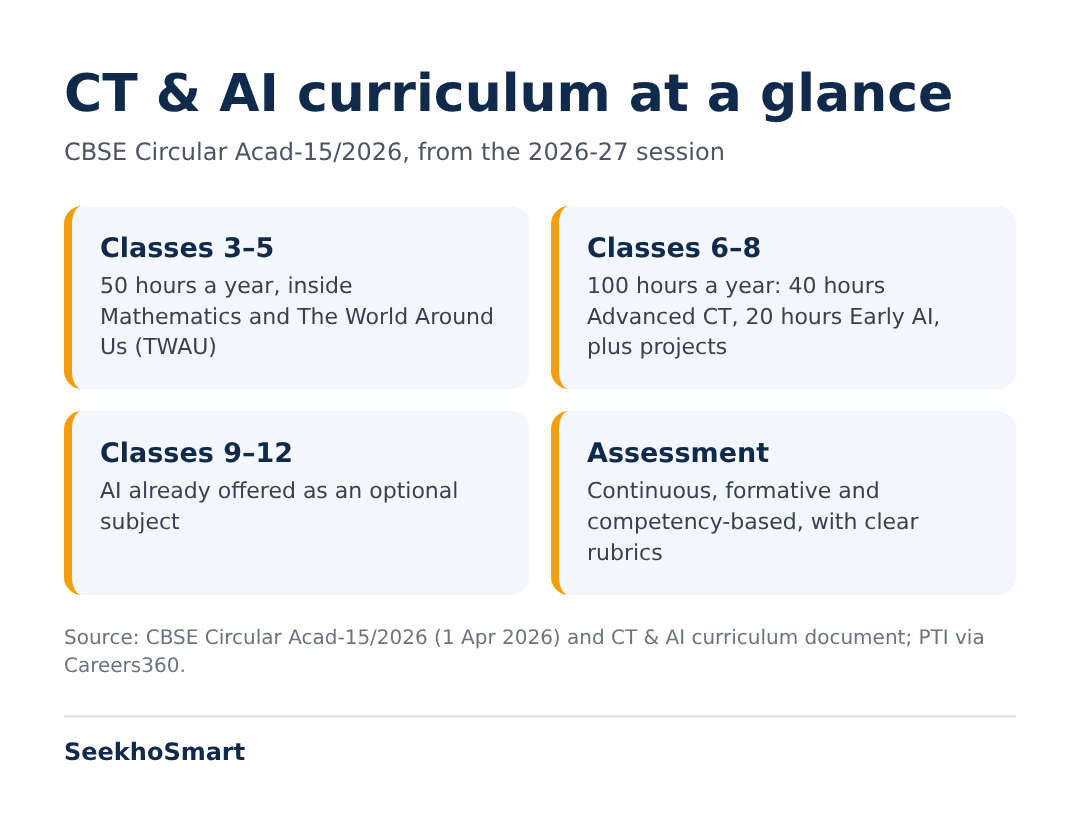
- 50 hours a year, integrated into Mathematics and The World Around Us (TWAU).
- Taught by Maths and other subject teachers using worksheets and handbooks.
- Focus on CT basics: abstract thinking, pattern recognition, decomposition and algorithmic thinking. Block-based coding such as Scratch appears as a competency.
Classes 6–8 (Middle stage)
- 100 hours a year: Advanced CT (40 hours), Early AI (20 hours, four units of five hours each) and interdisciplinary projects.
- Class 6 introduces AI with everyday examples and basic data ideas. Class 7 covers AI domains such as computer vision and natural language processing. Class 8 covers the AI project cycle, fairness and responsible AI.
- Subject teachers handle CT; the computer teacher handles AI literacy and assesses joint CT–AI projects.
Schools may go beyond these hours. The curriculum is platform-independent, and free and open-source tools are recommended.
Ethics is built in
The document includes digital footprints, privacy, passwords, safe online behaviour, consent for personal data, bias and responsible use. It suggests discussions, debates, case studies and reflective journals.
Assessment: not just another written test
The curriculum asks for continuous, formative and competency-based assessment. For Classes 3–5, that means written tests with CT puzzles, group activities and a teacher observation journal. For Classes 6–8, add practical exams, thematic projects and reflections. Teachers are advised to use clear, consistent rubrics.
This matters for planning. Your teachers will need time to observe, record and give feedback, not only to set papers.
Classes 9–12: AI as a subject
AI is not new at senior levels. According to a PTI report on Careers360, over 18,000 CBSE schools already teach AI as a skill subject from Class 6 through a 15-hour module, and Classes 9–12 offer it as an optional subject.

The new Classes 3–8 curriculum gives students a foundation before they reach these choices. A school that runs CT and AI well in the middle years can offer the optional AI subject in Classes 9–12 with more confidence, and show parents a clear pathway.
The bigger picture
The Ministry of Education plans to bring AI into the school curriculum for all students from Class 3, starting in 2026-27, the same PTI report says. School Education Secretary Sanjay Kumar said over one crore teachers need to be oriented, and that the ministry aims to prepare students and teachers within the next two to three years. Schools that start now will not be scrambling later.
A 6-step readiness plan
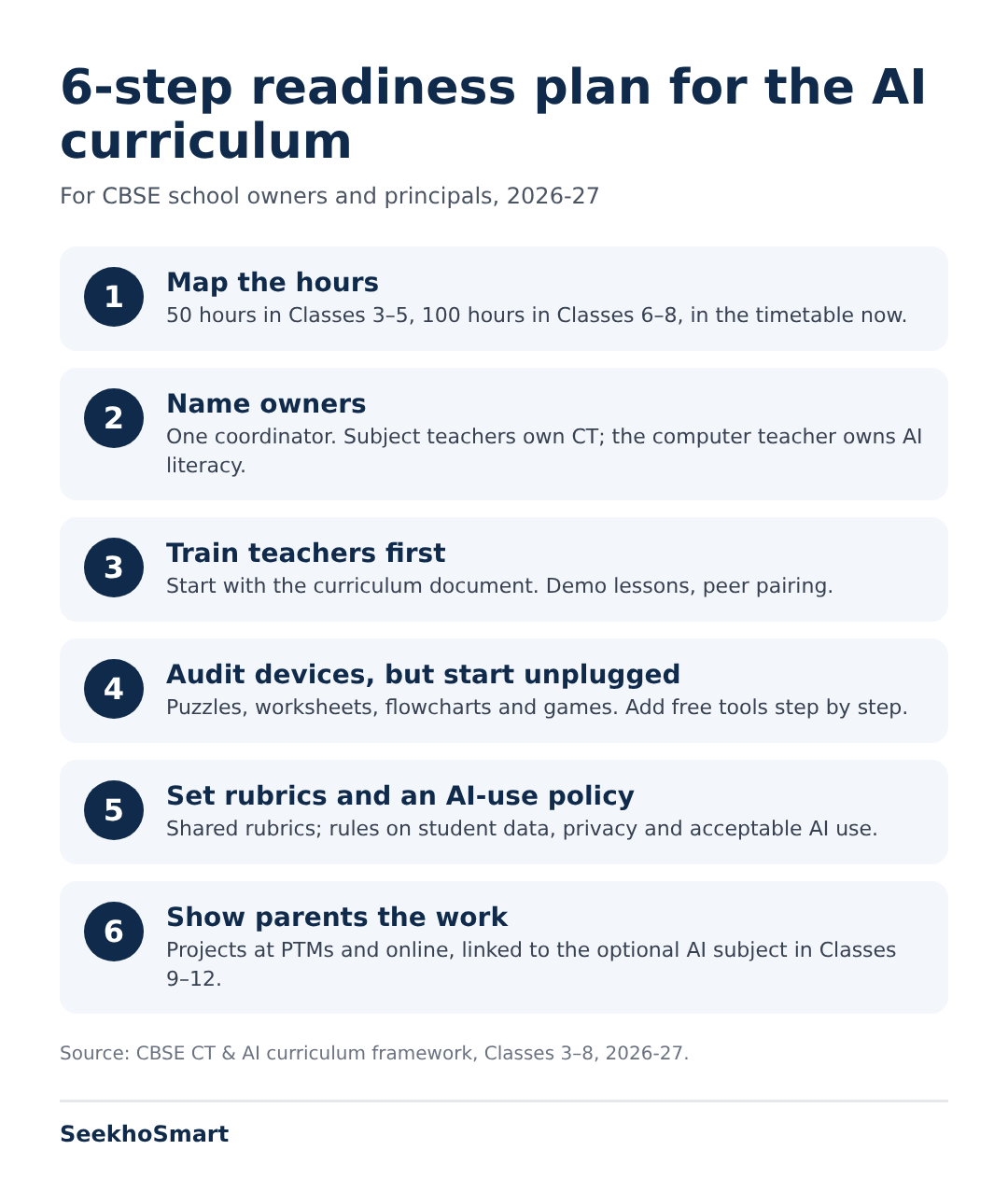
- Map the hours. Fit 50 hours a year into Classes 3–5 (within Maths and TWAU periods) and 100 hours into Classes 6–8. Put them in the timetable now, not "when time allows".
- Name owners. One coordinator for the programme. Maths and subject teachers own CT; the computer teacher owns AI literacy and project assessment.
- Train teachers before students. Start with the curriculum document itself. Run demo lessons in staff meetings. Pair a confident teacher with a hesitant one.
- Audit devices, but start unplugged. Puzzles, worksheets, flowcharts and games teach CT without a lab. Add free tools step by step.
- Set rubrics and an AI-use policy. Agree on assessment rubrics across sections. Write a short policy on student data, privacy and acceptable AI use for staff and students.
- Show parents the work. Display projects at PTMs and on your website. Explain how CT and AI connect to the optional AI subject in Classes 9–12.
You don't need an expensive lab to begin
Many vendors will pitch AI labs, robotics kits and smart boards. Some are useful. But the curriculum itself emphasises hands-on, worksheet-based and puzzle activities for younger students, and allows manual methods such as flowcharts in the middle years. Begin with trained teachers and good lessons. Buy equipment when you know what your teachers will actually use.
What to tell parents
Keep it simple: "From this year, your child will learn computational thinking and the basics of AI, as part of CBSE's new curriculum. They will solve puzzles, build simple projects and learn to use technology safely and responsibly." Parents want to hear that the school is prepared, not that it has bought the latest gadget.
Bring AI-powered learning to your senior classes with SeekhoSmart
The new curriculum asks your teachers for more hours, more projects and more assessment. Your Class 9–12 students still need strong board results at the same time. SeekhoSmart helps there, so your staff can focus on the new work.
- For your students: NCERT-based adaptive practice. Each student practises the topics they are weak in, chapter by chapter, for Class 9–12.
- For your teachers: less time on worksheets. Practice and revision happen on the platform, which frees time for CT and AI lessons, projects and observation.
- For parents: AI they can see working. A practical example of the school using AI responsibly for learning, which you can show at PTMs and on admission day.
See how it fits your school before the board exam season begins.
Try SeekhoSmart today → · Book a demo for your school
Sources
- CBSE Circular Acad-15/2026: CT and AI curriculum framework for Classes III–VIII (1 Apr 2026)
- CBSE Computational Thinking and AI curriculum, Classes 3–8, 2026-27
- CBSE launches framework for computational thinking and AI — Target Publications
- Centre to introduce AI in school curriculum from Class 3 — Careers360 / PTI (11 Oct 2025)
- Google autocomplete, India, checked 17 Oct 2026
Frequently asked questions
What is the CBSE AI curriculum for classes 3 to 8?+
It is CBSE's Computational Thinking and AI framework, launched by Circular Acad-15/2026 for the 2026-27 session. Classes 3–5 get 50 hours a year inside Maths and TWAU; Classes 6–8 get 100 hours a year, including 20 hours of early AI.
Is the CBSE AI curriculum for Class 3 compulsory?+
The circular introduces the curriculum for Classes 3–8 from 2026-27 and advises all schools to take the necessary steps to implement it. It does not set a separate deadline.
What about the CBSE AI curriculum for Class 9 and Class 10?+
AI is already offered to Classes 9–12 as an optional subject. The new framework covers Classes 3–8 and builds the foundation for that choice.
Do schools need an AI lab for the new curriculum?+
The curriculum is platform-independent and recommends free and open-source tools. Much of the early work is hands-on, worksheet- and puzzle-based, so trained teachers matter more than equipment at the start.
- CBSE Circular Acad-15/2026: CT and AI curriculum framework for Classes III–VIII
- CBSE Computational Thinking and AI curriculum, Classes 3–8, 2026-27
- Centre to introduce AI in school curriculum from Class 3 — Careers360 / PTI
- CBSE launches framework for computational thinking and AI — Target Publications
- Gustavo Fring / Pexels
- Pallav Suthar / Pexels
- Alena Darmel / Pexels
- SeekhoSmart (infographic)
- SeekhoSmart (infographic)