Your students are already using AI. Some use it to understand a hard Physics chapter; some use it to write their English project in five minutes. Your teachers are using it for lesson plans and question papers. Parents are asking what the school allows.
Yet most Indian schools still have no written AI policy. That gap matters more this year. AI and Computational Thinking are entering the curriculum from Class 3 onwards starting in 2026-27, and on 1 September 2026 the Union Education Minister asked NCERT to develop evidence-based practices for responsible AI use. No national rulebook for schools has been published yet. Until it is, each school has to set its own rules.
This guide gives principals and school owners a practical, six-step way to write a one-page AI policy, with a template you can adapt.
Why a policy, and why not just a ban?
A ban sounds simple, but it rarely works. Students have AI on their phones at home, and teachers lose a useful planning tool. A policy does three things a ban cannot:
- It tells students what is allowed, so honest students are not punished for guessing wrong.
- It protects student data, which is now a legal issue (more below).
- It gives parents a clear answer when they ask, "Does the school allow ChatGPT?"
International guidance points the same way. UNESCO's guidance on generative AI in education asks for data privacy protection, validation of AI systems before schools use them, and suggests a minimum age of 13 for classroom use of generative AI.
The 6-step process
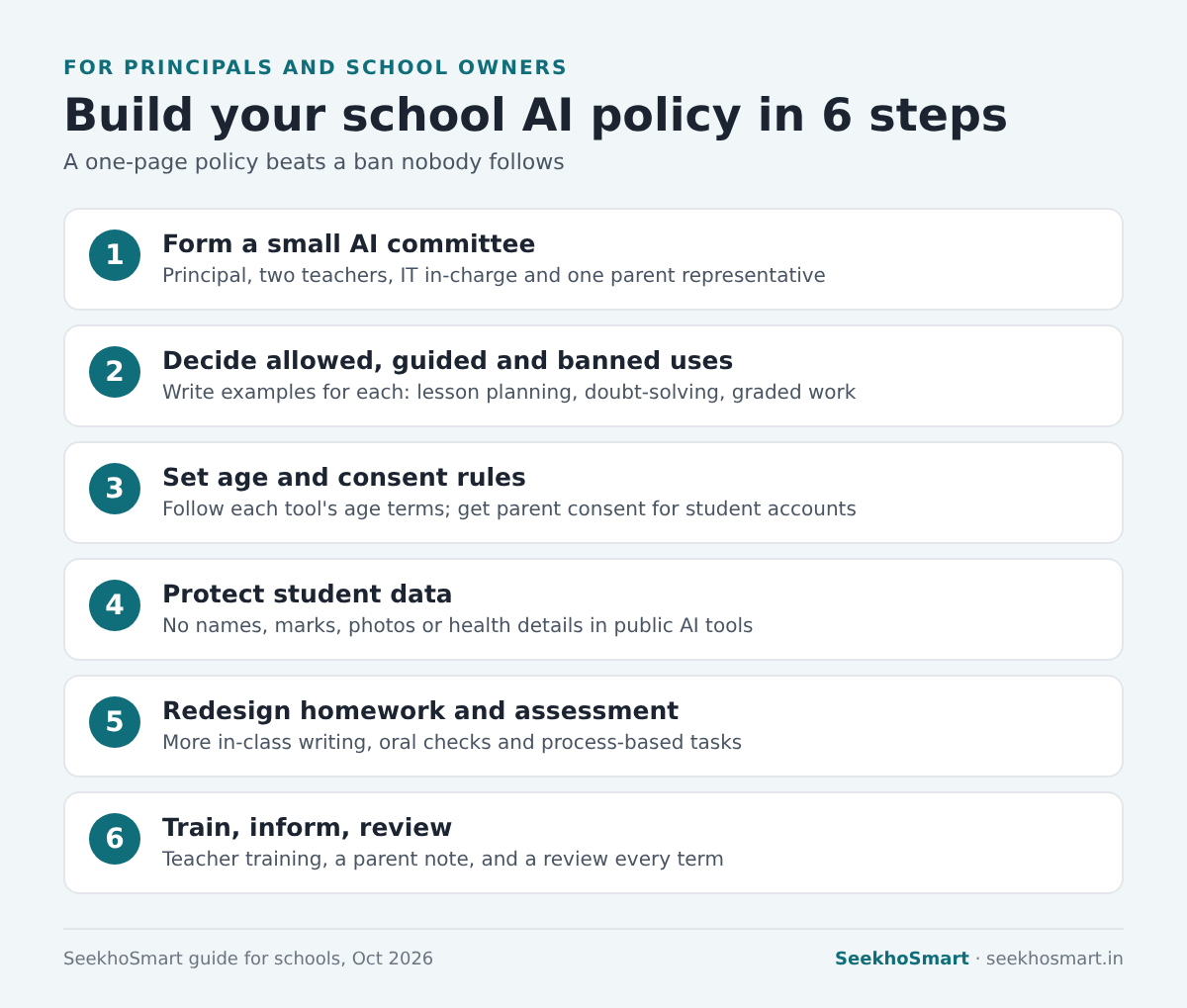
Step 1: Form a small AI committee
Keep it to five or six people: the principal or vice-principal, two teachers (one senior secondary, one middle school), the IT or computer in-charge, and one parent representative. Give the committee three weeks to produce a draft, not three months.
Step 2: Decide what is allowed, guided and not allowed
This is the heart of the policy. Use three simple levels:
| Use | Students (Class 9–12) | Teachers |
|---|---|---|
| Allowed | Understanding a concept, asking for hints, making practice questions | Drafting lesson plans, worksheets, question banks |
| Guided (with teacher permission, and AI use disclosed) | Project research, language feedback on drafts | Feedback comments on student work, after teacher review |
| Not allowed | Submitting AI-written answers, essays or projects as own work; AI in tests | Uploading student names, marks or photos to public AI tools |
Write one real example under each line. Students follow examples better than rules.
Step 3: Set age and consent rules
Most AI tools set their own minimum age in their terms; check them before recommending any tool. UNESCO's suggested minimum of 13 is a sensible floor for classroom use. For any tool where students create accounts through the school, take written parent consent.
Step 4: Protect student data
India's data protection law now shapes this. Under the DPDP framework, a child is anyone under 18, and processing a child's personal data needs verifiable parental consent. The rules also prohibit tracking or behavioural monitoring of children and targeted advertising aimed at them. Schools have only narrow exemptions, for things like health, safety and essential services, and these cannot be used for analytics or profiling, as this legal explainer from King Stubb & Kasiva sets out.

In practice, your policy should say:
- No student names, roll numbers, marks, photos or health details go into public AI chatbots.
- Any AI platform the school adopts must explain what student data it collects and why.
- One named staff member answers parents' data questions.
Step 5: Redesign homework and assessment
If a task can be fully done by a chatbot in two minutes, it will be. Ask departments to shift some marks to:
- In-class writing and short oral checks ("Explain your answer to me").
- Process evidence: rough work, drafts and reflection notes.
- Competency-based questions that use local data or classroom experiments.
Step 6: Train teachers, inform parents, review every term
CBSE's training theme for 2026-27 is Computational Thinking and Understanding AI, and its District Level Deliberation guidelines let teachers share classroom practice in one-day sessions that count as 6 hours of CPD. Use these to build staff confidence.
Then send parents a one-page note in English and the regional language. Review the policy at the end of every term, because the tools change that fast.
A one-page AI policy template
Copy this structure and fill it in:

- Purpose: "Our school uses AI to support learning and teaching, not to replace thinking."
- Scope: Students of Classes ___ to ___, all teaching staff, all school devices and accounts.
- Allowed, guided and not-allowed uses: (your table from Step 2).
- Age and consent: Minimum age for student use: ___. Parent consent required for: ___.
- Data protection: What may never be entered into AI tools; who to contact.
- Academic honesty: How AI use must be disclosed; what happens on misuse (first time: re-do the task; repeated: as per discipline policy).
- Approved tools: List, with the reason each was chosen.
- Training and review: Who trains whom; review date: ___.
Keep it to one page. If parents and students cannot read it in two minutes, it is too long.
Common mistakes to avoid
- Copying a foreign template as-is. Many online templates follow other countries' laws, not India's DPDP rules or CBSE norms.
- Writing it only for students. Teachers need rules too, especially on data.
- No named owner. Without one person responsible, the policy is forgotten by December.
How SeekhoSmart fits into your school's AI policy
A good policy needs at least one "allowed" AI tool that actually supports learning. SeekhoSmart adds NCERT-aligned, adaptive practice for Class 9–12, so students get the help of AI in a guided form: they attempt questions first, then see an AI explanation of every answer, including wrong ones. The adaptive daily plan adjusts practice to each student, which supports remedial work without extra periods.
It is free to start, so there is no upfront cost to pilot it with one section, and the Hindi/English switch helps in mixed-language classrooms.
Try SeekhoSmart for your school → seekhosmart.in
Frequently asked questions
Is there an official AI policy for schools in India?+
Not yet. AI and Computational Thinking are in the curriculum from Class 3 in 2026-27, and the Education Minister has asked NCERT to develop evidence-based practices for responsible AI use, but no national school policy has been published. Schools need their own for now.
What should a model AI policy for schools include?+
Purpose, scope, allowed/guided/not-allowed uses, age and consent rules, data protection, academic honesty, approved tools, and a training and review plan, ideally on one page.
Is there an AI policy for schools template?+
Yes, use the one-page template in this article and adapt it. Avoid copying foreign templates as-is, since they follow other countries' laws.
What are good AI guidelines for schools on student data?+
Never enter student names, marks, photos or health details into public chatbots; take verifiable parent consent for student accounts; and ask every AI vendor what data it collects and why.
- Students to learn AI, computational thinking from Class 3 starting 2026-27 (Careers360)
- Joshi urges NCERT to study responsible AI use (Business Standard)
- UNESCO calls for regulation of generative AI in schools (UN News)
- Children's data protection under India's DPDP Rules (King Stubb & Kasiva)
- CBSE DLD guidelines on CT and AI 2026-27 (TRG-02)
- SeekhoSmart (infographic)
- Swastik Arora / Unsplash
- Vlad Deep / Unsplash
- Usman Yousaf / Unsplash